



☕ Good Morning Security Gang,
Today’s episode hits differently. This isn’t just another day of vulnerabilities and breaches, this is a shift in where attackers are focusing. They’re no longer knocking on the front door…
👉 They’re going straight for the control systems that run everything.
Think SD-WAN controllers. Think CI/CD pipelines. Think OAuth integrations.
💡 If it manages your environment, it’s now a primary target.
Double espresso ready, let’s dive in. Coffee Cup Cheers,
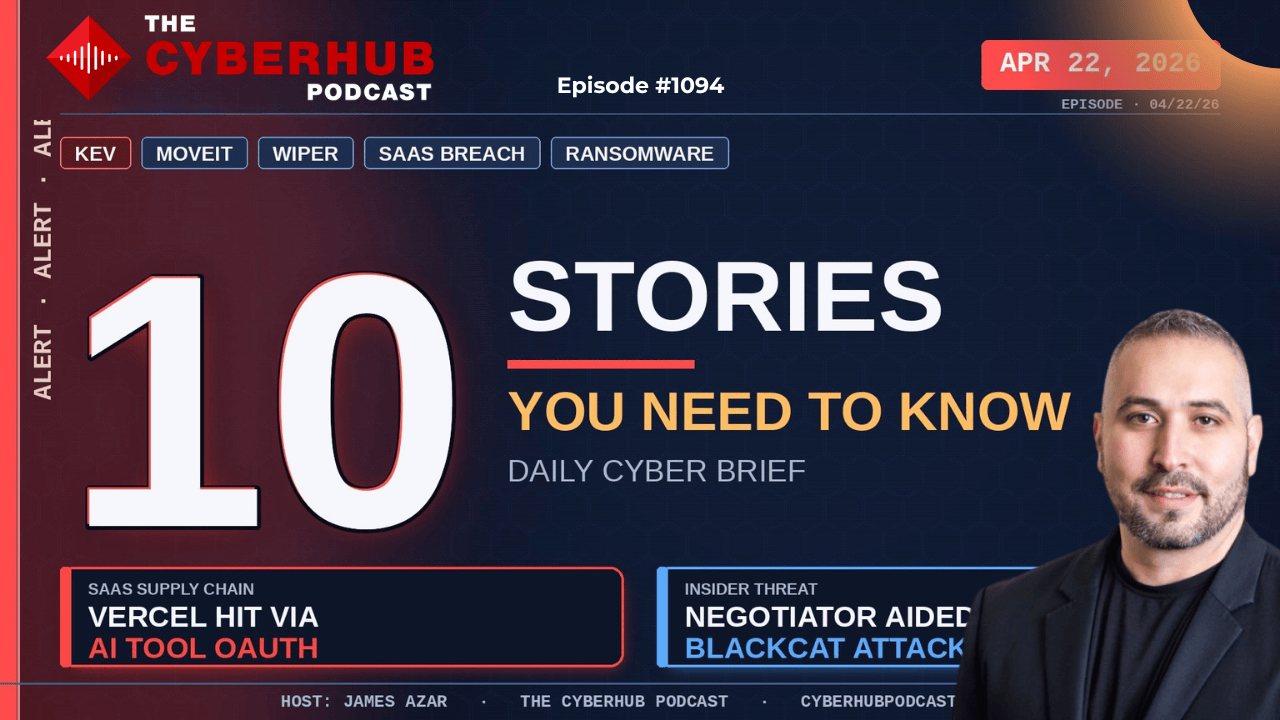
🧭 Executive Snapshot
Today’s stories all point to one uncomfortable truth:
Attackers are scaling access by targeting orchestration layers, not endpoints.
🎯 Control planes are being exploited
🤖 AI integrations are becoming insider threats
🏭 OT systems remain dangerously exposed
💣 Destructive malware is back on the table
This isn’t about isolated incidents anymore, it’s about systemic exposure across modern architectures.
🌐 Cisco SD-WAN Vulnerability – Control of the Network Itself
CISA’s addition of the Cisco SD-WAN vulnerability (CVE-2026-20133) to the KEV catalog with a rapid federal patch deadline highlights just how critical this issue is. This flaw allows unauthenticated attackers to extract sensitive data directly from the SD-WAN manager, which acts as the centralized control plane for enterprise connectivity. In practical terms, this system governs routing, segmentation, and policy enforcement across all branch locations. Once compromised, attackers can gain visibility into network topology, harvest credentials, and potentially manipulate traffic flows. This is not lateral movement, it’s centralized dominance of the network, making it one of the most dangerous classes of vulnerabilities we see today.
🧱 MOVEit WAF & Load Balancer Vulnerabilities – Breaking the Shield
Progress Software’s patching of multiple vulnerabilities in MOVEit WAF and Kemp LoadMaster is particularly concerning because these systems are designed to protect enterprise edges. Among the flaws are command injection vulnerabilities and a WAF bypass that allows crafted requests to slip through inspection mechanisms. The implication is severe: attackers can execute commands or bypass defenses without triggering alerts, effectively turning a protective control into an entry point. Given MOVEit’s history with mass exploitation campaigns, this reinforces that edge security appliances remain high-value and high-risk targets, especially when they sit between external traffic and internal systems.
🤖 Vercel Breach via AI OAuth – Trust Exploited Through Integration
The Vercel breach is one of the most important case studies of modern cyber risk. Attackers didn’t exploit Vercel directly—they compromised a third-party AI tool (Context AI), harvested credentials, and leveraged OAuth permissions to gain access to Vercel’s internal environment. Because OAuth grants are often broad and persistent, the attacker effectively operated with legitimate access, reaching environment variables, API keys, and internal systems. This attack demonstrates how AI tools and SaaS integrations blur the line between external and internal access, creating blind spots in security monitoring. It also reinforces that OAuth is no longer just a convenience feature, it is a critical identity boundary that must be governed like privileged access.
🚀 Spinnaker RCE – Direct Path to Production Environments
The disclosure of two unauthenticated remote code execution vulnerabilities in Spinnaker introduces risk directly into the software delivery pipeline. Spinnaker is widely used to manage continuous delivery across cloud environments, meaning it has access to deployment logic, credentials, and production systems. Exploiting these vulnerabilities allows attackers to execute commands within cloud driver components, potentially exposing secrets, altering deployments, or injecting malicious code into production. This is not just a breach of infrastructure, it’s a compromise of software integrity and trust in application delivery, which can have downstream effects across customers and users.
🏭 OT “Bridge Break” Vulnerabilities – The Weak Link Between IT and OT
Forescout’s disclosure of 22 vulnerabilities in serial-to-Ethernet converters highlights a persistent and dangerous issue in industrial environments. These devices act as bridges between operational technology (OT) and traditional IT networks, often enabling remote monitoring and control of physical systems. Because they are frequently exposed to the internet and lack modern security controls, they become ideal entry points for attackers. Exploitation could allow manipulation of sensor data, disruption of industrial processes, or lateral movement into broader networks. This is particularly concerning in sectors like manufacturing, utilities, and healthcare, where these systems underpin critical operations. The reality is that OT environments continue to inherit risk from legacy design assumptions that no longer hold true.
💣 Lotus Wiper Malware – Destruction Over Disruption
The Lotus wiper malware represents a different class of threat—one focused on destruction rather than financial gain. Targeting energy and utility organizations in Venezuela, this malware operates at a low level to erase data, remove recovery mechanisms, and corrupt systems beyond repair. Unlike ransomware, there is no negotiation or recovery path. The intent is to permanently disrupt operations, potentially impacting power generation and distribution. This aligns with broader geopolitical tensions and demonstrates that cyber operations are increasingly being used as tools of strategic disruption, not just crime.
🧠 Gentleman Ransomware & SystemBC – The Signals Before the Storm
The use of SystemBC malware by ransomware groups provides a valuable insight into how attacks unfold. SystemBC establishes proxy tunnels and encrypted communication channels, allowing attackers to maintain persistent access while preparing for later stages of the attack. This phase often includes reconnaissance, credential harvesting, and lateral movement. By the time ransomware is deployed, the attacker has already mapped the environment and established control. This underscores the importance of detecting early indicators, as the real opportunity to stop ransomware is before encryption begins, not after.
🏭 Akira Ransomware – Supply Chain Risk Amplified
Akira’s continued targeting of manufacturing and engineering firms highlights the growing importance of supply chain risk. Many of these organizations serve as suppliers to larger enterprises, including those in aerospace and defense. A breach at this level can expose sensitive data, disrupt production, and create cascading effects across industries. This is no longer about a single organization being compromised, it’s about entire ecosystems being impacted through interconnected dependencies.
⚖️ Insider Threat – When Trust Becomes the Vulnerability
The case of a ransomware negotiator pleading guilty to collaborating with attackers is a stark reminder that insider risk extends beyond employees. Third-party vendors, consultants, and incident response providers often have deep access to sensitive information. In this case, that trust was exploited to provide attackers with negotiation strategies and victim data. This highlights the need for strict controls, monitoring, and segmentation even within trusted relationships, as insider threat is often a function of access, not intent.
👮 Scattered Spider – Social Engineering at Scale
The guilty plea of a Scattered Spider member reinforces the effectiveness of social engineering-driven attacks. This group leveraged phishing, SIM swapping, and identity manipulation to gain access to major platforms and financial assets. Their success demonstrates that even advanced organizations remain vulnerable to human-layer attacks, which often bypass technical controls entirely. While law enforcement actions are a positive development, the techniques used by these groups continue to evolve and proliferate.
Priority Actions
Priority Action
🔴 FridayPatch Cisco SD-WAN CVE-2026-20133
🔴 CriticalPatch MOVEit WAF/Kemp LoadMaster
🔴 CriticalUpgrade Spinnaker
🟠 HighAudit ALL OAuth grants in Workspace/M365
🟠 HighMicrosegment Lantronix/Silex OT gateways
🟡 MediumBlock SystemBC C2 at egress
CISO’s Take
Control planes are the target this week: SD-WAN managers, WAF admin APIs, Spinnaker pods, OAuth tokens, all one unauthenticated bug or over-scoped consent away from compromise. The Vercel breach is the clearest example of AI supply chain risk we’ve seen: a third-party AI tool’s compromised employee led to OAuth pivot into Vercel’s environment. An AI tool with unrestricted OAuth scope is indistinguishable from an insider.
The other thread: destructive intent and insider accountability. Lotus burning Venezuelan energy infrastructure shows wipers don’t ransom—they take generation offline. Akira hitting defense supply chain parts manufacturers creates exposure beyond single victims. And courtrooms are catching up: a ransomware negotiator selling victim data to BlackCat, Scattered Spider’s Tyler B owning up to $8M in sim swaps. If you do three things today: patch CVE-2026-20133 before Friday, audit your OAuth grants, and stress test your offline backups.
Stay Cyber Safe


