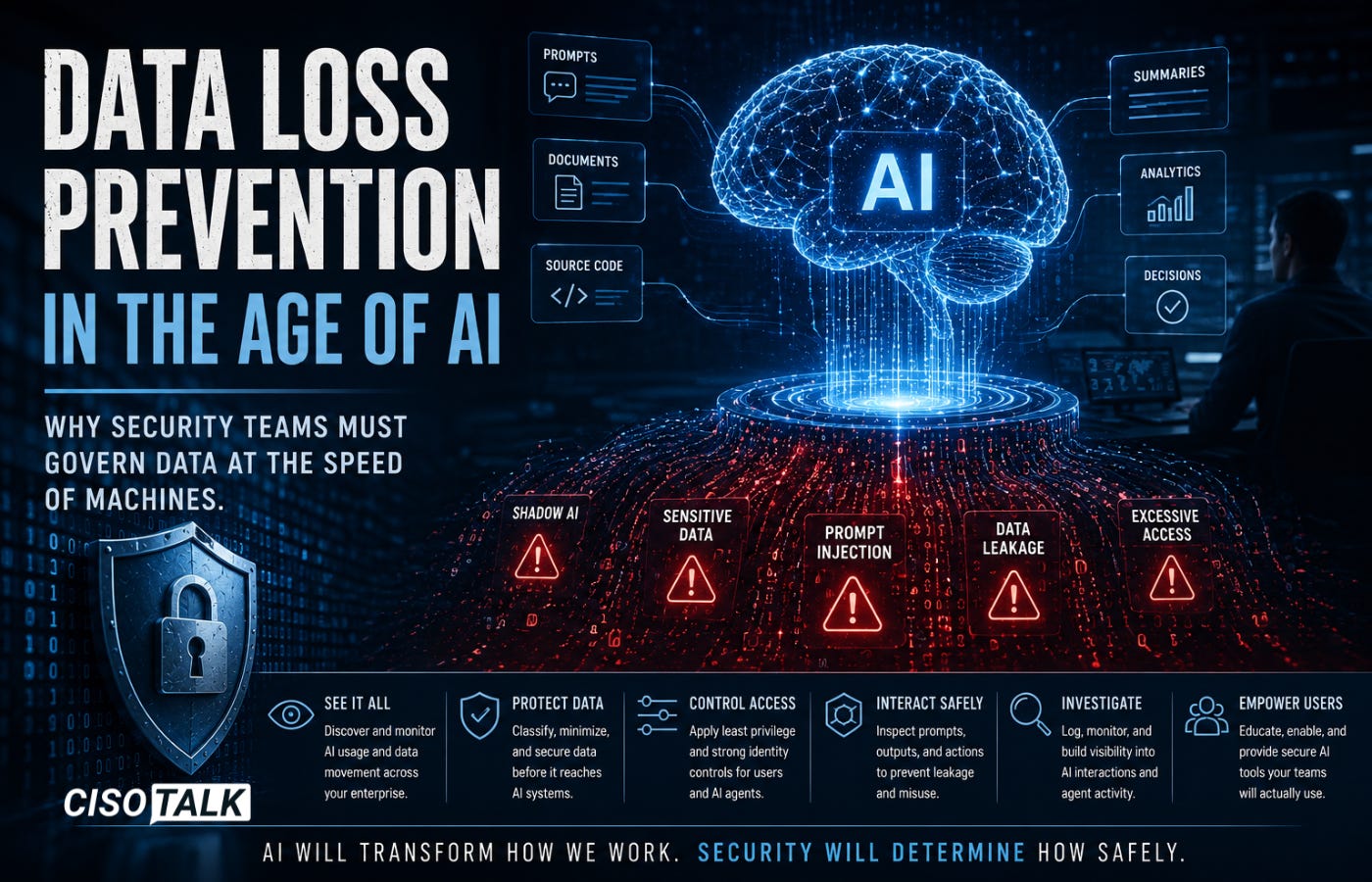
Data Loss Prevention in the Age of AI
Why Security Teams Must Govern Data at the Speed of Machines

In the previous article, I argued that Data Loss Prevention is not dead, but the promise behind it is.
For years, cybersecurity teams treated data protection as a relatively linear challenge. Sensitive information existed in known systems. Users accessed it through managed applications. Security teams classified it, monitored its movement, and attempted to prevent it from leaving approved boundaries.
That model was never perfect, but it was understandable.
Artificial intelligence is breaking what remained of it.
AI does not simply store or transmit data. It ingests information, summarizes it, restructures it, combines it with other sources, generates derivative content, embeds it into vector databases, passes it between agents, and uses it to make decisions. It can convert a confidential document into a paragraph, a paragraph into code, code into an automated task, and an automated task into an action across multiple enterprise systems.
The original data may never leave in its original format.
Its meaning still can.
That is the central data-security challenge of the AI era. Traditional DLP was designed primarily to inspect files, messages, endpoints, networks, and known data patterns. AI turns data into a constantly changing stream of prompts, outputs, embeddings, model context, application calls, agent instructions, and machine-generated decisions.
Security teams are no longer trying to control data moving from Point A to Point B.
They are trying to govern data that is being continuously interpreted and transformed at machine speed.