



Good Morning Security Gang
Today’s show was one of those episodes where the lines between kinetic warfare, cloud infrastructure, telecom policy, identity abuse, and even tire pressure sensors all blurred into one unmistakable reality:
Cyber is no longer a vertical. It’s the connective tissue of everything.
From Iranian-linked drone strikes impacting AWS infrastructure, to LexisNexis confirming a breach, to pro-Russia actors aligning with Iran-aligned hackers, to CISA flagging actively exploited VMware vulnerabilities, to quantum acceleration and OAuth abuse — today was layered, fast-moving, and deeply interconnected
Let’s break it down.
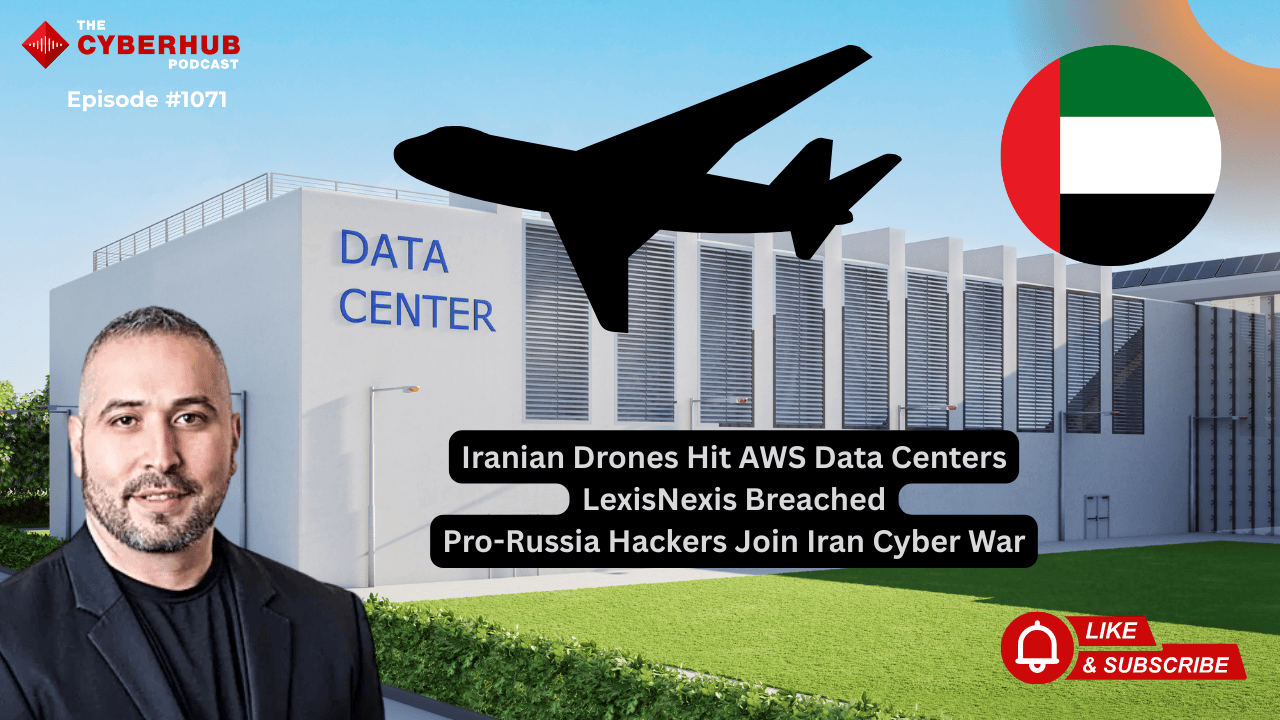
LexisNexis Confirms Breach After Stolen Files Leak
LexisNexis confirmed a data breach after a threat actor publicly leaked stolen files.
This isn’t just another SaaS vendor incident. LexisNexis is one of the largest identity intelligence and risk-scoring data brokers in the world, serving financial institutions, insurers, law enforcement, and government agencies.
According to the report, the actor claims they exploited an unpatched application vulnerability within AWS infrastructure to access and extract data. The alleged data includes records tied to .gov email addresses — potentially impacting federal judges, DOJ attorneys, and SEC personnel
The blast radius of a data broker breach is different. When identity aggregation hubs are compromised, fraud enablement increases across the ecosystem. Centralized identity intelligence becomes centralized attack fuel.
This incident reinforces a difficult truth: the stronger your fraud detection ecosystem becomes, the more valuable it is to adversaries.
Iranian-Linked Drone Strikes Hit AWS Infrastructure
Security reporting highlighted Iranian-linked drone strikes targeting infrastructure tied to AWS facilities in the region.
Cloud resilience still depends on buildings, power grids, cooling systems, and geography. Multi-AZ is powerful — until multiple facilities in the same geopolitical zone face physical disruption.
"Did Iran really mean 'Death to America'? They mean it in every sense of the word—anything American. Are they going to hit a McDonald's next? Maybe a Burger King. I hear KFCs are really popular in the Emirates."
If your workloads are regionally constrained by data sovereignty laws, you may not have the luxury of moving data across borders during crisis windows. That’s not a cloud problem — that’s a geopolitical and regulatory risk issue.
This is a wake-up call for every enterprise operating in volatile regions: cloud is digital, but availability is physical.
Surge in Hacktivism Strategic Patience from State Actors
We’re seeing a surge in hacktivist noise aligned with Iran, but comparatively restrained confirmed state-sponsored operations.
Hacktivists generate disruption, defacement, and propaganda amplification. Structured state operators operate differently — patiently, strategically, and with long-term objectives.
Adversarial collaboration is increasing. Pro-Russia actors are aligning with Iran-linked groups, sharing infrastructure and tooling.
This is coalition warfare in cyberspace. Temporary alliances, shared objectives, and infrastructure blending.
The takeaway? Separate ideological noise from structured APT tradecraft in your intelligence modeling.
Western Allies Form 6G Security Coalition
The U.S., UK, Canada, Japan, Australia, Sweden, and Finland are forming a 6G security coalition to secure next-generation telecom infrastructure. 5G was reactive. 6G is trying to be proactive.
Supply chain compromise and embedded vendor risk at the telecom layer can create decade-long vulnerabilities. By embedding security-by-design into procurement frameworks now, these nations are attempting to avoid repeating the Huawei/5G geopolitical fight.
Telecom security isn’t theoretical — it becomes the foundation for identity, IoT, AI transport, and critical infrastructure.
Quantum Decryption Timeline May Be Accelerating
Researchers warn that quantum decryption of RSA may be closer than previously estimated. This doesn’t mean RSA falls tomorrow. It means crypto-agility must become operational reality.
“Harvest now, decrypt later” campaigns are plausible. Sensitive encrypted data captured today could become readable tomorrow if quantum advancements outpace defensive migration.
If you manage long-lived sensitive data (healthcare, financial records, intellectual property), post-quantum migration planning should already be underway.
CISA Flags VMware Aria Operations RCE as Actively Exploited
CISA added a VMware Aria Operations remote code execution vulnerability to its actively exploited catalog.
Management and monitoring platforms are prime targets. If attackers compromise your observability layer, they gain visibility and potentially credential paths across the environment.
Federal agencies have a hard deadline to patch. Enterprises should treat this with equal urgency.
OAuth Error Flow Abuse to Spread Malware
Threat actors are manipulating OAuth authentication error flows to trick users into granting access tokens.
This bypasses traditional phishing patterns. Victims may never enter credentials into fake forms — instead, they unknowingly authorize malicious apps through legitimate identity flows.
Identity is still the perimeter.
Token abuse enables persistent access without password compromise. Conditional access, token scope limitations, and strict OAuth app governance are no longer IAM hygiene they are defensive essentials.
Telegram Used for Initial Access and C2
Telegram is increasingly being used as infrastructure for initial access brokerage and C2 coordination. Encrypted collaboration platforms are now blended into enterprise traffic patterns. This mirrors earlier abuse of Discord and Slack-like services.
The risk? Encrypted outbound channels masking attacker coordination.
Network telemetry capable of detecting anomalous encrypted traffic patterns is critical.
Tracking Vehicles via Tire Pressure Sensors
Researchers demonstrated the ability to track vehicles using tire pressure monitoring system (TPMS) signals. This is IoT risk entering the automotive domain. Embedded sensors broadcasting unique identifiers can create privacy exposure vectors.
For organizations managing fleets, connected vehicle firmware validation and OTA integrity checks should become part of the threat model.
Sometimes surveillance doesn’t require malware it requires physics.
Key Action Items
Conduct third-party exposure reviews for critical data brokers
Validate regional cloud failover and geographic redundancy plans
Differentiate hacktivist noise from structured APT tradecraft
Accelerate crypto-agility planning for post-quantum migration
Patch VMware Aria Operations immediately and validate exposure paths
Implement strict OAuth governance and conditional access policies
Monitor encrypted outbound traffic for anomalous patterns
Validate IoT and connected vehicle firmware integrity controls
Review supply chain dependencies tied to telecom and hyperscalers
James Azar’s CISOs Take
Today was about escalation and expansion.
Escalation in geopolitics Iran, Russia, coalition dynamics, and kinetic spillover impacting hyperscalers. Expansion in attack surface OAuth abuse, encrypted collaboration misuse, IoT tracking, and crypto timelines accelerating faster than comfort levels allow.
As a CISO, I don’t respond to noise. I respond to structure. That means validating assumptions, stress-testing failover, accelerating crypto agility, tightening identity controls, and raising monitoring thresholds during geopolitical spikes.
Security is no longer static defense. It’s dynamic alignment between infrastructure, identity, geopolitics, and technology acceleration.
If you do the basics well disciplined patching, strong identity governance, hardened endpoints, segmentation, you raise the cost of attack and reduce the value of compromise.
Stay cyber safe.


