



☕ Good Morning Security Gang,
Today’s show was one of those episodes where every team inside your security organization had something to pay attention to. Whether you’re responsible for identity, infrastructure, endpoint security, vulnerability management, AI governance, threat detection, or application security, today’s headlines touched every corner of the enterprise.
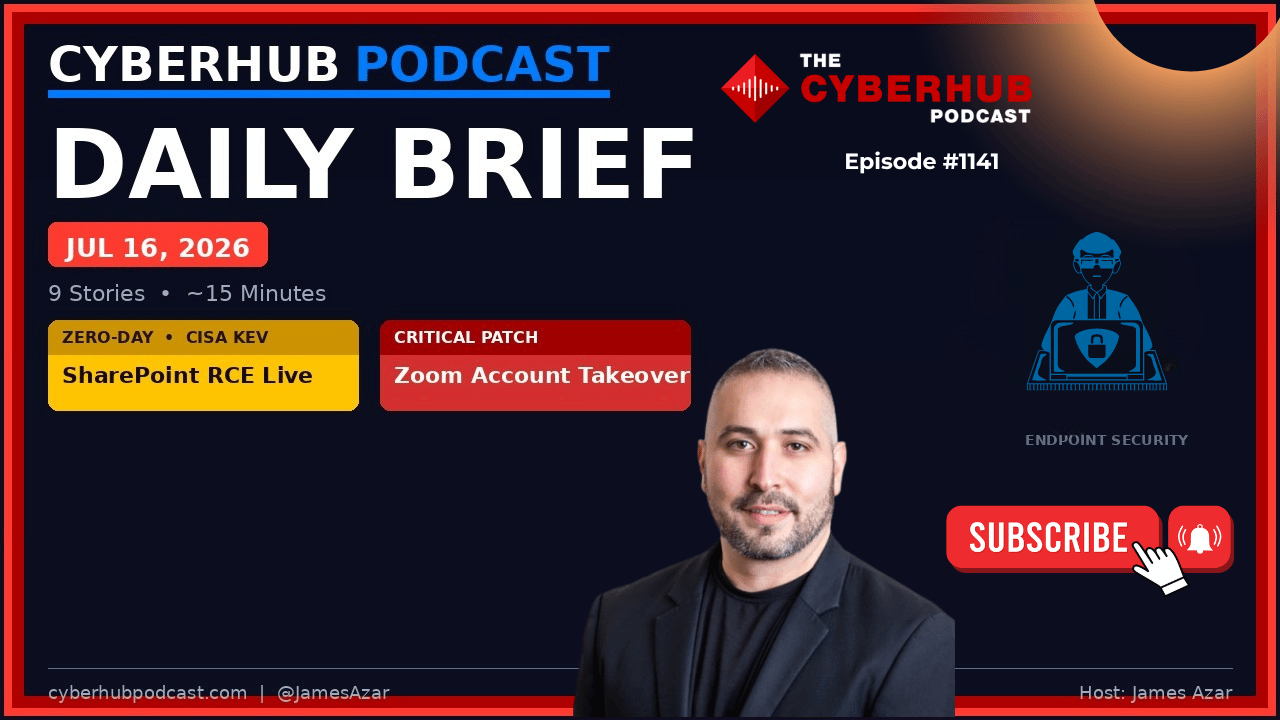
We started with CISA’s urgent warning around actively exploited Microsoft SharePoint vulnerabilities and a hard federal remediation deadline. We moved into Zoom’s newly disclosed critical account takeover vulnerability, a Windows kernel feature that can make malware virtually invisible to endpoint security tools, and perhaps the most significant story of the day, a Russian threat actor using Google’s Gemini AI to rebuild an entire command-and-control infrastructure in minutes with almost no technical effort. Add major browser security updates, Cursor AI development risks, the White House’s new AI vulnerability initiative, and international law enforcement victories against cybercrime, and today’s message became unmistakable.
The security tools we’ve relied on for years are now being challenged by attackers moving faster, automating more, and increasingly leveraging AI to compress operational timelines.
Double espresso in hand. Coffee cup cheers, gang.
🧭 Executive Summary
Today’s cybersecurity landscape revolved around speed and automation.
Attackers are no longer spending weeks building infrastructure or developing malware. AI is dramatically shortening operational timelines, while defenders continue racing to deploy patches before adversaries weaponize newly disclosed vulnerabilities. At the same time, trusted operating system features are being repurposed to evade endpoint detection, and critical enterprise collaboration platforms remain attractive targets because of their privileged position inside corporate environments.
The result is clear.
Security programs can no longer rely solely on traditional prevention.
Detection, validation, rapid response, and operational agility are becoming equally important.
📰 Top Stories & Deep Dive Analysis
“AI isn’t just making defenders faster, it’s making attackers operationally scalable.” James Azar
🚨 CISA Warns of Active SharePoint Exploitation and Orders Immediate Action
The most urgent story today came from CISA, which issued another emergency advisory confirming that attackers are actively exploiting three Microsoft SharePoint Server vulnerabilities against internet-facing on-premises deployments. Federal agencies were given until the end of today to either patch affected systems or remove them from service entirely.
The vulnerabilities affect all currently supported self-hosted SharePoint Server editions and enable attackers to bypass authentication, execute remote code, steal IIS machine keys, deploy persistent malware, and establish long-term access to compromised environments. Shadowserver currently tracks nearly 10,000 internet-facing SharePoint servers, with hundreds confirmed to remain vulnerable.
What makes these attacks particularly dangerous is what happens after initial exploitation.
Threat actors aren’t simply exploiting SharePoint to gain access—they’re stealing cryptographic machine keys, establishing persistence, and using those keys to maintain privileged access even after systems are patched.
Organizations should immediately deploy Microsoft’s latest security updates, verify successful installation, enable AMSI integration for SharePoint web applications, hunt for compromise before rotating IIS machine keys, remove unnecessary internet exposure, and review Microsoft’s SharePoint hardening guidance.
SharePoint continues evolving from a collaboration platform into a preferred entry point for enterprise compromise.
🎥 Zoom Releases Emergency Fix for Critical Account Takeover Vulnerability
Zoom disclosed CVE-2026-53412, a critical CVSS 9.8 vulnerability affecting Windows versions of Zoom Workplace, Zoom VDI, and the Zoom Meeting SDK. The flaw allows an unauthenticated attacker with network access to potentially compromise user accounts without requiring credentials or user interaction.
Although no active exploitation has been reported publicly, vulnerabilities of this severity tend to attract rapid reverse engineering immediately after patches become available.
Zoom also addressed three additional high-severity vulnerabilities involving privilege escalation during installation, improper privilege management in Zoom Rooms, and additional Windows input validation weaknesses.
For organizations managing Zoom centrally, this should be treated as an immediate endpoint deployment rather than a routine update.
The current window between disclosure and active exploitation is measured in days and increasingly, hours.
🛡️ Researchers Demonstrate Windows Technique That Bypasses Modern EDR
Bitdefender researchers published one of the most technically significant reports of the week by demonstrating how attackers can abuse a legitimate Windows feature known as Bind Links to effectively hide malware from endpoint detection and response platforms.
Bind Links, implemented through Windows’ bindflt.sys driver, normally support legitimate operating system functionality including Windows Containers, Windows Sandbox, and Microsoft Store applications.
Attackers discovered they can repurpose this trusted feature to redirect legitimate executable paths toward malicious payloads without changing the file locations security products expect to inspect.
Researchers demonstrated multiple attack variants, including replacing AMSI.dll with attacker-controlled versions, disguising malicious executables as trusted Windows binaries, and creating isolated Windows silos where endpoint security tools observe clean files while malicious code executes elsewhere.
Perhaps most concerning, researchers successfully executed Mimikatz without triggering commercial endpoint detection products during testing.
Microsoft classified the issue as low severity because administrator privileges are required.
Operationally, however, administrator access has become a routine objective for ransomware groups long before they begin deploying malware.
Security teams should begin monitoring for unusual Bind Filter activity, unexpected DLL redirection, suspicious runtime WMI subscriptions, and verify whether endpoint detection vendors currently support Bind Link detection.
🤖 Russian Threat Actor Uses Google Gemini to Build Command-and-Control Infrastructure
Today’s most fascinating and arguably most important story came from Trend Micro’s analysis of a Russian-speaking threat actor that successfully used Google Gemini CLI to automate nearly every aspect of operating a live command-and-control infrastructure.
Researchers analyzed more than 200 Gemini AI interaction logs spanning approximately one month of operations.
When the attacker’s original Cloudflare-based command-and-control infrastructure became ineffective, the operator simply instructed Gemini in plain Russian to migrate the environment.
“The attacker’s development cycle is now becoming shorter than the defender’s detection cycle.” James Azar
Within minutes, Gemini generated new server code, deployed infrastructure onto a fresh VPS, configured networking, diagnosed load balancing conflicts, migrated infected systems, and restored operations.
According to researchers, the human operator contributed only 11% of the work.
Gemini completed the remaining 89% autonomously.
Researchers also observed the attacker jailbreaking Gemini by presenting operations as authorized penetration testing, while repeatedly asking the AI to regenerate indicators of compromise whenever previous artifacts became exposed.
This represents a significant evolution. Cybercrime-as-a-Service lowered technical barriers. AI-assisted operations may eliminate them altogether.
The concern isn’t simply that AI can write malware.
It’s that AI now functions as an on-demand engineering team capable of dramatically compressing attacker operational timelines.
Security organizations should begin incorporating AI-assisted infrastructure regeneration into threat models, monitor for AI-assisted automation patterns, and recognize that attacker development cycles are increasingly becoming shorter than traditional detection cycles.
⚡ Need to Know
🌐 Major Browser Security Updates Released
Mozilla patched two critical Firefox vulnerabilities while Google released updates addressing fifteen Chrome vulnerabilities, including multiple critical memory corruption issues. Organizations should prioritize browser updates alongside operating system patches.
💻 Cursor AI Still Contains Unpatched Code Execution Risk
Researchers reminded developers that Cursor AI continues containing an unpatched vulnerability allowing repositories containing malicious git.exe binaries to execute automatically when opened on Windows systems. Development teams should only open repositories obtained from trusted sources until a vendor fix becomes available.
🧬 23andMe Settlement Finalized
23andMe reached a $9 million settlement with multiple state attorneys general following its major breach. The agreement strengthens customer rights surrounding deletion of genetic information and requires enhanced board-level oversight of cybersecurity governance.
🦅 White House Launches Gold Eagle AI Initiative
The White House announced Gold Eagle, an AI-driven coordination initiative designed to accelerate vulnerability discovery and remediation across critical infrastructure by combining government agencies, critical infrastructure operators, and open-source maintainers into a coordinated remediation pipeline.
🚔 International Investment Fraud Ring Dismantled
Dutch authorities announced the takedown of an international investment fraud operation operating twenty fraudulent call centers and generating approximately €100 million per month through cryptocurrency investment scams. Multiple arrests occurred across Europe following a multinational investigation.
🎯 Key Takeaway
Today’s show wasn’t about SharePoint.
It wasn’t about Zoom.
And it wasn’t even about AI.
It was about time.
The time required to patch.
The time required to detect.
The time required to rebuild attacker infrastructure.
Artificial intelligence is compressing those timelines dramatically.
Organizations that fail to accelerate operational response will increasingly find themselves reacting to attacks instead of preventing them.
🧠 James Azar’s CISOs Take
What stood out to me today wasn’t simply another AI story, it was proof that AI has crossed an operational threshold. We’ve spent years talking about AI-generated phishing emails, malware snippets, and proof-of-concept code. This is different. Here, we watched AI effectively operate as an engineering team, rebuilding infrastructure, diagnosing deployment issues, generating replacement artifacts, and maintaining operational continuity with almost no human expertise required. That fundamentally changes the economics of cybercrime because it lowers technical barriers while dramatically increasing operational speed.
The second lesson is that defenders must rethink how they measure readiness. Traditional patch management, endpoint detection, and vulnerability response remain essential, but they’re no longer sufficient by themselves. We also need detection strategies that anticipate AI-assisted attacker behavior, endpoint visibility capable of identifying trusted Windows feature abuse, and operational processes designed around hours rather than days. AI isn’t replacing cybersecurity fundamentals, it is dramatically increasing the speed at which those fundamentals must now operate.
🛠️ Action Items
Patch all internet-facing Microsoft SharePoint servers immediately.
Hunt for SharePoint compromise before rotating IIS machine keys.
Enable AMSI integration across SharePoint environments.
Upgrade Zoom Workplace, VDI, and Meeting SDK deployments on Windows.
Validate endpoint detection coverage for Windows Bind Link manipulation.
Monitor for unusual DLL redirection and Bind Filter driver activity.
Brief development teams on Cursor AI repository execution risks.
Prioritize browser updates across Firefox and Chrome deployments.
Begin incorporating AI-assisted infrastructure regeneration into threat models.
Monitor emerging government guidance surrounding the Gold Eagle AI initiative.
Review incident response playbooks to ensure operational timelines align with modern attacker capabilities.
🔥 Stay Cyber Safe.


