


For the first time in my career, I looked at a cybersecurity technology announcement and realized the bottleneck was no longer detection.
It was operational capacity.
That realization hit me while reading through the early reports around Anthropic’s Mythos Preview and Project Glasswing. Like many CISOs and practitioners, I initially assumed this was another incremental AI announcement dressed up in Silicon Valley marketing language. We have spent the better part of three years hearing promises that AI would revolutionize security operations, automate analysts, reduce alert fatigue, and magically solve staffing shortages. Most of those promises ended up becoming workflow enhancements rather than transformational change.
Mythos feels different.
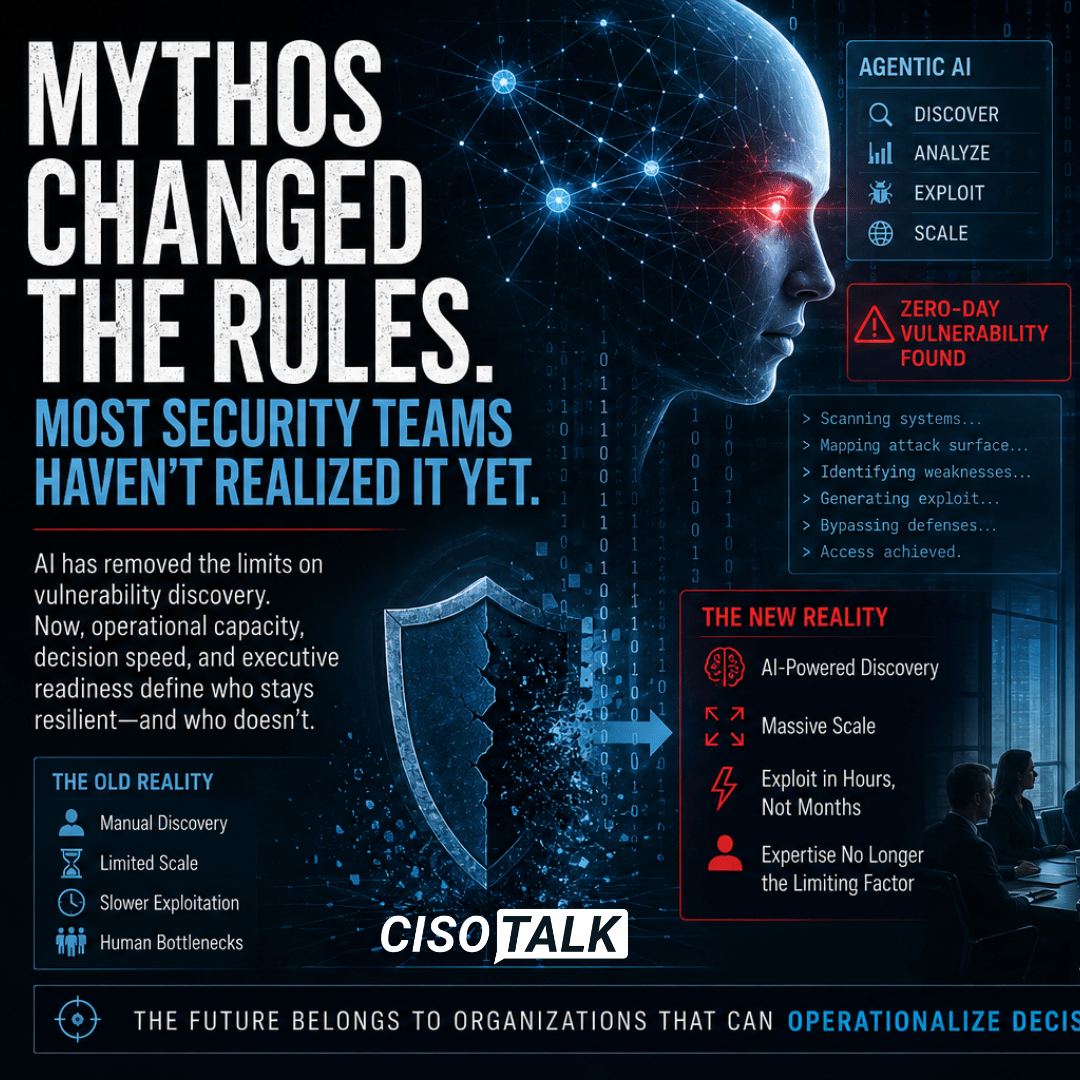
Not because it is smarter than other models. Not because it can write exploits faster. Not because it can identify vulnerabilities in operating systems and browsers. Those capabilities are impressive, but they are not the real story.
The real story is this:
Cybersecurity has officially entered an era where vulnerability discovery is no longer constrained by human scale.
That changes everything.
Anthropic stated that Mythos Preview identified and exploited zero-day vulnerabilities across every major operating system and major web browser during testing, including vulnerabilities that had existed undetected for decades. One now-patched OpenBSD flaw reportedly dated back 27 years. Mozilla reportedly identified and patched hundreds of Firefox vulnerabilities after limited access to the platform.
One statement from Anthropic should concern every security executive:
“Engineers at Anthropic with no formal security training have asked Mythos Preview to find remote code execution vulnerabilities overnight, and woken up the following morning to a complete, working exploit.”
Read that again carefully.
The significance is not merely that AI can find bugs.
It is that expertise is no longer the limiting factor in exploit development.
For decades, cybersecurity had natural bottlenecks. Offensive capability required deep technical knowledge, years of experience, access to tooling, operational patience, and significant manual effort. Even sophisticated nation-state operators faced scaling limitations because highly skilled exploit developers are rare.
Agentic AI begins removing those limitations.
That does not mean AI replaces elite researchers tomorrow. Even early industry analysis around Mythos-like systems noted that meaningful human oversight is still required to validate findings and operationalize attacks effectively. But the direction is obvious. Human expertise is moving from direct execution toward orchestration and validation.
And that creates a serious problem for enterprise defenders.
Because most organizations were already drowning before AI accelerated the pace.
The average enterprise vulnerability management program was struggling long before Agentic AI entered the conversation. Security teams already faced impossible prioritization challenges:
tens of thousands of scanner findings
inconsistent asset inventories
fragmented ownership between infrastructure and application teams
legacy systems that cannot be patched easily
operational downtime concerns
competing business priorities
and boards demanding measurable risk reduction without increasing budgets
Most vulnerability management programs quietly evolved into acceptance-management programs years ago. Organizations patch what they can, defer what they cannot, and hope compensating controls buy enough time.
That operational reality matters because AI dramatically changes the economics of offensive security.
Historically, defenders relied heavily on attacker limitations. Attackers had finite time, finite talent, finite research capability, and finite scalability. Those constraints created survivable windows for defenders. Patch cycles could stretch for weeks or months because exploit development itself required time.
That assumption no longer holds.
A recent AgenticVM research paper demonstrated how agentic workflows reduced nearly 4,000 raw vulnerability findings into 82 prioritized high-risk items while maintaining risk visibility. The important lesson is not the reduction percentage itself. The important lesson is that AI is beginning to compress decision-making cycles faster than enterprise operational models can adapt.
And that is where the real collision begins.
Boards see AI and immediately think productivity.
Security operators see AI and immediately think velocity.
Those are not the same thing.
Velocity without operational maturity creates instability.
Every security leader today is under pressure to “do more with less.” Budgets across much of the industry remain flat while operational complexity continues increasing. CISOs are expected to integrate AI, improve resilience, reduce response times, modernize tooling, manage third-party risk, secure identity, support cloud transformation, and address regulatory pressure simultaneously often without proportional increases in staffing or operational investment.
AI is arriving in the middle of that pressure cooker.
And while the market is obsessed with detection and automation, most organizations are ignoring the operational consequences of accelerated discovery.
Finding vulnerabilities faster does not automatically make organizations safer.
In many cases, it may temporarily make them less stable.
Because now security teams must answer harder questions:
Which vulnerabilities truly matter?
Which systems can tolerate downtime?
What operational risks outweigh patch urgency?
Which business services are actually critical?
How quickly can engineering teams realistically respond?
Which technical debt decisions are no longer survivable?
These are no longer purely technical decisions.
They are business survivability decisions.
One of the areas that deserves far more attention in this discussion is the boardroom itself.
Because while practitioners are beginning to grasp the operational implications of Agentic AI and platforms like Mythos, many executive teams and boards are still viewing AI primarily through the lens of productivity gains, cost optimization, and competitive advantage.
That gap in understanding is dangerous.
Most boards are not yet prepared for what accelerated vulnerability discovery actually means operationally. They hear “AI-powered cybersecurity” and assume organizations become safer, faster, and more efficient. What many do not yet understand is that AI also compresses the timeline between vulnerability discovery and exploitation. It increases operational pressure on engineering teams, shortens remediation windows, amplifies attacker capability, and forces organizations to make risk decisions faster than traditional governance models were designed to handle.
In practical terms, that means the boardroom conversation around cyber risk must evolve quickly.
For years, cyber briefings to boards revolved around maturity metrics:
phishing test percentages
patch compliance
MFA adoption
vulnerability counts
framework alignment
heat maps
third-party assessment scores
Those metrics created comfort because they simplified complexity. The problem is they were built around a slower-moving threat environment where reporting cycles could lag operational reality by weeks or quarters.
Agentic AI changes that dynamic entirely.
Boards now need to understand exposure in operational terms:
Which business functions are most vulnerable to AI-assisted exploitation?
Which critical systems cannot be patched rapidly due to operational constraints?
What is the organization’s realistic remediation velocity?
Which third parties introduce cascading risk?
How long would business operations tolerate a widespread identity compromise or destructive attack?
What technical debt decisions represent existential business risk rather than acceptable operational compromise?
These are not theoretical questions anymore.
When AI can compress exploit discovery timelines from months to hours, governance models built around quarterly reporting cycles become dangerously outdated.
This is where the role of the CISO fundamentally changes.
The modern CISO is no longer simply translating technical threats into business language. The modern CISO is increasingly acting as an operational risk strategist responsible for helping executive leadership understand how rapidly shifting technology changes business survivability itself.
That requires different conversations in the boardroom.
The board does not need a deep technical briefing on how Mythos identifies memory corruption vulnerabilities. What the board needs to understand is how AI changes the economics of cyber risk:
why legacy technical debt becomes more dangerous
why operational resilience matters more than compliance alignment
why recovery capability is now as important as prevention
why flat budgets may no longer align with accelerated attacker capability
and why decision-making speed itself is becoming a competitive security advantage
The uncomfortable reality is that many organizations are structurally unprepared for this transition.
Not because their security teams lack talent.
Not because their tooling is inadequate.
But because executive governance itself still operates at human pace while both offense and exposure are beginning to operate at machine pace.
That mismatch will define many of the cybersecurity failures over the next several years.
And it is precisely why executive briefings around AI cannot become innovation theater presentations designed to impress boards with futuristic terminology. CISOs need to begin framing these discussions around operational resilience, business continuity, financial impact, and organizational adaptability.
The organizations that thrive in the next era of cybersecurity will not necessarily be the ones with the largest security budgets or the most sophisticated tooling stacks. They will be the organizations capable of operationalizing decisions faster than their peers.
That requires a different kind of security leadership.
For years, cybersecurity maturity was measured through coverage:
endpoint coverage
MFA coverage
patch coverage
logging coverage
framework alignment
dashboard metrics
The AI era is forcing a transition from coverage-based thinking toward operational resilience thinking.
Can the organization absorb accelerated vulnerability discovery?
Can engineering teams remediate at machine speed?
Can risk decisions happen quickly enough?
Can business leaders tolerate the operational friction required to reduce exposure?
Those are the questions that matter now.
And there is another uncomfortable reality that security leaders need to address honestly:
Many cybersecurity teams are psychologically unprepared for this shift.
I am already seeing practitioners quietly step back from AI initiatives out of fear that automation will eventually replace them. Others are overwhelmed by the pace of change itself. Some are skeptical. Some are exhausted. Many simply do not know how their role evolves in an environment where AI handles increasing portions of research, triage, and analysis.
That fear is understandable.
But I believe the future security professional becomes more valuable — not less.
The repetitive work disappears first:
alert triage
spreadsheet correlation
basic enrichment
repetitive vulnerability classification
low-level investigation workflows
What remains are the harder human problems:
operational judgment
business prioritization
architecture
resilience engineering
strategic risk communication
governance
recovery planning
trust building
AI changes the shape of security teams. It does not eliminate the need for operators. But leadership must guide that transition intentionally.
Because if employees only see AI as a workforce reduction strategy, leadership has already failed.
What Mythos represents is not simply a technological breakthrough. It represents a warning shot that cybersecurity’s existing operational model may no longer scale against the pace of machine-assisted offense.
The economics of offense have changed. Defenders are still budgeting, staffing, prioritizing, and operating like it is 2021. That gap will become impossible to ignore over the next 24 months.
And the organizations that recognize this early the ones that modernize operational decision-making before they modernize tooling will likely define the next era of cybersecurity leadership.
The future belongs neither to the organizations with the biggest SOCs nor the most AI tooling.
It belongs to the organizations that can operationalize trust, prioritization, and resilience faster than everyone else.