

The Operator’s Dilemma – Part II
Why visibility, ownership, and operational alignment matter more than scanners, dashboards, and remediation SLAs

The Vulnerability Management Problem Was Never About Patching
Why visibility, ownership, and operational alignment matter more than scanners, dashboards, and remediation SLAs
When Anthropic announced Mythos and demonstrated the ability of Agentic AI to identify exploitable vulnerabilities at a scale previously reserved for elite security researchers, much of the cybersecurity community immediately focused on discovery.
The assumption was understandable. If AI can identify vulnerabilities faster, defenders will need to patch faster.
While true, that conclusion misses a more important reality.
Most organizations are not struggling because they lack awareness of vulnerabilities. They are struggling because vulnerability management has always been constrained by operational complexity rather than technical capability.
For nearly twenty years, the cybersecurity industry has invested heavily in improving discovery. Vulnerability scanners became more sophisticated. Asset discovery platforms expanded coverage. Threat intelligence feeds improved prioritization. Exposure management platforms emerged to help organizations understand attack paths and business impact.
Yet despite those investments, vulnerability backlogs continue to grow.
The reason is straightforward.
Finding vulnerabilities has become significantly easier.
Remediating them has not.
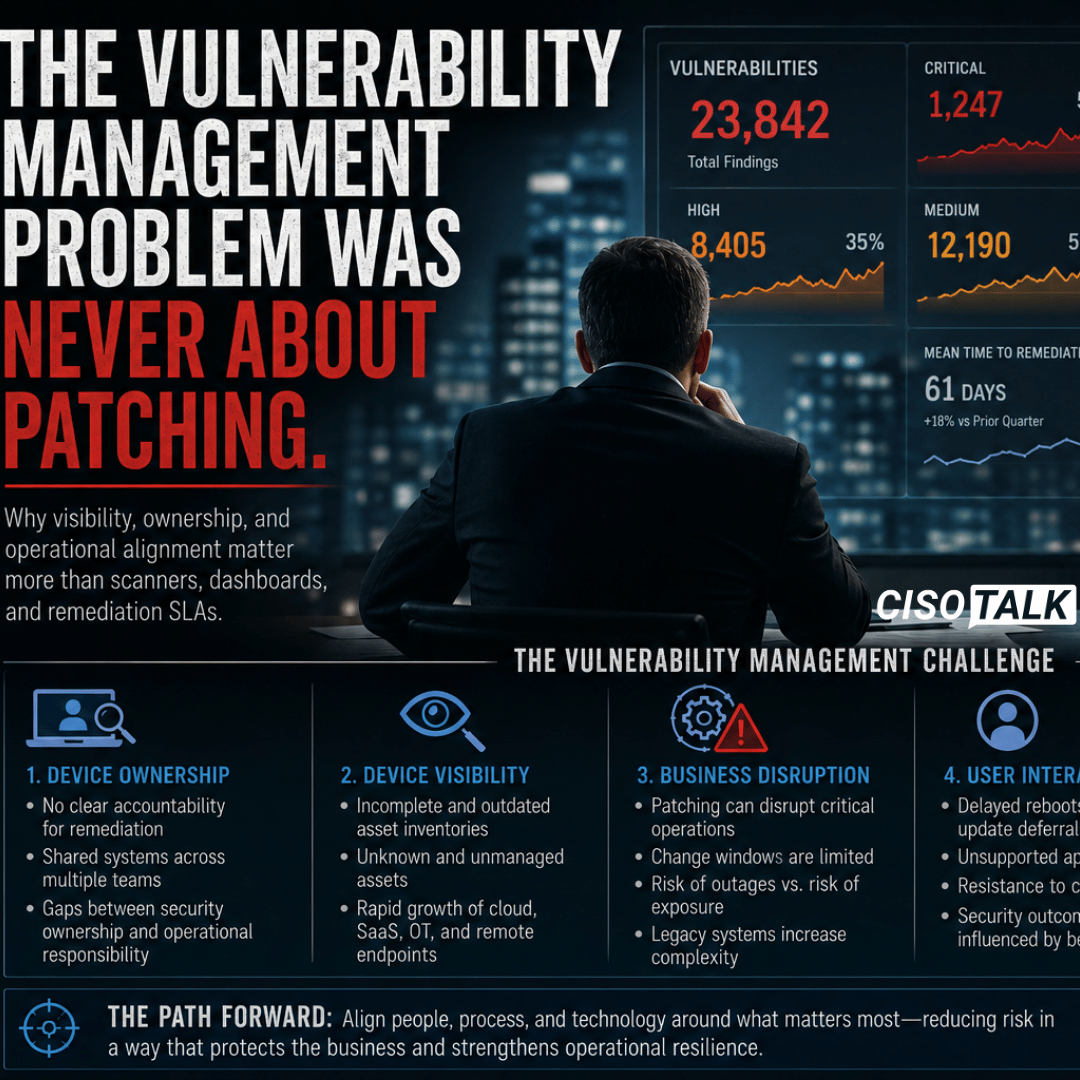
The challenge becomes particularly apparent in large enterprises where vulnerability management sits at the intersection of multiple teams, competing priorities, and business constraints. Security identifies risk, but rarely owns the systems requiring remediation. Infrastructure teams manage operating systems, application teams manage software, cloud teams manage platforms, operational technology teams manage industrial systems, and business leaders ultimately determine acceptable levels of operational disruption.
As a result, vulnerability management often becomes less about cybersecurity and more about organizational alignment.
This distinction is becoming increasingly important as AI accelerates the pace of discovery.
Visibility Remains an Executive Problem
Before an organization can remediate vulnerabilities, it must first understand what it owns.
That sounds obvious. In practice, it remains one of the most persistent challenges facing security leaders.
The modern enterprise bears little resemblance to the environments vulnerability management programs were originally designed to support. Mergers and acquisitions introduce inherited infrastructure. Cloud adoption creates dynamic workloads. SaaS applications expand the attack surface beyond traditional network boundaries. Remote work introduces devices that rarely connect directly to corporate environments. Operational technology and Internet of Things deployments further complicate asset inventories.
Most organizations operate in a state of partial visibility.
While security vendors continue marketing the promise of complete visibility, experienced practitioners understand that asset inventories are often snapshots rather than complete representations of reality.
The significance of this challenge extends beyond cybersecurity. Visibility drives accountability. Organizations cannot assign ownership, prioritize remediation, or accurately assess risk for systems they do not know exist.
As attack surfaces continue expanding, visibility increasingly becomes an operational and governance challenge rather than a technical one.
The Ownership Challenge
Once vulnerabilities are identified, the next challenge emerges: ownership.
One of the more persistent misconceptions in cybersecurity is that vulnerability management is primarily a security function. Security teams certainly facilitate the process, but they rarely possess the authority or operational responsibility required to remediate vulnerabilities directly.
Security teams do not typically patch servers, upgrade applications, reboot manufacturing systems, modify ERP platforms, or approve production outages. Those responsibilities belong to operational teams and business stakeholders.
This distinction matters because many vulnerability management programs continue measuring security organizations against outcomes they do not fully control.
Organizations often invest considerable effort in improving discovery while dedicating far less attention to establishing clear accountability for remediation. The result is a familiar cycle of reporting, escalation, exception requests, and recurring findings.
The issue is not a lack of data.
The issue is the absence of clearly defined ownership structures capable of translating risk identification into operational action.
As AI increases the volume and speed of vulnerability discovery, this challenge will become increasingly visible.
The Economics of Business Disruption
Security professionals often discuss vulnerabilities as technical risks.
Business leaders experience them differently.
For business leaders, remediation activities introduce their own form of risk. Patching may require downtime. Application upgrades may impact users. Infrastructure changes may interrupt production schedules. Testing requirements consume resources and delay project timelines.
Consequently, vulnerability management frequently becomes an exercise in balancing competing forms of risk.
The security organization seeks to reduce exposure.
The business seeks to maintain operational continuity.
Neither objective is inherently more important than the other.
The organizations that consistently perform well in vulnerability management are not necessarily those that patch the fastest. Rather, they are the organizations that have developed mature processes for evaluating risk, coordinating stakeholders, and integrating remediation activities into operational planning.
This distinction becomes particularly relevant as AI reduces the time between vulnerability discovery and potential exploitation.
Organizations that rely on ad hoc remediation processes may find themselves increasingly unable to respond at the speed required by emerging threats.
The Human Element
Technology receives the majority of attention in vulnerability management discussions, but human behavior often determines outcomes.
Delayed reboots, unsupported applications, resistance to change, legacy business processes, and competing operational priorities routinely influence remediation timelines.
Many organizations attempt to solve these challenges through tooling investments alone. While automation certainly improves efficiency, it does not eliminate the need for organizational alignment, communication, and executive sponsorship.
Successful vulnerability management programs often resemble change management initiatives as much as technical programs.
The ability to influence behavior, establish accountability, and align stakeholders frequently determines whether vulnerabilities are remediated more than the capabilities of the scanning platform itself.
Preparing for the Next Phase
The emergence of Agentic AI does not fundamentally change the challenges associated with vulnerability management.
Rather, it exposes weaknesses that have existed for years.
AI will continue improving discovery.
AI will continue improving prioritization.
AI will likely improve remediation recommendations.
What AI cannot solve is organizational indecision.
It cannot establish ownership.
It cannot align competing business priorities.
It cannot determine acceptable operational risk.
Those responsibilities remain leadership functions.
As organizations begin evaluating the impact of AI-driven vulnerability discovery, security leaders should resist the temptation to focus exclusively on tooling. The more important discussion involves governance, accountability, operational resilience, and decision-making velocity.
The organizations that succeed in the next phase of cybersecurity maturity will not necessarily be those that identify the most vulnerabilities.
They will be the organizations capable of consistently making the best decisions about the vulnerabilities that matter most.