

The Operator’s Dilemma – Part III
Why leadership, governance, and strategic partnerships will define cybersecurity’s next decade

The Future Belongs to Organizations That Can Decide Faster
Throughout this series, we’ve explored two major realities shaping the future of cybersecurity.
In Part I, we examined how Agentic AI and technologies like Mythos are fundamentally altering the economics of vulnerability discovery. For perhaps the first time in cybersecurity history, the ability to identify vulnerabilities is no longer constrained by human expertise or scale. Discovery is accelerating, offensive research is becoming more accessible, and the time between vulnerability identification and exploitation continues to shrink.
In Part II, we shifted from discovery to execution. We examined why vulnerability management remains one of cybersecurity’s most persistent challenges despite decades of investment in scanners, dashboards, threat intelligence platforms, and exposure management technologies. The conclusion was straightforward: vulnerability management has never been primarily a technology problem. It is an operational challenge rooted in visibility, ownership, prioritization, and business alignment.
Taken together, those two trends point to a larger transformation taking place across our industry.
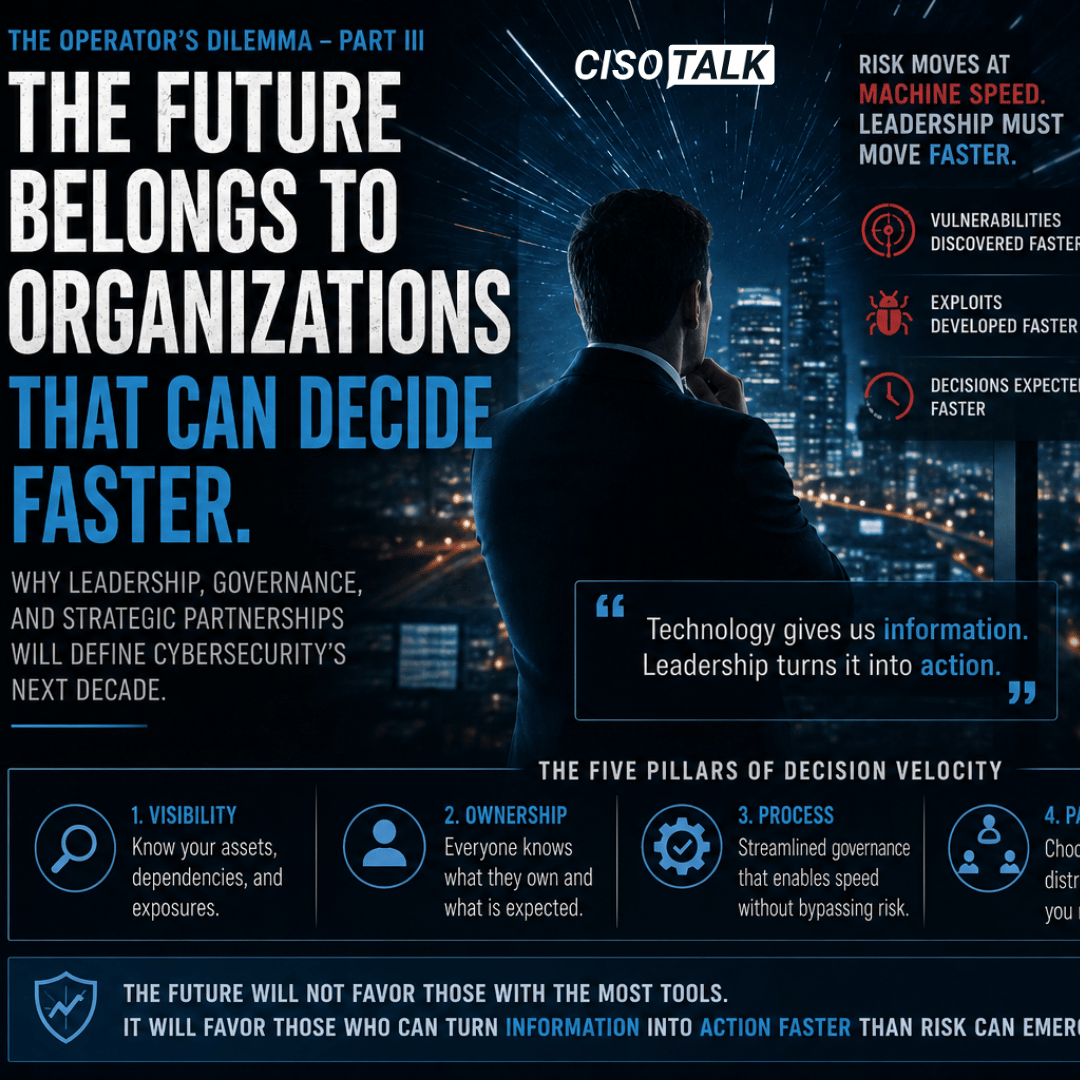
The future of cybersecurity will not be determined by which organizations possess the most data, the largest security teams, or even the most advanced technology stacks. Increasingly, success will be determined by an organization’s ability to convert information into action faster than the risks around it develop.
The Compression of Time
One of the least discussed consequences of AI’s rapid adoption is the compression of decision-making timelines.
Historically, organizations benefited from time. Vulnerabilities could remain undiscovered for months or years. Threat intelligence moved relatively slowly. Exploit development required specialized expertise. Governance processes, change review boards, and remediation plans operated at a pace that was generally aligned with the threat landscape.
That environment no longer exists.
Today, vulnerabilities are often identified within hours of disclosure. Public proof-of-concept code may emerge within days. Threat intelligence is distributed globally in near real time. AI-assisted research is accelerating vulnerability analysis and exploit development in ways that were difficult to imagine only a few years ago.
The challenge for most organizations is not a lack of information. In fact, many security teams are overwhelmed by the volume of information available to them. The challenge is determining which information matters, who owns the response, and how quickly decisions can be made once a risk is identified.
In many ways, cybersecurity is becoming less of a technology discipline and more of a decision-making discipline.
The New Measure of Cybersecurity Maturity
For years, cybersecurity maturity was measured through the implementation of controls. Organizations invested heavily in endpoint security, identity management, SIEM platforms, vulnerability scanners, cloud security solutions, and security operations centers. Those investments remain necessary and valuable.
However, the organizations demonstrating the greatest resilience today share a different characteristic.
They are able to make informed decisions quickly.
When a critical vulnerability is disclosed, ownership is immediately understood. When a supplier experiences a cyber incident, business dependencies are known. When an acquisition is completed, asset accountability is established early. When operational disruptions occur, escalation paths are already defined.
These capabilities are not products. They are not technologies. They are organizational competencies.
This distinction becomes increasingly important as AI continues accelerating the pace at which information is generated. Security leaders should expect a future where intelligence, alerts, vulnerabilities, indicators, and recommendations arrive faster than most organizations can reasonably process. The differentiator will not be visibility alone. It will be the ability to act on that visibility.
Why Your Security Partners Matter More Than Ever
This shift also changes how organizations should evaluate security vendors, service providers, and strategic partners.
Historically, purchasing decisions often revolved around features, analyst rankings, functionality, and cost. Those factors still matter, but they no longer tell the whole story.
As cyber risk continues to evolve at increasing speed, security leaders should begin asking a different question:
Does this partner help us make better decisions faster?
That question applies equally to technology vendors, MSSPs, incident response providers, consulting firms, value-added resellers, distributors, and threat intelligence partners.
The value of a security partner is increasingly measured by its ability to reduce uncertainty. The organizations creating the most value today are not simply producing more alerts, more dashboards, or more reports. They are providing context. They are helping security leaders understand what matters, what can wait, and what requires immediate action.
This distinction becomes particularly important in an era of constrained budgets. Most CISOs are being asked to manage expanding responsibilities without proportional increases in resources. Every investment must contribute to operational efficiency and better decision-making.
The organizations that continue accumulating tools without improving outcomes will struggle. The organizations that build ecosystems designed around visibility, context, automation, and action will be positioned to respond more effectively.
The Boardroom Transformation
This evolution is also changing the relationship between cybersecurity leaders and the boardroom.
For many years, cyber reporting focused heavily on control effectiveness, compliance frameworks, maturity assessments, and vulnerability metrics. While these measurements remain useful, they often fail to answer the questions boards increasingly care about most.
Boards are no longer asking whether a control exists.
They are asking what happens when it fails.
They want to understand recovery timelines, operational dependencies, business continuity impacts, and organizational resilience. They want clarity around how quickly leadership can assess risk, make decisions, and restore critical operations when disruptions occur.
This represents a meaningful shift in governance.
Cybersecurity is becoming less about demonstrating compliance and more about demonstrating preparedness. The most effective CISOs are increasingly acting as business leaders who happen to specialize in risk rather than technical specialists attempting to explain technology.
That distinction is subtle, but important.
The Human Element Remains the Differentiator
Despite the attention surrounding AI, automation, and machine-assisted security operations, cybersecurity remains fundamentally a people business.
Technology can identify anomalies.
Technology can prioritize vulnerabilities.
Technology can automate workflows.
Technology can recommend actions.
What technology cannot do is build trust, align stakeholders, navigate competing business priorities, or create accountability across an organization.
Those remain leadership functions.
The most successful cybersecurity organizations over the next decade will not necessarily have the most advanced tools. They will have leadership teams capable of creating clarity during uncertainty, establishing accountability during disruption, and making informed decisions under pressure.
These capabilities have always mattered.
What is changing is the speed at which they must be exercised.
The Operator’s Dilemma
When I began this series, I believed I was writing about Agentic AI, Mythos, and vulnerability management.
What became clear throughout the process is that these topics are merely symptoms of a larger transformation.
Technology is accelerating.
Complexity is increasing.
Threat actors are becoming more capable.
Attack surfaces continue expanding.
None of those trends are likely to reverse.
The question facing security leaders is not whether these changes will occur. The question is whether their organizations can adapt quickly enough to keep pace.
Can ownership be established before a crisis occurs?
Can governance operate at the speed of modern risk?
Can security teams provide context rather than simply information?
Can boards make informed decisions quickly when operational resilience is challenged?
Can partners help reduce uncertainty instead of contributing to it?
These are the questions that will define cybersecurity leadership over the next decade.
Because in an environment where threats increasingly move at machine speed, competitive advantage will not belong to the organizations with the most information.
It will belong to the organizations that can transform information into action faster than everyone else.
And that may become the most important cybersecurity capability of all.
Stay cyber safe.