

The Vulnerability Management Shift Left Moment Is Here
Claude Mythos isn’t just another AI model — it’s the forcing function that will redefine how CISOs, security practitioners, and the entire enterprise approach risk. Here’s what you need to do about it

First, a personal note before we get into it. The past few weeks have tested me in ways I didn’t anticipate. With the birth of my son, and navigating grief and loss alongside it, carving out the time to produce something both articulate and useful has been a real challenge. I appreciate your patience, and I’m committed to getting back to the consistent, high-quality cadence you expect from this publication and from the CyberHub Podcast. With that said, let’s get into what matters.
If you’ve had your head down in operations, you may have missed the story that’s reshaping the cybersecurity conversation at every level of the enterprise: Claude Mythos, Anthropic’s new AI model that is poised to deliver the vulnerability management industry its long-overdue “shift left” moment. There’s been no shortage of commentary on the geopolitical implications, the dual-use risks, and the theoretical disruption to DevSecOps pipelines. What’s been missing is a grounded, practitioner-focused perspective on what this actually means for those of us running security programs today.
This is my attempt to provide that.
Validated Research
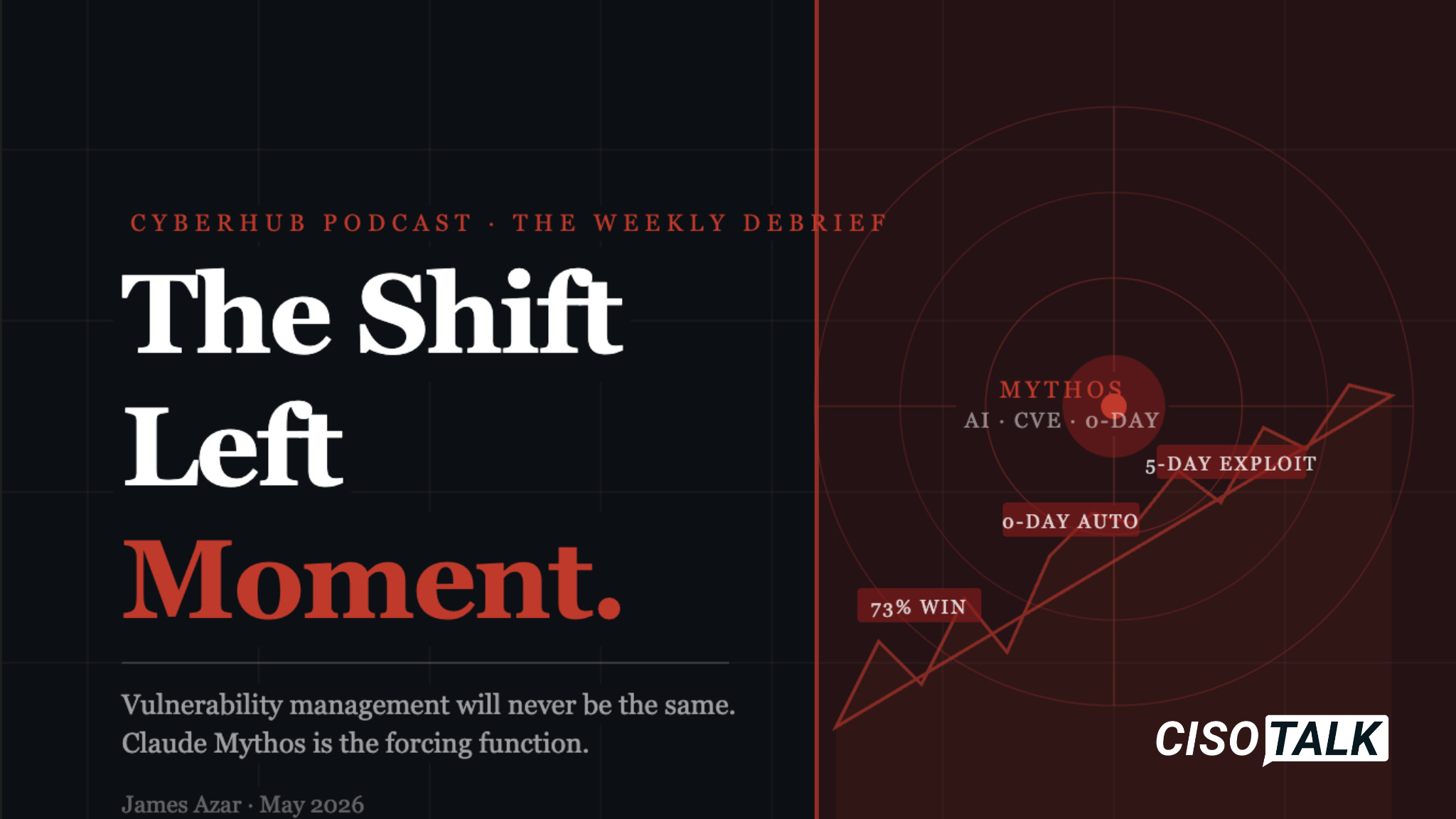
Anthropic’s Mythos Preview model was publicly announced April 7, 2026. In internal testing, it autonomously identified and exploited vulnerabilities across all major operating systems and every major web browser including a 17-year-old remote code execution flaw in FreeBSD (CVE-2026-4747) requiring zero human intervention after the initial prompt. The UK’s AI Security Institute evaluated Mythos on expert-level Capture the Flag tasks and found it succeeded 73% of the time, tasks that no model could complete at all prior to April 2025. (Source: Anthropic Frontier Red Team, AISI, April 2026)
The speed of adoption should already be keeping you up at night
Before we talk about Mythos specifically, we have to acknowledge the broader context: AI adoption is moving faster than any enterprise risk model was designed to accommodate.
We saw early proof of this with Cursor the AI-native coding platform that became the fastest-growing SaaS company in history.
Validated Research
Cursor went from $1M to $100M in ARR in just 12 months faster than Wiz (18 months), Deel (20 months), and Ramp (24 months). By early 2026, Sacra estimates Cursor had reached $2B in annualized revenue, with nearly 70% of the Fortune 1000 represented in its customer base. This growth was achieved with virtually zero marketing spend. (Source: Sacra Research, SaaStr, 2024–2026)
The point isn’t the number, it’s the velocity. When a developer tool scales that fast, security practitioners don’t get warned in advance. They find out when it’s already embedded in production workflows across six business units. Now imagine that same velocity applied to an AI model that can autonomously discover and exploit zero-day vulnerabilities. That’s not a theoretical risk. That’s Mythos. And the clock is already running.
Vulnerability management has always been the Achilles heel and the gap just widened
Let me be direct with you: vulnerability management has been the consistent failure point of nearly every security program I’ve ever seen, consulted on, or studied. Not because practitioners don’t care, and not because the tools aren’t there but because it has always been a team sport that spans security, IT, development, infrastructure, network engineering, and architecture. Getting all of those stakeholders aligned, accountable, and moving at the same pace is genuinely hard.
Validated Research
Current industry SLAs define critical vulnerability remediation at 24–72 hours, high-severity at 30 days, and medium-severity at 60–90 days. The reality is far worse: most organizations take 60–150 days to patch critical vulnerabilities, while adversaries are now exploiting critical flaws in as little as 5 days after public disclosure down from an average of 15 days a year prior. The 2024 MOVEit Transfer breach exploited a vulnerability within 48 hours of disclosure, affecting over 2,700 organizations and exposing data on 93 million people. (Source: CISA INSIGHTS, Secure.com, Tenable Research, 2024–2026)
The SLA model we’ve lived by 24 hours for critical, 72 hours for zero-day, 30 days for high, 90 days for low is already demonstrably broken in practice. Mythos doesn’t just pressure that model. It obliterates it. When an AI agent can turn a CVE into a working exploit in under an hour, the entire concept of a “remediation window” has to be rethought from the ground up.
“The SLA model we’ve lived by is already demonstrably broken in practice. Mythos doesn’t just pressure it — it obliterates it.”
What I believe we’re moving toward within the next 12 to 18 months is inline patching, autonomous agent-assisted remediation, and AI-driven continuous monitoring that operates at speeds no human team can match. Patch Tuesday, as a concept, may be heading toward its sunset. Organizations already receiving Mythos-adjacent capabilities through Project Glasswing are reportedly pushing out of-band patches on timelines we’ve never seen before.
Validated Research
Anthropic’s Project Glasswing launched in April 2026 gives a select group of partners early access to Mythos Preview for defensive use. Initial partners include Microsoft, Google, Apple, Nvidia, CrowdStrike, Palo Alto Networks, and Wiz. Separately, Anthropic launched Claude Security (public beta, April 30, 2026) a codebase vulnerability scanning tool built on Claude Opus 4.7, requiring no API integration, now available to Claude Enterprise customers. CrowdStrike, Microsoft Security, SentinelOne, TrendAI, and Wiz are integrating Opus 4.7 capabilities into existing enterprise platforms. (Source: Anthropic, SecurityWeek, Infosecurity Magazine, April–May 2026)
The government is paying attention and so should you
One of the more telling signals of Mythos’s significance is the degree to which it has generated government engagement at the highest levels and not through the usual bureaucratic channels.
Validated Research
The week prior to Anthropic’s April 7, 2026 Mythos announcement, Vice President JD Vance and Treasury Secretary Scott Bessent convened a call with the CEOs of Anthropic, OpenAI, Google, Microsoft, Palo Alto Networks, and CrowdStrike to discuss AI model security and coordinated response capabilities. Anthropic separately briefed senior U.S. government officials on Mythos’s full offensive and defensive cyber capabilities before any external release. Anthropic CEO Dario Amodei subsequently met with White House Chief of Staff Susie Wiles, with the administration describing the talks as “productive and constructive.” (Source: CNBC, Reuters, PBS NewsHour, April 2026)
The significance here isn’t just the meeting it’s who was in the room. Having a sitting Vice President who comes from a VC and tech background, who understands the Silicon Valley ecosystem at a practical rather than performative level, in a room mediating between national security concerns and the commercial realities of AI deployment that’s a different kind of conversation than we’ve had before. It doesn’t guarantee the right policy outcomes. But it does signal the seriousness with which the government is treating this.
My CISO checklist: how I’m approaching Mythos across the enterprise
I want to be clear, I’m not dropping anything revolutionary here. What I am doing is emphasizing the human and organizational dimensions that AI will never be able to replace. Technology moves fast. Culture and alignment don’t. Here’s how I’m thinking about this:
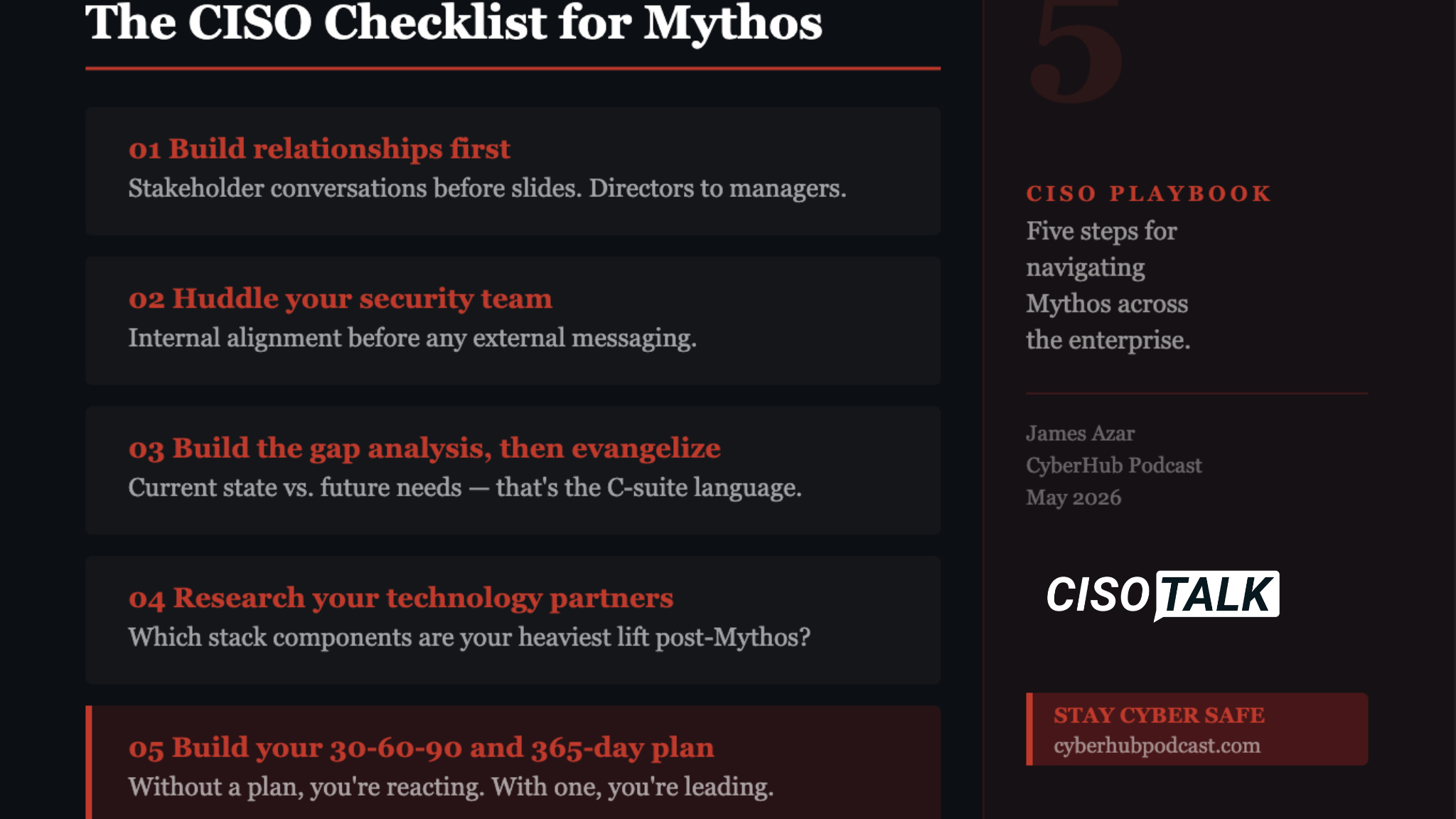
Start with relationships, not slides
Before you draft a single executive briefing, have the conversations with directors, managers, and team leads across IT, infrastructure, development, and engineering. The water cooler conversations, the Slack threads, the one-on-ones. You need to understand how these stakeholders think about Mythos and what their actual concerns are before you can represent them upward.
Huddle your security team first
What does Mythos mean for your specific program? What does it demand of your team in terms of adaptation? What risks does the team itself need to own? That internal conversation has to happen before you take anything to the C-suite.
Build the gap analysis, then evangelize
Only after you’ve gathered genuine signal from both the bottom of the house and the top do you go to your CFO, COO, CRO, and CEO. The current-state versus future-needed-capability gap, and the risk that gap introduces to the business — that’s the language the C-suite will engage with. The risk that it introduces to the business is also very important. Ground your presentation in those two things.
Do the technology partner research
Who are the right vendors and partners to help close the gaps you’ve identified? What in your current stack will be the heaviest lift to manage once Mythos-level capabilities become broadly available? What’s the business criticality of those systems? What compensating controls exist or need to be built? This is where you earn your keep as a leader not in the boardroom, but in the architecture review.
Build a 30-60-90 and 365-day plan
What does success look like at 30 days? 60? 90? What’s your ideal state at a year out? This isn’t just a planning exercise, it’s the foundation of accountability. Without it, you’re reacting. With it, you’re leading.
A final word on market implications
I’ve heard a lot of speculation about which security stocks are in trouble. My view is simple: the companies at risk are those that are single-threaded around vulnerability management and exposure management without a credible path to autonomous, near-real-time remediation. Those companies need to be modernizing their offering, pursuing acquisitions, or identifying disruptors in their space right now. The window is short.
What we’re also watching is a race that our adversaries are running in parallel. They’re adopting these tools just as aggressively, and in some cases more freely, than defenders. The asymmetry of the attacker’s advantage has always been real, Mythos, in the wrong hands, makes it existential.
Validated Research
UK AISI evaluators found that Claude Mythos Preview is “the first model to solve a 32-step corporate network attack simulation from start to finish” a simulation estimated to require human professionals 20 hours to complete in 3 out of 10 attempts. The AI Security Institute concluded: “Future frontier models will be more capable still, so investment now in cyber defence is vital.” (Source: AISI, April 2026)
Three months from now, we’ll all be flying into Las Vegas for Hacker Summer Camp. I fully expect these conversations to be at the center of every hallway discussion, every panel, every side meeting. The vulnerability management shift left moment isn’t coming, it’s here. How we as security leaders respond in the next 90 days will define the shape of our programs for the next several years.
I’d genuinely love to hear where you see this going. Drop a comment, reply to this post, or find me at the show.
Until then — stay cyber safe.