



Good Morning Security Gang,
Today’s show is one of those where you can clearly see the convergence of everything we’ve been talking about AI risk, supply chain compromise, critical infrastructure targeting, and long-tail operational damage.
And if there’s one theme that cuts across every single story today, it’s this: attackers are abusing trust faster than defenders can validate it.
Double espresso in hand, let’s get into it. Coffee Cup Cheers
"A career in cyber will help you understand what it's like to only function on three or four hours of sleep. If you've ever been through an incident, you know the marathon you're going through in the hours and days post-event until you get the all-clear signal. Your career kind of prepares you for parenting, so don't hold back, go make yourself some little ones, join the party, it's a blast!" James Azar on new parenting
AI Threat to Global Banking: Speed vs. Control
We kick things off with financial leaders warning that advanced AI models could destabilize parts of the global banking system. This isn’t about hallucinations or bad outputs, it’s about scale and speed.
AI is enabling fraud, automating attacks, and accelerating decision-making faster than human oversight can keep up. And in banking, where regulation slows everything down, that gap becomes dangerous.
The real risk here is systemic fraud happening faster than institutions can detect or respond, potentially leading to financial instability.
This is where AI shifts from a tool to a threat multiplier.
Vercel Breach: Developer Infrastructure Under Fire
Next, Vercel confirmed a breach involving unauthorized access to internal systems, with attackers claiming access to source code, tokens, and internal dashboards.
This is a direct hit on developer infrastructure and CI/CD environments.
“Attackers don’t need to break trust, they just need to use it better than we protect it.”
And that matters because these systems aren’t just internal, they’re gateways into production environments and customer data. The risk here isn’t just what was accessed, it’s what can be accessed next through stolen tokens and deployment pipelines.
This is supply chain risk in real time.
Crypto Exchange Hack: Blame vs. Reality
A crypto exchange suffered a $13.7 million hack and blamed Western intelligence agencies. Regardless of attribution, the reality is simple, the funds are gone.
This highlights a recurring issue in crypto incidents: geopolitics often clouds transparency. But users don’t care about attribution, they care about access to their funds.
The risk is erosion of trust in platforms where accountability becomes secondary to narrative.
NHS Ransomware Fallout: Two Years Later, Still Broken
The NHS story is one of the most important today—and the most overlooked.
Nearly two years after a ransomware attack, healthcare services in London are still dealing with the fallout thousands of delayed procedures, disrupted diagnostics, and ongoing operational issues.
“Cyber incidents don’t end when systems come back online—they end when operations fully recover.” James Azar
This is the long tail of cyber incidents. Ransomware isn’t just a data problem, it’s a multi-year operational crisis. And healthcare, more than any other sector, feels that impact directly in patient care.
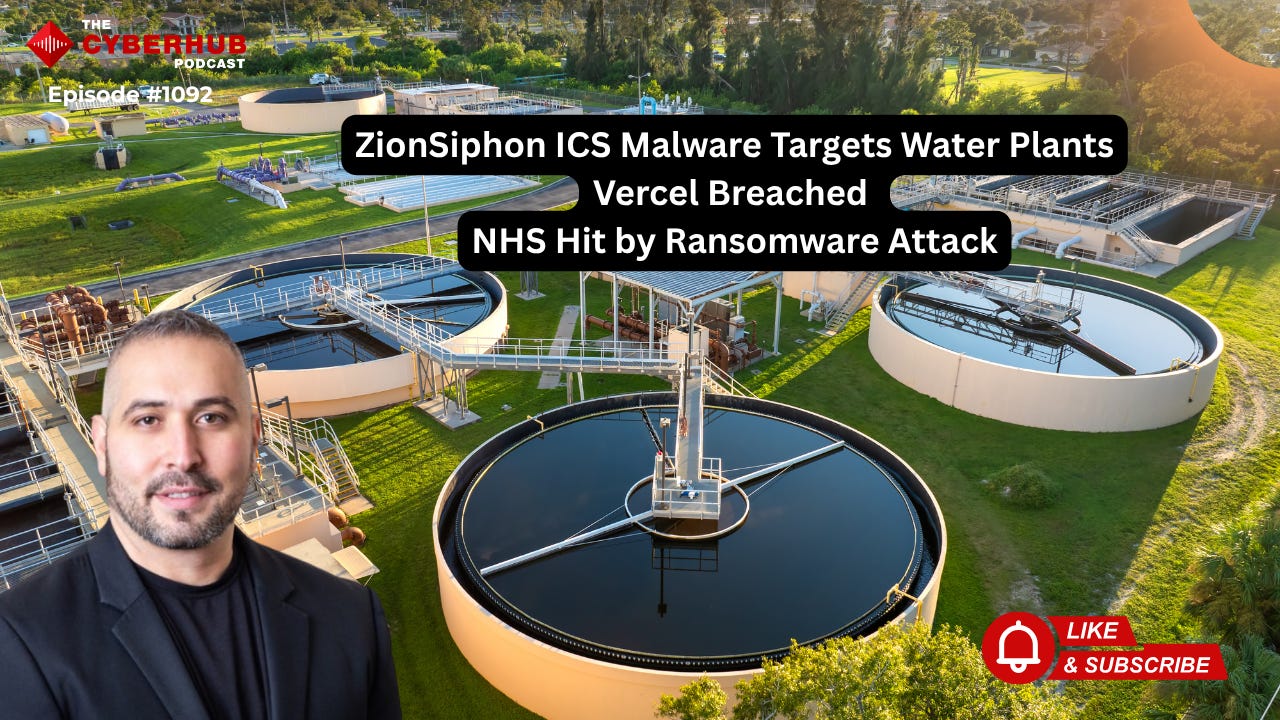
ZionSiphon Malware Targets Water Infrastructure
This is one of the most concerning stories of the day. ZionSiphon malware is targeting water treatment and desalination systems, specifically looking for processes related to chlorine handling and water purification.
It even includes references to poisoning water supplies. This isn’t theoretical.
This is early-stage OT malware with real-world consequences.
Even if incomplete, it’s enough to cause damage—and that’s what makes it dangerous. We’ve seen this before. Oldsmar, Florida. One analyst prevented disaster. This is that same playbook evolving.
Apache ActiveMQ Exploited: Old Bugs, New Campaigns
ActiveMQ vulnerabilities are now being actively exploited, often chained with default credentials and older bugs. This is a recurring theme:
Old vulnerabilities + weak configurations = new attacks. Middleware like ActiveMQ sits deep in application environments, making it a perfect foothold for attackers.
Quiet. Persistent. Dangerous.
Fortinet Sandbox Flaw: Security Tools Become Attack Vectors
A critical Fortinet Sandbox vulnerability allows unauthenticated command execution as root with public exploit code already available. This is a reminder that security tools themselves are part of the attack surface.
If compromised, they become trusted footholds for attackers. The irony is real and so is the risk.
Apple Alert Phishing: When Real Becomes the Threat
Attackers are abusing legitimate Apple account notifications to deliver phishing messages. These emails pass all authentication checks, SPF, DKIM, DMARC, because they’re actually sent by Apple.
This is next-level phishing. No fake domains. No obvious red flags. Just trusted communication turned into an attack vector.
Good Guys Prevail: DDoS Crackdown and North Korea Sentencing
On the positive side, law enforcement disrupted a DDoS-for-hire network, seizing domains and warning over 75,000 users. Additionally, two individuals were sentenced for supporting North Korea’s fake IT worker scheme.
These are wins—but they’re temporary. Cybercrime ecosystems adapt quickly. Disruption creates friction, not elimination.
DraftKings Credential Stuffing Case: Old Tactics Still Work
Finally, the DraftKings case reminds us that credential stuffing is still highly effective. Attackers used reused credentials from other breaches to access 60,000 accounts and monetize them.
No zero-days. No advanced techniques. Just reused passwords.
Sometimes the biggest risks are still the simplest.
Action Items for Security Leaders
Introduce human approval gates for high-risk AI-driven financial workflows
Treat CI/CD and developer platforms as production-grade assets
Enforce rapid token rotation and eliminate static credentials
Demand transparency and proof-of-reserve in crypto platforms post-incident
Build healthcare recovery plans around clinical workflows, not just IT systems
Baseline OT behavior and monitor for unauthorized process changes
Remove default credentials and patch middleware like ActiveMQ immediately
Patch and audit security appliances as high-priority infrastructure
Train users to verify alerts directly from official apps—not email links
Strengthen defenses against credential stuffing and automated abuse
"The pattern here is clear. Trust is getting abused everywhere—in banks, clouds, hospitals, industrial systems, software appliances, brand alerts, and user accounts. Attackers keep winning when defenders assume a system is safe because it's familiar. It isn't. Our work is to verify the trust, reduce the blast radius, and be faster at seeing misuse than the attacker is at scaling it."
James Azar’s CISOs Take
What stood out to me today is how interconnected everything has become. AI, cloud, OT systems, and user behavior are no longer separate domains—they’re all part of the same attack surface. When attackers exploit trust in one area, it cascades into others. That’s why we’re seeing incidents that start in one place and end somewhere completely different.
The second takeaway is the importance of resilience. Too many organizations still think in terms of prevention, but today’s stories especially NHS and water infrastructure show that recovery and continuity are just as critical. We need to design systems not just to stop attacks, but to survive them. Because in today’s environment, survival is the real measure of security.
Stay Cyber Safe.


