



☕ Good Morning Security Gang,
Today’s episode centered around one word that every cybersecurity practitioner should have top of mind:
Trust.
Whether it’s trusting a privileged remote access vendor, an AI Model Context Protocol (MCP) server with thousands of GitHub stars, an internet-facing router that hasn’t been patched in years, or credentials issued to a third party, today’s stories all highlighted the same reality: trust without continuous verification has become one of the largest risks facing modern enterprises.
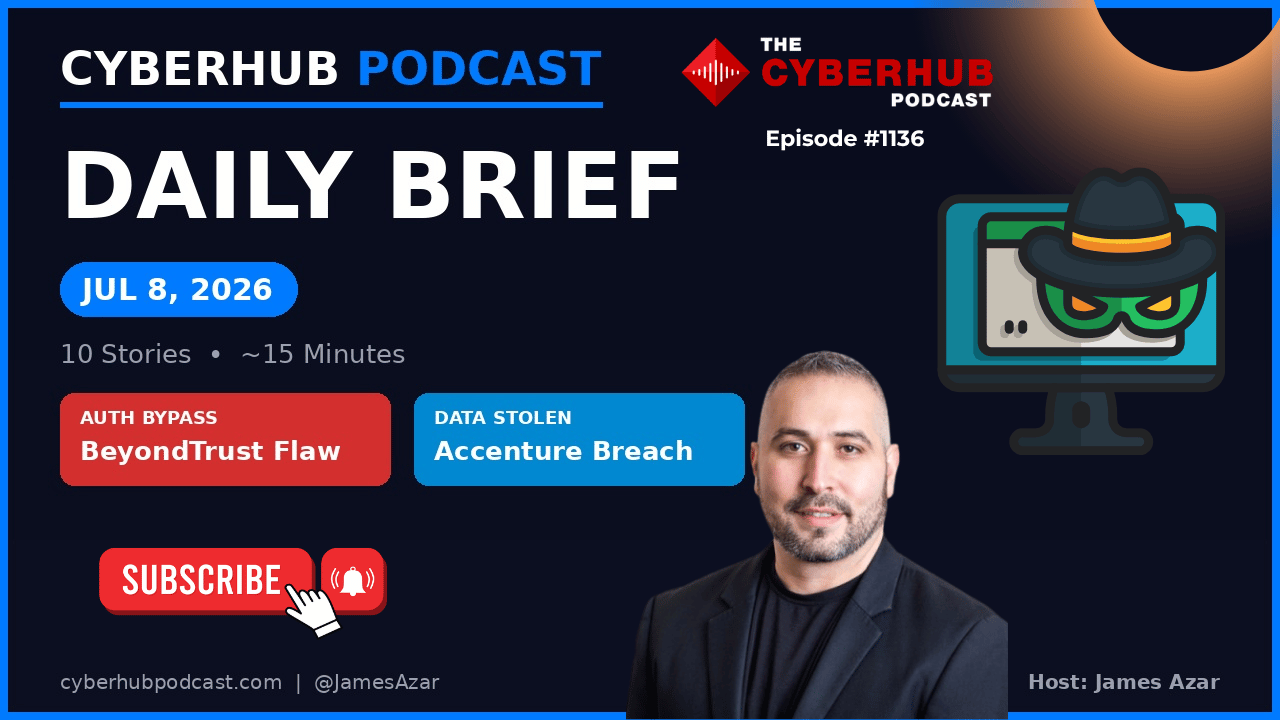
We examined critical authentication bypass vulnerabilities in BeyondTrust’s remote access platform the same product family previously exploited during the U.S. Treasury breach. Accenture confirmed a security incident after an attacker claimed to possess 35GB of source code and cloud credentials. Cisco Talos uncovered China’s expanding LongLeash operational relay box infrastructure targeting internet-facing routers. Trend Micro revealed nearly 5,000 security issues across publicly available MCP servers, raising new concerns around Agentic AI adoption. We also looked at how CISA is using Anthropic’s Mythos model to scan federal code for vulnerabilities and discussed several significant developments affecting critical infrastructure, hacktivism, and AI governance.
Today’s lesson is simple.
Trust is no longer a security control. Verification is.
Coffee cup cheers, gang.
Let’s get into it.
🧭 Executive Summary
Today’s cybersecurity landscape revolved around the growing challenge of trusted systems becoming attack vectors.
Remote access platforms, developer ecosystems, AI agents, networking equipment, cloud credentials, and managed service providers all represent privileged relationships inside modern enterprises. Attackers increasingly recognize that compromising one trusted platform often provides access to hundreds of downstream systems without needing sophisticated exploits.
The technology continues evolving rapidly.
The organizations that continuously validate trust relationships—not simply establish them will be the ones best positioned to defend themselves.
📰 Top Stories & Deep Dive Analysis
“Trust but verify or better yet, verify before you trust.” James Azar
🚨 BeyondTrust Releases Critical Authentication Bypass Patches
BeyondTrust issued emergency security updates addressing two critical vulnerabilities affecting its Remote Support (RS) and Privileged Remote Access (PRA) platforms, software widely deployed across enterprise environments to manage privileged administrative access. The primary vulnerability, CVE-2026-40138, allows unauthenticated attackers to bypass authentication controls and potentially gain elevated access to targeted appliances. A second command injection vulnerability further increases the potential impact.
Cloud-hosted customers received automatic updates earlier this year, but organizations operating self-hosted deployments must manually upgrade to RS 25.3.3 or PRA 25.3.3 or later.
“Trust is doing a lot of unearned work in cybersecurity today.” James Azar
The significance extends far beyond routine patch management.
BeyondTrust products have already been exploited by nation-state actors, most notably during the compromise of the U.S. Treasury Department. When privileged remote access platforms repeatedly appear in major intrusion campaigns, they deserve the highest level of operational scrutiny.
Organizations relying on BeyondTrust should immediately verify patch levels, review privileged account activity, assess appliance exposure, and incorporate these systems into their highest-priority vulnerability management processes.
🔐 Accenture Confirms Security Breach Following Source Code Leak Claims
Accenture acknowledged a security incident after a threat actor known as 888 advertised approximately 35GB of allegedly stolen data for sale on a cybercrime forum. According to the attacker, the dataset includes source code, SSH keys, RSA private keys, Azure storage credentials, Azure DevOps access tokens, and additional configuration files.
Accenture stated that the incident has been contained and that no disruption to client operations has occurred. However, the greatest concern isn’t necessarily the leaked source code.
It’s the potential exposure of privileged credentials.
If Azure access tokens, SSH keys, or storage credentials remain active, attackers could leverage them to access downstream environments or trusted development infrastructure.
For organizations working with Accenture, this should trigger immediate conversations with vendor management teams regarding credential rotation, shared access reviews, and confirmation that no customer-specific secrets were impacted.
🇨🇳 Cisco Talos Exposes China’s Expanding LongLeash Proxy Network
Cisco Talos published new research detailing how Chinese state-aligned threat actors continue expanding Operation Relay Box (ORB) infrastructure through compromised routers running vulnerable firmware. The campaign targets internet-facing Ruckus and ASUS networking devices, transforming them into covert proxy infrastructure supporting multiple Chinese espionage operations.
The newly identified LongLeash malware significantly expands previous capabilities by supporting reverse shells, proxy tunneling across multiple protocols including HTTP, DNS, ICMP, SOCKS, TCP, UDP, and SMTP, while also introducing self-removal features designed to frustrate forensic analysis.
Supporting malware families including DogLeash, JarLeash, and LeashTest—provide authentication, administration, and reconnaissance capabilities across compromised networking equipment.
Perhaps the most important observation is that none of the exploited vulnerabilities are new.
Attackers continue succeeding because routers often remain unpatched long after updates become available.
Organizations should immediately update firmware on exposed networking equipment, remove end-of-life hardware from production environments, and monitor unusual outbound proxy traffic originating from network infrastructure.
🤖 Trend Micro Finds Nearly 5,000 Vulnerabilities Across Public MCP Servers
One of today’s most significant stories comes from Trend Micro’s audit of 9,695 public Model Context Protocol (MCP) servers, where researchers identified 4,982 distinct security issues across 2,259 vulnerable servers.
The findings are striking.
Researchers identified more than 2,000 servers with no authentication, hundreds vulnerable to arbitrary file access, command injection, SQL injection, server-side request forgery, prompt injection, cross-site scripting, denial-of-service attacks, and direct code execution.
Even more concerning, server popularity proved almost meaningless as a security indicator.
Highly rated, verified, and widely adopted MCP servers contained nearly the same number of vulnerabilities as unverified projects.
One cryptocurrency-focused developer maintained more than forty MCP servers containing over one hundred vulnerabilities capable of enabling unauthorized blockchain transactions. Another office automation project allowed arbitrary Python execution through unsafe code evaluation.
The takeaway is straightforward.
Treat every third-party MCP server exactly like any other externally developed software component.
Popularity is not security. Verification badges are not security. Only code review, authentication, least privilege, and continuous monitoring provide meaningful protection.
⚡ Need to Know
🤖 Google Dialogflow CX Vulnerability Could Expose AI Chatbots
Researchers at Varonis disclosed a vulnerability known as Rogue Agents, allowing users with limited editing permissions to inject persistent malicious logic into Google Dialogflow CX chatbot playbooks. Google has fully patched the issue, but organizations should review historical playbook changes for unauthorized modifications.
🛡️ CISA Deploys Anthropic’s Mythos for Federal Code Review
CISA’s Attack Surface Evaluation Team is using Anthropic’s Mythos AI model to automatically scan federal software repositories for security vulnerabilities. Early testing reportedly uncovered numerous previously unidentified flaws, demonstrating the growing role AI will play in vulnerability discovery.
🇺🇸 Hacktivists Deface U.S. Army Websites
Hacktivists briefly defaced two lower-level U.S. Army WordPress sites by exploiting outdated plugins. Although no sensitive information was stolen, the incident reinforces the importance of patching even low-profile public-facing websites that carry organizational branding.
🚔 Spanish Police Arrest Suspected Pro-Russian Hacktivist
Spanish authorities arrested an individual believed to be affiliated with Cyber Army of Russia Reborn and Z-Pentest, groups linked to attacks targeting U.S. water utilities, food processing facilities, and European critical infrastructure as part of the FBI’s Operation Red Circus.
📱 Texas App Store Age Verification Law Takes Effect
The U.S. Supreme Court declined to block Texas’ App Store Accountability Act while litigation continues, allowing new age verification and parental consent requirements for app downloads to move forward. Organizations distributing consumer mobile applications should begin preparing compliance efforts.
🇬🇧 United Kingdom Launches Cyber Resilience Pledge
The UK government introduced a voluntary Cyber Resilience Pledge with approximately seventy participating organizations, signaling what many analysts expect will eventually transition from voluntary guidance into future regulatory requirements.
🎯 Key Takeaway
Today’s episode wasn’t about BeyondTrust. It wasn’t about Accenture. And it wasn’t really about AI.
It was about trust.
The trusted remote access platform. The trusted cloud credential. The trusted router. The trusted AI server.
Every major incident today exploited something organizations had already decided to trust.
Modern cybersecurity isn’t about trusting less.
It’s about verifying continuously.
🧠 James Azar’s CISOs Take
What stood out to me today is how frequently privileged trust relationships continue becoming the initial point of compromise. BeyondTrust sits at the heart of privileged administration. Accenture operates inside countless customer environments. Routers quietly move traffic every day without drawing attention. MCP servers are quickly becoming the connective tissue between AI agents and enterprise systems. None of these platforms were designed to become attack vectors, yet all of them demonstrate how quickly trusted infrastructure can become an organization’s weakest link when governance fails to keep pace with operational reality.
The second takeaway is that AI adoption doesn’t eliminate traditional cybersecurity responsibilities, it amplifies them. The Trend Micro research should serve as a wake-up call for every organization building Agentic AI workflows. Simply because a project is open source, widely adopted, or carries a verification badge doesn’t mean it’s secure. We spent decades learning not to blindly trust software from the internet. We cannot forget those lessons simply because the software now happens to be called an AI tool. Verification, least privilege, authentication, and code review remain just as important today as they’ve always been.
🛠️ Action Items
Patch BeyondTrust Remote Support and Privileged Remote Access immediately.
Audit privileged access appliances for exposure and authentication activity.
Contact Accenture account teams regarding credential exposure and token rotation.
Update firmware on Ruckus and ASUS networking equipment.
Remove unsupported networking devices from internet-facing environments.
Inventory every MCP server currently deployed inside your organization.
Treat third-party MCP servers as untrusted software until reviewed.
Review Google Dialogflow CX playbook modifications.
Patch all public-facing WordPress instances and plugins.
Evaluate vendor risk management processes for privileged technology providers.
Continuously validate trust relationships rather than assuming previous approvals remain safe.
🔥 Stay Cyber Safe.


