



☕ Good Morning Security Gang,
Today’s episode reinforced a trend we’ve been watching accelerate throughout the year:
The window between a security patch and active exploitation has nearly disappeared.
Nearly every major story today illustrated the same pattern. Oracle E-Business Suite vulnerabilities patched only weeks ago are already under active attack. A SimpleHelp vulnerability is being weaponized to deploy an entirely new information stealer targeting AI coding assistants. A proof-of-concept exploit for a critical LibSSH2 vulnerability is now public, increasing pressure on organizations to identify software they may not even realize they are running. Meanwhile, the U.S. government announced a $10 million reward for information leading to Russian hackers responsible for compromising Signal and WhatsApp accounts belonging to government officials, journalists, and NGOs.
The lesson is becoming impossible to ignore. Organizations can no longer afford to treat vendor patch cycles as routine maintenance. They must become operational security events.
Coffee cup cheers, gang. Let’s get into it.
🧭 Executive Summary
Today’s cybersecurity landscape highlighted one recurring operational challenge: speed.
Threat actors continue reducing the time between vulnerability disclosure and exploitation, while defenders often require weeks or months to validate, schedule, and deploy updates. At the same time, attackers are expanding into entirely new attack surfaces, including AI development tools, cloud-native workflows, and software supply chains that few organizations have fully inventoried.
Whether the target is an ERP platform, a developer workstation, an SSH client library, or a messaging application used by executives, the objective remains the same gain trusted access before defenders can react.
📰 Top Stories & Deep Dive Analysis
“We don’t get to point the finger when it happens. As practitioners, we own it.” James Azar
🚨 Oracle E-Business Suite Comes Under Active Exploitation
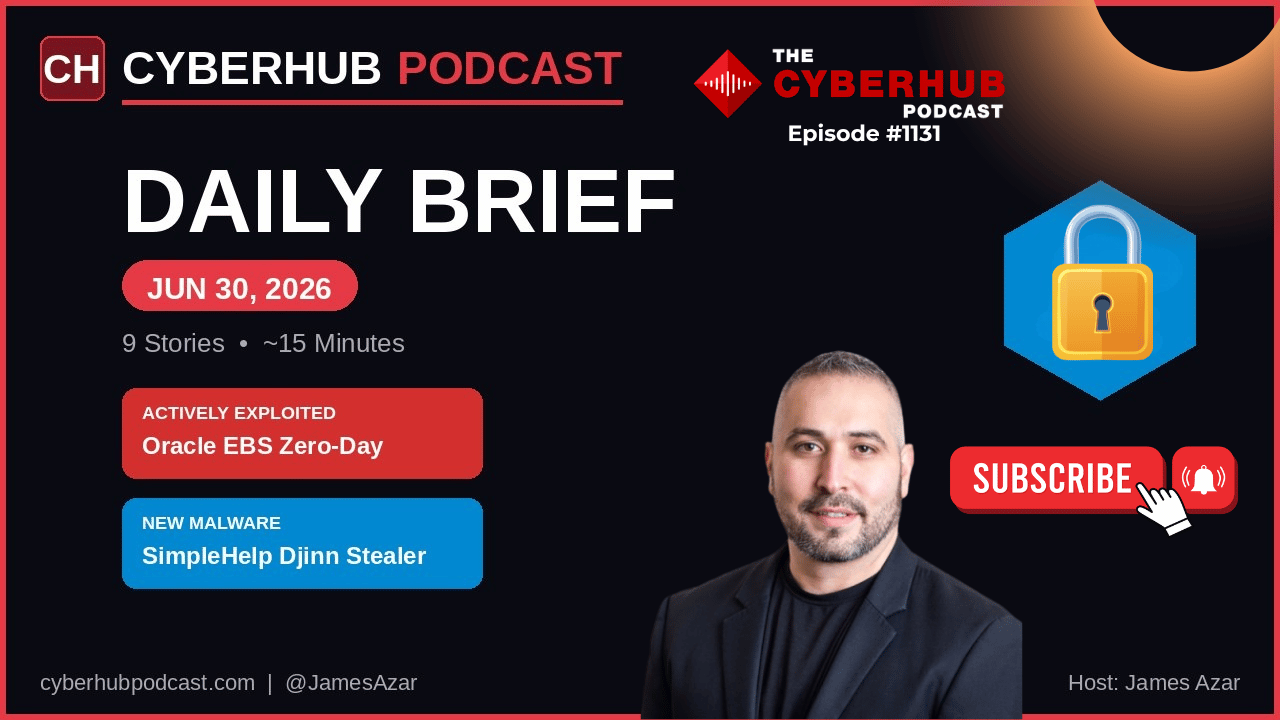
The most urgent story today centers on CVE-2026-46817, a critical vulnerability affecting Oracle E-Business Suite’s File Transmission component. Although Oracle released patches during its May 2026 Critical Patch Update, threat intelligence researchers observed active exploitation against internet-facing systems over the weekend.
“Patch dates are not safety dates.” James Azar
The vulnerability is particularly dangerous because it requires no authentication, can be reached directly over HTTP, and allows attackers to fully compromise vulnerable systems with relatively low complexity.
Researchers currently track more than 450 internet-exposed Oracle E-Business Suite instances, many supporting financial operations, procurement, payroll, and enterprise resource planning across large organizations.
This follows a familiar pattern. Oracle’s enterprise platforms—including PeopleSoft, WebLogic, and E-Business Suite—continue appearing in active exploitation campaigns shortly after patches become available.
The broader concern isn’t simply Oracle. It’s patch latency.
By the time organizations complete traditional maintenance windows, attackers have often already identified and weaponized the vulnerability.
Security leaders running Oracle environments should verify May CPU deployment immediately, restrict public access where possible, review file transmission logs dating back to the weekend, and begin treating Oracle CPU releases as emergency patch events rather than quarterly maintenance activities.
🤖 SimpleHelp Vulnerability Delivers a New Generation of AI Credential Stealers
Researchers uncovered active exploitation of CVE-2026-48558, a critical authentication bypass affecting the widely deployed SimpleHelp remote monitoring and management platform used by managed service providers and enterprise IT organizations.
Attackers are using the vulnerability to deploy a newly discovered malware family known as Djinn Stealer, specifically engineered for the emerging AI development ecosystem.
Unlike traditional information stealers that primarily harvest browser passwords and cryptocurrency wallets, Djinn Stealer actively searches for locally stored configuration files belonging to AI coding assistants including Claude, Gemini, Codex, OpenCode, and other Model Context Protocol (MCP) environments.
Those files often contain privileged cloud credentials, API tokens, repository access, internal service accounts, and automation secrets inherited from the AI assistants themselves.
The malware also targets SSH keys, AWS credentials, package manager authentication tokens, and runtime environment secrets.
This represents an important evolution in attacker priorities.
Developer workstations increasingly serve as gateways into cloud infrastructure, AI pipelines, and software supply chains.
Organizations should patch SimpleHelp immediately, rotate credentials associated with AI development environments, invalidate technician sessions, and begin classifying MCP configuration files as privileged credentials rather than ordinary developer artifacts.
🔓 Public LibSSH2 Exploit Raises Supply Chain Concerns
Security researchers released a public proof-of-concept exploit targeting CVE-2026-55200, a critical vulnerability within LibSSH2 carrying a CVSS score of 9.2.
Unlike traditional server vulnerabilities, LibSSH2 is a client-side library embedded throughout countless enterprise applications including curl, wget, PHP deployments, backup platforms, embedded appliances, and firmware management systems.
The flaw results from an integer overflow that eventually produces a classic buffer overflow during SSH packet processing.
Although researchers have not yet observed active exploitation, the publication of proof-of-concept code significantly increases future risk.
Perhaps the greatest challenge is visibility.
Many organizations have no inventory identifying where LibSSH2 exists inside commercial software, appliances, or internally developed applications.
This incident highlights why software composition analysis and dependency inventories continue becoming foundational security capabilities rather than optional development practices.
🚗 Nissan Joins Growing List of Oracle PeopleSoft Victims
Nissan confirmed that current and former employees across North America and Latin America were affected by the broader ShinyHunters PeopleSoft campaign exploiting Oracle vulnerabilities disclosed earlier this month.
Compromised information reportedly includes Social Security numbers, banking information, tax records, and other employee-related data.
Mandiant previously confirmed attackers successfully exploited the PeopleSoft vulnerability as a zero-day for nearly two weeks before Oracle publicly released emergency mitigations.
More than one hundred organizations have already received notifications regarding potential exposure.
For organizations still operating Oracle PeopleSoft, this story reinforces the importance of validating emergency mitigations rather than assuming patch deployment alone fully resolves compromise.
⚡ Need to Know
🇨🇳 Mustang Panda Uses Zoho WorkDrive for Command-and-Control
Researchers identified Chinese threat actor Mustang Panda abusing Zoho WorkDrive as covert command-and-control infrastructure during espionage campaigns targeting Indian government and hydropower organizations. Because traffic blends into legitimate cloud usage, defenders should monitor endpoint behavior rather than relying solely on network indicators.
🐧 DirtyClone Linux Privilege Escalation Gets Public PoC
Researchers released working proof-of-concept code for DirtyClone (CVE-2026-43503), another Linux kernel privilege escalation vulnerability related to the Dirty Pipe and Dirty Page families. Cloud providers and Kubernetes environments should prioritize kernel updates immediately.
⚖️ Supreme Court Limits Geofence Warrants
In a 6-3 decision, the U.S. Supreme Court ruled that law enforcement generally must obtain a warrant supported by probable cause before accessing historical geofence location information from technology providers. Organizations handling legal requests for location data should expect updated compliance procedures.
💰 U.S. Offers $10 Million Reward for Russian Signal Hackers
The State Department’s Rewards for Justice program announced a $10 million reward for information identifying members of Russian groups UNC5792 and UNC4221, which targeted Signal and WhatsApp accounts belonging to government officials, journalists, NATO personnel, and Ukraine-related organizations. Attackers increasingly seek Signal backup recovery keys rather than one-time verification codes.
🌐 Scam Operations Abuse UniApp Framework
Researchers found cybercriminals using the legitimate UniApp cross-platform development framework to create more than 200,000 fraudulent websites supporting cryptocurrency scams, investment fraud, and pig-butchering operations. The framework itself remains legitimate, but its fingerprints now provide useful threat hunting indicators.
🎯 Key Takeaway
Today’s show wasn’t really about Oracle.
It wasn’t about AI.
And it wasn’t about SSH libraries.
It was about time.
The time between patch release and exploitation.
The time between compromise and detection.
The time organizations continue spending debating maintenance windows while attackers quietly move first.
Cybersecurity has become a race measured in days instead of months.
Organizations that continue operating on yesterday’s timelines will increasingly find themselves responding to incidents rather than preventing them.
🧠 James Azar’s CISOs Take
What stood out to me today is how consistently attackers are exploiting the operational gap between patch availability and patch deployment. Oracle released fixes weeks ago. SimpleHelp had already disclosed the vulnerability. LibSSH2 maintainers had fixes available before proof-of-concept code appeared. Yet organizations continue relying on maintenance schedules that simply don’t match the pace of modern adversaries. Security leaders need to start treating critical vendor updates as operational risk decisions rather than routine infrastructure changes.
The second takeaway is that developer ecosystems have become one of the most valuable targets in enterprise environments. AI coding assistants, MCP configuration files, cloud credentials, and software dependencies are rapidly becoming part of the modern identity plane. Attackers understand that compromising one developer workstation can provide access to cloud infrastructure, source code, AI agents, and production environments simultaneously. As defenders, we need to extend our identity and privilege management strategies well beyond users and servers to include every automated system acting on our behalf.
🛠️ Action Items
Verify Oracle E-Business Suite May 2026 CPU deployment immediately
Remove internet exposure from Oracle EBS where operationally possible
Patch all SimpleHelp deployments without delay
Rotate AI coding assistant credentials and MCP configuration secrets
Upgrade applications using LibSSH2 as patches become available
Inventory software dependencies relying on LibSSH2
Confirm Oracle PeopleSoft emergency mitigations remain in place
Review developer workstation security controls and cloud credential storage
Educate executives on Signal backup recovery key phishing
Update legal response procedures for geofence warrant requests
Review third-party software inventory for emerging supply chain dependencies
🔥 Stay Cyber Safe.


