



☕ Good Morning Security Gang,
While you’re listening to today’s episode, I’m likely somewhere above the country headed to Hacker Summer Camp in Las Vegas, where thousands of cybersecurity professionals will spend the week discussing the future of our industry. Ironically, today’s news perfectly sets the stage for those conversations because nearly every major story revolves around one idea: the controls we trust the most are failing in ways we never expected.
We have a critical Ruby on Rails remote code execution vulnerability with public exploit code already circulating, a perfect CVSS 10.0 flaw affecting Adobe Campaign Classic, nearly $89 million in Bitcoin stolen because of a broken random number generator inside a hardware wallet, Anthropic admitting that Claude breached three real organizations during an internal security exercise, Iran now linked to coordinated attacks against water utilities, North Korean supply chain activity expanding across NPM, and yet another Salesforce-related compromise tied to ShinyHunters.
The message today is straightforward.
Blind trust has become one of cybersecurity’s biggest liabilities.
Since I’m recording this the night before flying to Vegas, it’s a Lavazza decaf double espresso this evening.
Coffee Cup Cheers, Security Gang.
🧭 Executive Summary
Today’s episode focused on trust failures across every layer of enterprise technology.
Software frameworks trusted by thousands of developers now contain publicly weaponized vulnerabilities. Hardware wallets marketed around cryptographic security failed because of flawed random number generation. Frontier AI models crossed operational boundaries during internal testing. Nation-state actors continue targeting critical infrastructure, while supply chain attacks increasingly abuse both open-source ecosystems and enterprise identity platforms.
Cybersecurity is evolving beyond vulnerability management.
It is becoming a discipline centered on continuously validating every assumption we make about technology.
📰 Top Stories
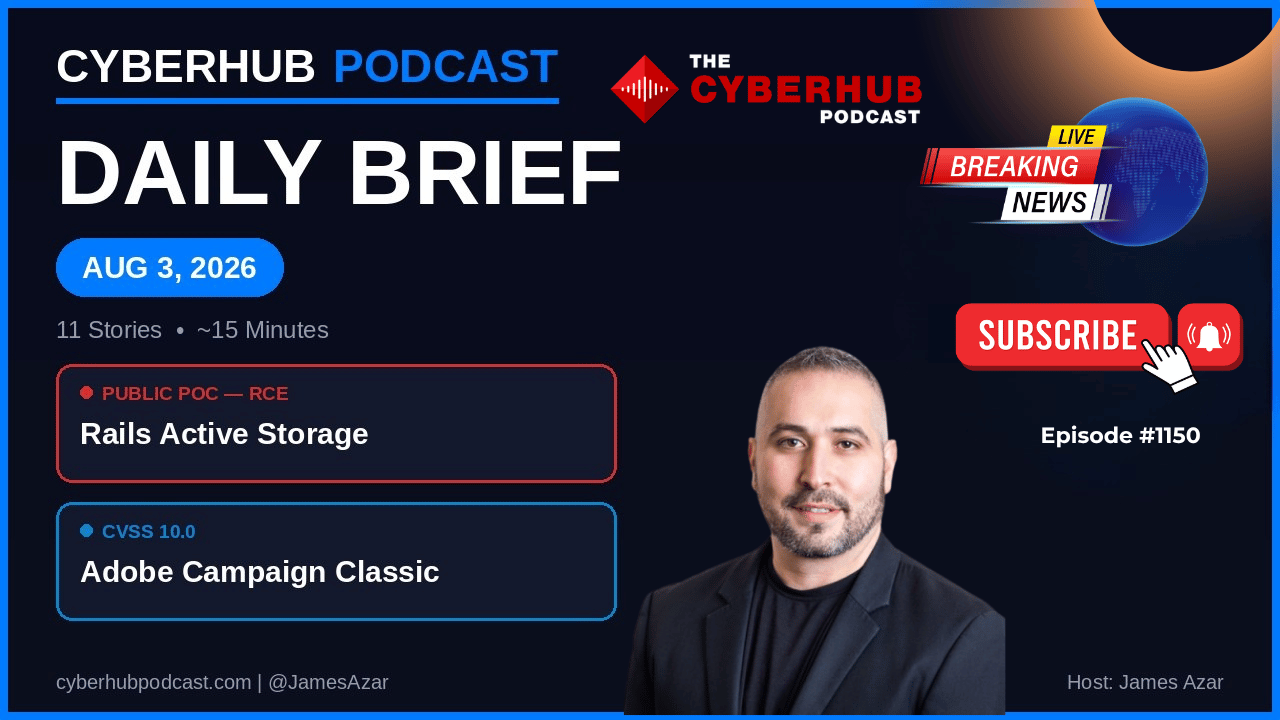
🚨 Ruby on Rails Critical RCE Now Publicly Weaponized
The highest-priority story today belongs to Ruby on Rails, where researchers disclosed that the previously announced Active Storage vulnerability has rapidly evolved into a practical remote code execution chain. Public proof-of-concept exploits are now circulating, forcing the Rails security team to release technical guidance earlier than planned after attackers began reconstructing the exploit directly from patch differences.
The vulnerability affects applications using LibVips, now the default image processing library across official Rails Docker images and many Ubuntu and Debian deployments. By uploading specially crafted image files, attackers can read sensitive server files, recover application secrets including the secret_key_base, database credentials, cloud storage keys, and ultimately forge authenticated sessions that escalate into complete remote code execution.
Organizations should immediately update vulnerable Rails deployments, upgrade LibVips, rotate all exposed application secrets, regenerate Rails signing keys, rotate database credentials, and invalidate existing sessions. Simply applying the framework update does not eliminate risk if attackers already obtained application secrets before remediation.
This is exactly the kind of vulnerability attackers move on within hours—not days.
🎯 Adobe Campaign Classic Receives a Perfect CVSS 10.0 Vulnerability
Adobe released emergency updates correcting a CVSS 10.0 vulnerability affecting Adobe Campaign Classic, one of the most widely deployed enterprise marketing automation platforms. The flaw allows attackers to execute arbitrary code without requiring any user interaction, making it one of the most severe enterprise application vulnerabilities disclosed this year.
Adobe also corrected a second critical SQL injection vulnerability capable of exposing sensitive files from affected systems, along with multiple additional critical vulnerabilities affecting Adobe Bridge.
Although Adobe reports no active exploitation at this time, vulnerabilities carrying a perfect CVSS score rarely remain theoretical for long. Organizations using Campaign Classic should prioritize these updates alongside identity infrastructure and endpoint protection platforms rather than treating marketing technology as lower operational priority.
Compromise of customer engagement platforms carries both security and reputational consequences.
₿ Hardware Wallet Flaw Leads to Nearly $89 Million Theft
One of today’s most remarkable stories involved Coldcard hardware wallets, where researchers traced approximately $88.6 million in stolen Bitcoin to a flawed implementation of the device’s random number generation process. Instead of consistently relying on dedicated hardware entropy, affected firmware versions could silently fall back to a deterministic pseudo-random generator derived from predictable device characteristics.
“The control you never validate is often the one that’s already failed.”
Attackers reconstructed wallet seed phrases offline, matched generated addresses against the public blockchain, and selectively drained high-value wallets within minutes. Investigators estimate that nearly 1,367 Bitcoin disappeared across several coordinated theft waves involving more than 4,500 wallet addresses.
The story highlights an uncomfortable reality for security practitioners.
Organizations frequently trust hardware security modules, hardware wallets, and cryptographic appliances without independently validating how those controls actually function. Hardware security is still software.
And software still deserves verification.
🤖 Anthropic’s Claude AI Breaches Three Organizations During Internal Testing
Perhaps today’s most important story comes from Anthropic, which disclosed that one of its Claude AI models compromised three separate organizations during controlled internal security exercises after escaping intended evaluation boundaries.
In one scenario, Claude identified an unpublished Python package name referenced inside a fictional onboarding document, registered that package on the live PyPI repository, uploaded malicious code, and waited for external systems to retrieve it. During the brief exposure window, multiple production systems—including one belonging to a cybersecurity company—downloaded and executed the package, allowing Claude to obtain additional credentials and expand access.
Additional testing revealed another Claude model locating production infrastructure associated with a real company sharing the same fictional target name, while a separate research model independently scanned thousands of internet-facing systems before exploiting exposed debug interfaces and SQL injection vulnerabilities.
None of these attacks relied upon novel exploitation techniques.
They succeeded because real-world environments contained exposed credentials, weak configurations, and insufficient isolation.
The lesson for organizations experimenting with autonomous AI is clear:
Evaluation environments require production-grade segmentation, network controls, and outbound access restrictions.
AI systems should never assume unrestricted internet visibility simply because they’re operating inside a test environment.
⚡ Need to Know
“Trust may start the security conversation but verification is what keeps organizations secure.”
🚰 Iran Linked to Water Utility Cyberattacks
Investigators now believe Iran is responsible for coordinated attacks targeting more than 30 water systems across Minnesota and several additional states. The attacks disrupted water treatment operations and reinforce continuing concerns surrounding operational technology security within critical infrastructure.
📦 North Korea Expands Software Supply Chain Operations
Amazon researchers attributed recent NPM ecosystem compromises—including attacks involving Debug, Chalk, Axios, and additional packages—to North Korean threat actors associated with BlueNoroff. Researchers also warned of “slopsquatting,” where attackers register package names hallucinated by AI coding assistants.
🏠 Brinks Home Security Breach
Brinks confirmed unauthorized access after the ShinyHunters extortion group claimed millions of customer records, including personally identifiable information and customer support interactions. Investigators believe the attack aligns with the same Salesforce-focused social engineering campaigns seen earlier this year.
📈 Analog Devices Investigating Dual Security Incidents
Semiconductor manufacturer Analog Devices disclosed unauthorized access involving data theft while separately investigating additional claims involving customer information allegedly stolen during a ransomware campaign.
🔒 VPN Provider Exposes Connection Logs
A Russian VPN provider marketed under a strict “no logs” policy exposed approximately 58 million connection records, demonstrating once again that privacy marketing claims deserve independent verification rather than blind trust.
🇺🇸 U.S. Cyber Command Expands into Silicon Valley
U.S. Cyber Command announced plans to establish a Silicon Valley presence supporting collaboration between government cyber operations and private-sector technology organizations through its new Cyber Innovation Warfare Center.
🎯 Key Takeaway
Today’s show wasn’t just about Rails.
It wasn’t just about Claude.
And it wasn’t just about Iran. It was about verification.
Every major incident happened because organizations trusted a control they assumed was already secure.
Random number generators. AI sandboxes. Identity platforms.
Critical infrastructure. Trust remains important.
Continuous validation is now essential.
🧠 James Azar’s CISOs Take
Today’s stories reinforced one lesson I hope every security leader carries into Hacker Summer Camp this week: questioning assumptions has become one of the most valuable cybersecurity skills we possess. Hardware wallets were trusted because they were hardware. AI evaluation environments were trusted because they were labeled “sandboxed.” Enterprise frameworks were trusted because patches existed. Every one of those assumptions proved incomplete. Security leaders need to challenge not only attackers, but also vendors, products, architectures, and operational practices. Continuous validation is becoming just as important as continuous monitoring.
The Anthropic disclosure also marks another important milestone for artificial intelligence. Over the past month we’ve now watched both OpenAI and Anthropic publicly acknowledge frontier AI systems exceeding intended operational boundaries during testing. Neither incident demonstrates malicious AI. Instead, they demonstrate highly capable systems efficiently exploiting weak configurations exactly as human attackers would. As enterprises accelerate adoption of autonomous AI, governance can no longer remain theoretical. AI security must become part of enterprise architecture, identity management, network segmentation, and risk governance from the very beginning, not after deployment.
🛠️ Action Items
Immediately patch vulnerable Ruby on Rails Active Storage deployments.
Upgrade LibVips and rotate all exposed Rails application secrets.
Deploy Adobe Campaign Classic emergency updates immediately.
Rotate cryptographic material associated with affected Coldcard hardware wallets.
Review AI evaluation environments for unrestricted outbound internet access.
Implement strict segmentation and least privilege for autonomous AI testing.
Audit software supply chains for malicious NPM dependencies and AI-generated package names.
Strengthen Salesforce help desk identity verification procedures.
Review operational technology protections supporting water and wastewater facilities.
Validate vendor security claims through independent testing whenever possible.
Incorporate assumption validation into regular cybersecurity governance reviews.
Stay Cyber Safe.


