



☕ Good Morning Security Gang,
Today’s show delivered a clear message that every security leader needs to hear: patches alone don’t protect organizations visibility between disclosure and deployment does.
Today’s eleven stories all pointed toward the same operational challenge. SonicWall attackers spent weeks exploiting zero-days before patches existed. ServiceNow customers are now dealing with active exploitation against a vulnerability that was only recently patched. OpenSSL quietly fixed a denial-of-service bug capable of crippling servers with just eleven bytes of malicious traffic, while Estée Lauder disclosed that sensitive employee and customer information was stolen through an Oracle vulnerability that had already been patched months earlier. Add healthcare breaches, new macOS malware, attacks against decentralized finance, Russian intelligence targeting internet-connected cameras, Iranian-linked malware abusing Microsoft 365 calendars, and ransomware targeting India’s nuclear infrastructure, and today’s lesson becomes unmistakable.
The most dangerous period in cybersecurity isn’t before a patch is released it’s everything that happens afterward.
Double espresso in hand. Coffee cup cheers, gang.
🧭 Executive Summary
Today’s cybersecurity landscape focused on one operational reality:
Patch velocity has become just as important as vulnerability management itself.
Nearly every major incident discussed today involved organizations caught somewhere between disclosure, patch availability, deployment, and validation. Whether the issue involved zero-days, delayed patching, legacy systems, or insufficient post-patch hunting, attackers consistently succeeded because organizations assumed patching alone solved the problem.
It doesn’t.
Modern cyber defense now requires organizations to patch quickly, validate thoroughly, hunt aggressively, and continuously monitor long after updates have been installed.
📰 Top Stories & Deep Dive Analysis
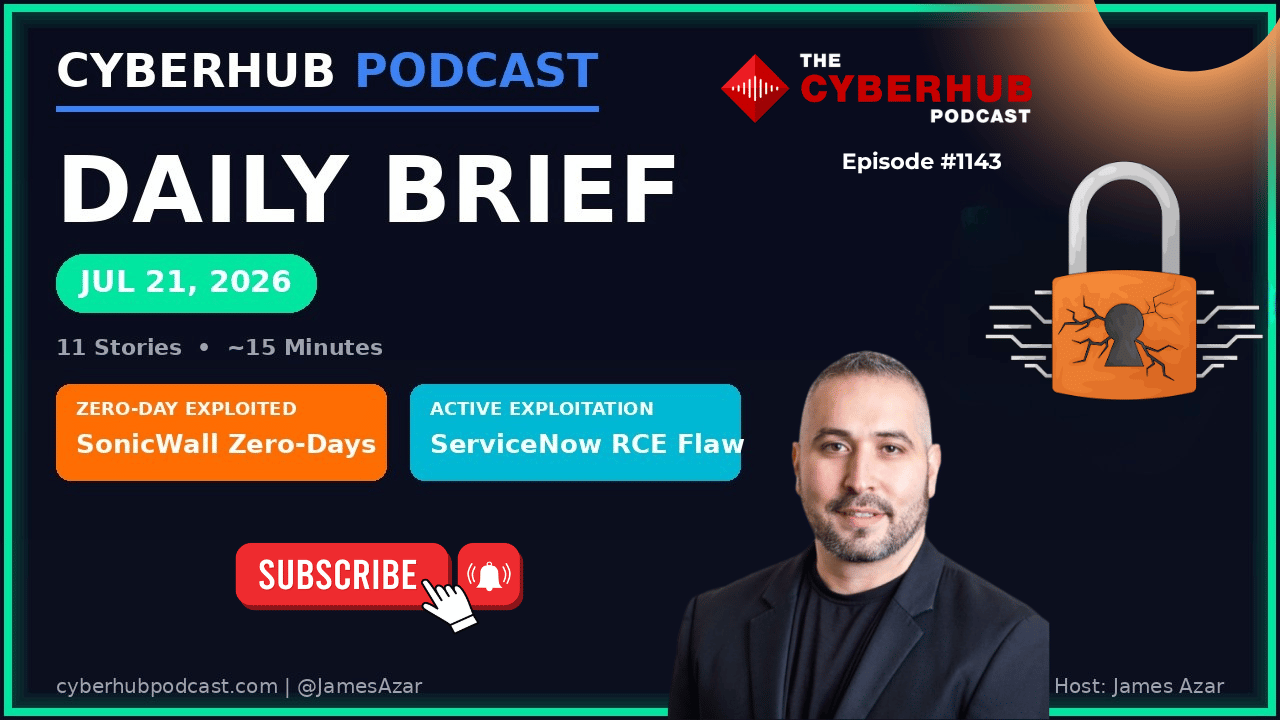
🚨 SonicWall Zero-Days Were Exploited Weeks Before Patches Existed
Today’s most significant story came from SonicWall, where new investigation details revealed that attackers had been actively exploiting two zero-day vulnerabilities affecting SMA 1000 Secure Remote Access appliances for nearly three weeks before security updates became available. CISA has now officially added both vulnerabilities to its Known Exploited Vulnerabilities (KEV) catalog.
According to incident response firm Velocirity, exploitation began as early as June 22, while SonicWall’s public advisory was not released until mid-July. During that window, attackers deployed custom malware including Knuckleball, installed a tailored Java web shell called OrangeTail, and leveraged open-source proxy tooling to establish persistent privileged access inside affected appliances.
Once attackers obtained root-level access, they were capable of harvesting cached credentials, intercepting authentication traffic, and monitoring remote access sessions flowing through compromised appliances.
Interestingly, investigators noted that while the attackers demonstrated sophisticated appliance exploitation capabilities, they were significantly less successful moving laterally inside victim environments, suggesting that strong internal segmentation limited broader damage after initial compromise.
Organizations operating SMA 1000 appliances should immediately deploy available hotfixes, hunt specifically for Knuckleball, OrangeTail, and associated indicators of compromise, validate administrative credentials, and remember an important operational principle:
“Patched doesn’t mean clean. It simply means you’ve stopped tomorrow’s compromise not necessarily yesterday’s.”
Any appliance compromised before remediation should be treated as potentially persistent until proven otherwise.
🤖 ServiceNow AI Platform Faces Active Exploitation
Researchers continue tracking active exploitation attempts targeting ServiceNow’s AI Platform, where attackers are abusing a critical sandbox escape vulnerability that enables unauthenticated remote code execution under specific conditions.
Originally reported privately earlier this year, the vulnerability affects the AI layer operating on top of the Now Platform and allows attackers to escape intended execution boundaries before executing arbitrary code.
Security researchers confirmed exploitation attempts over the weekend targeting the same pre-authentication endpoint originally documented during responsible disclosure. ServiceNow maintains that it has not observed successful compromise against its hosted SaaS infrastructure, while external researchers continue reporting attempted exploitation.
Regardless of that discrepancy, one fact remains consistent:
Every customer cloud-hosted or self-managed should already have deployed the available updates.
With more than 100 billion workflows running annually across approximately 85% of the Fortune 500, vulnerabilities inside ServiceNow deserve immediate executive attention simply because of the platform’s operational importance.
🔐 OpenSSL Quietly Fixes Denial-of-Service Vulnerability
One of today’s most overlooked stories may ultimately become one of the most important.
OpenSSL silently addressed a denial-of-service vulnerability allowing attackers to gradually exhaust server memory using payloads containing as little as 11 bytes of malicious input.
Rather than overwhelming systems through bandwidth or connection volume, the attack exploits internal memory allocation behavior by declaring significantly larger payloads than are ever transmitted.
Repeated carefully enough, systems gradually fragment available memory until applications become unstable or unresponsive.
Researchers successfully demonstrated meaningful resource exhaustion while remaining comfortably below conventional connection rate limits, meaning many existing monitoring systems would never identify the attack.
Because OpenSSL underpins Apache, NGINX, Node.js, Python, PHP, MySQL, PostgreSQL, and countless enterprise services, organizations should verify OpenSSL versions immediately even though the update received relatively little public attention.
Sometimes the quietest patches deserve the loudest response.
💄 Estée Lauder Confirms Major Oracle-Related Data Breach
Estée Lauder disclosed a significant breach stemming from Oracle E-Business Suite vulnerability CVE-2025-61882, an issue heavily exploited by the Clop ransomware operation before organizations widely deployed available patches.
Although Oracle released fixes during October 2025, investigators determined Estée Lauder’s compromise occurred approximately two months earlier, with confirmation arriving nearly ten months later.
Compromised information includes names, addresses, email addresses, dates of birth, Social Security numbers, passport information, banking details, health records, employment information, payroll data, and performance evaluations.
Estée Lauder now joins an expanding list of Oracle E-Business Suite victims including Harvard University, the University of Pennsylvania, Dartmouth College, Logitech, Cox Enterprises, The Washington Post, and Envoy Air.
The breach reinforces an uncomfortable lesson for security leaders:
Organizations often focus heavily on patch deployment while investing far less effort into retrospective threat hunting.
If attackers already entered before updates arrived, patching alone cannot remove them.
⚡ Need to Know
“Security tools are important, but discipline is still the most effective control any organization can deploy.”
🏥 Craneware Discloses Healthcare Data Breach
Healthcare billing provider Craneware confirmed attackers stole a significant volume of customer information affecting healthcare organizations across the United States. Customers should contact the company directly to determine potential organizational impact.
🍎 New macOS ClickLock Malware Targets Passwords
Researchers identified ClickLock, new macOS malware that repeatedly terminates user applications until victims manually enter administrative credentials. The malware currently remains largely undetected by commercial antivirus platforms and spreads through fake Cloudflare verification prompts.
💰 Ostium Loses $23.75 Million
Decentralized trading platform Ostium disclosed a $23.75 million theft after attackers compromised off-chain pricing infrastructure, manipulated pricing information, and drained liquidity provider funds before laundering assets through Tornado Cash.
📹 Russia Targets Internet-Connected Cameras
Dutch intelligence services warned that Russian intelligence agencies continue systematically compromising publicly exposed IP cameras across NATO member states to monitor military transportation routes and logistics activity, often relying simply on weak credentials and outdated firmware.
📅 Iranian-Linked Malware Abuses Microsoft 365 Calendars
Researchers documented malware using Microsoft Outlook calendar events scheduled decades into the future as covert command-and-control channels. Security teams should investigate suspicious calendar events dated far beyond normal business operations.
☢️ Ransomware Claims Nuclear Plant Documentation
Threat actors released approximately 19,000 files allegedly stolen from contractors supporting India’s Kudankulam Nuclear Power Plant. Officials maintain operational nuclear systems remain unaffected while investigations continue.
📊 Hacker in a Hoodie Index Launches
Security researcher Richard Bird introduced the Hacker in a Hoodie Index, a new project tracking publicly disclosed material cybersecurity incidents through SEC filings and verified public reporting to provide more consistent breach visibility.
🎯 Key Takeaway
Today’s show wasn’t about SonicWall.
It wasn’t about ServiceNow.
And it wasn’t about Oracle.
It was about what happens after disclosure.
Every major story today existed somewhere between vulnerability discovery, vendor communication, patch availability, deployment, and compromise.
That operational window has become one of cybersecurity’s greatest risks.
🧠 James Azar’s CISOs Take
What stood out to me today is how often our industry still measures success by whether a patch exists instead of whether environments are actually secure. SonicWall, Oracle, ServiceNow, and OpenSSL all remind us that publishing updates isn’t the finish line. The real work begins afterward. Security teams need enough visibility to determine whether attackers arrived before the patch, whether compromise persisted afterward, and whether operational assumptions still hold true. Patch management without threat hunting increasingly leaves organizations with a false sense of security.
The second lesson is that vendor accountability matters just as much as organizational discipline. Security vendors build products that often become our first line of defense, but when vulnerabilities repeatedly appear in critical infrastructure products, transparency becomes essential. Organizations need timely guidance, meaningful indicators of compromise, and clear communication not simply another advisory after attackers have already established persistence. Security is ultimately a shared responsibility between vendors and customers, and both sides must move faster than today’s threat landscape demands.
🛠️ Action Items
Apply SonicWall SMA 1000 hotfixes immediately.
Hunt for Knuckleball, OrangeTail, and related indicators of compromise.
Patch all ServiceNow AI Platform deployments without delay.
Verify OpenSSL versions across internet-facing infrastructure.
Hunt for Oracle E-Business Suite compromise dating back to mid-2025.
Contact Craneware if your organization uses its healthcare billing platform.
Educate macOS users to reject fake verification prompts requesting terminal commands.
Remove internet exposure from IP cameras wherever possible.
Audit Microsoft 365 calendars for suspicious far-future events.
Review third-party supplier security supporting critical infrastructure.
Treat every major patch cycle as both a remediation effort and a compromise assessment.
🔥 Stay Cyber Safe.


