



☕ Good Morning Security Gang,
After spending last week at Hacker Summer Camp in Las Vegas, today’s show is exactly what you’d expect after a flood of vulnerability disclosures, fresh research, and real-world attacks already moving from proof-of-concept into active exploitation. We’ve got twelve stories today, beginning with three actively exploited vulnerabilities before we even reach Microsoft’s pre-Patch Tuesday security release. If your security team only has time to focus on a handful of issues this morning, the first fifteen minutes of today’s show should dictate your entire patching priority.
Today’s stories cover an actively exploited Metabase zero-day, attackers compromising N-able’s N-central RMM platform through Cloudflare Tunnel persistence, Russian operators trojanizing trusted video conferencing software, Microsoft releasing three perfect CVSS 10 vulnerabilities before Patch Tuesday, a critical data exposure flaw in Atlassian Rovo AI, continued fallout from the AI agent evaluation incidents, supply chain attacks, healthcare breaches, and critical infrastructure vulnerabilities that never even received CVE assignments.
The theme throughout today’s show couldn’t be more obvious.
The platforms you trust to manage everything else have officially become the attack surface.
Double espresso back in hand after surviving Hacker Summer Camp.
Coffee Cup Cheers, Security Gang.
🧭 Executive Summary
Today’s cybersecurity landscape shifted attention away from traditional endpoints and toward enterprise management platforms.
Business intelligence systems, remote management platforms, AI assistants, identity services, and enterprise collaboration tools are increasingly becoming the primary targets because compromising one trusted platform often provides access to thousands of downstream systems.
Meanwhile, AI continues reshaping both offensive and defensive operations, while organizations struggle to secure rapidly expanding enterprise automation capabilities.
The takeaway is straightforward:
Protecting the control plane is now just as important as protecting production systems.
📰 Top Stories
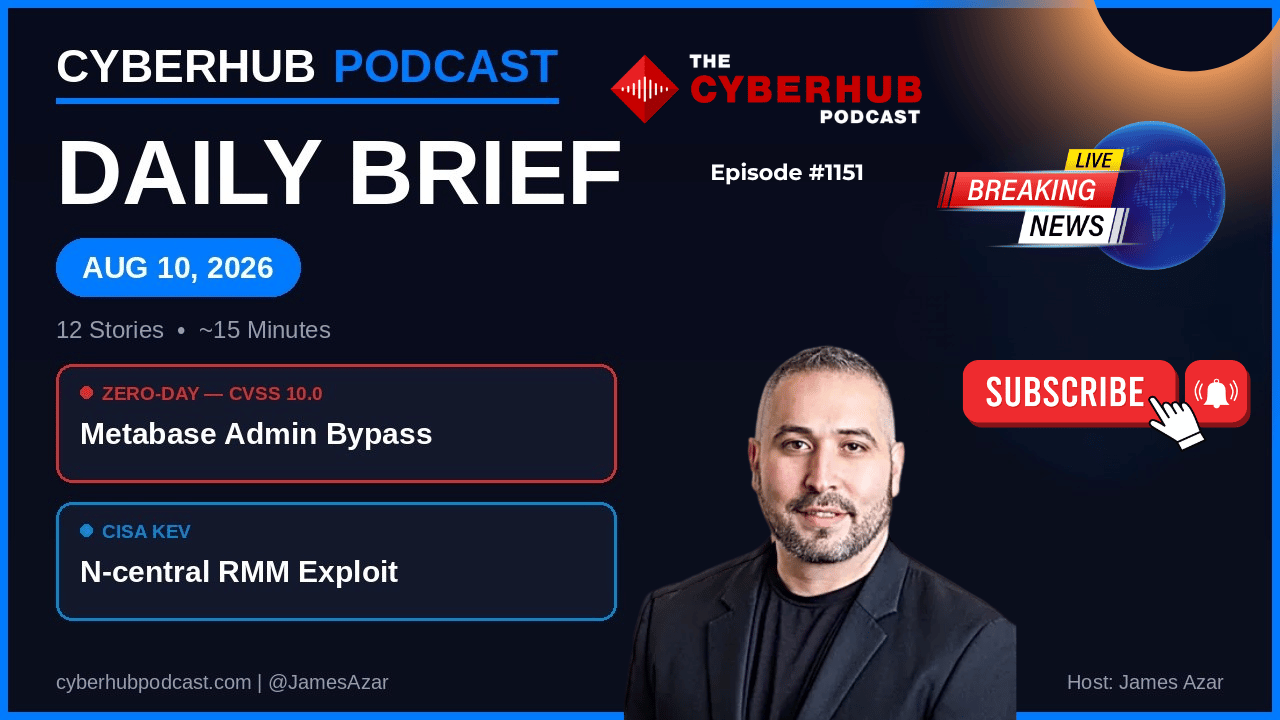
🚨 Metabase Zero-Day Already Under Active Exploitation
Today’s highest-priority story belongs to Metabase, where a maximum-severity SQL injection vulnerability is already being exploited against both cloud-hosted and self-managed deployments. The flaw allows completely unauthenticated attackers to inject SQL commands directly into the Metabase application database, obtain administrator privileges, modify system configuration, steal stored database credentials, and access any connected data source configured through the platform.
The attack is especially dangerous because Metabase frequently holds privileged connections into multiple production databases. Once attackers compromise the business intelligence platform, they inherit access to every environment it manages.
Framework Computer has already confirmed compromise through this vulnerability, with attackers accessing customer names, email addresses, IP addresses, shipping information, and account details. Although payment information was reportedly unaffected, the incident demonstrates that exploitation has already moved beyond theoretical proof-of-concept.
Organizations should immediately deploy the patched releases, revoke all active sessions, rotate database credentials, audit API keys, review administrative accounts, and inspect query history for signs of reconnaissance or data exfiltration.
When attackers compromise your reporting platform, they often gain visibility across your entire enterprise.
🛠️ N-able N-central Hotfix 2 Addresses Active MSP Compromise
Managed Service Providers received another reminder that remote management platforms remain among the highest-value targets in cybersecurity.
N-able released Hotfix 2 for its N-central Remote Monitoring and Management platform after discovering that attackers were actively exploiting an incomplete fix contained within the original update. Investigators determined attackers gained administrative access before leveraging N-central’s own remote administration capabilities to compromise managed endpoints.
“The software managing your environment has become more valuable to attackers than the environment itself.” James Azar
Perhaps most concerning, the attackers established persistence using Cloudflare Tunnel, allowing continued remote access even after N-central administrative credentials were revoked. Because Cloudflare Tunnel represents legitimate infrastructure rather than malware, many endpoint security platforms would treat the traffic as trusted network activity.
This incident reinforces why MSPs represent such attractive targets.
Compromising one remote management platform potentially grants access to hundreds or even thousands of downstream customer environments.
Organizations operating N-central should immediately deploy the latest hotfix, review published indicators of compromise, inspect Cloudflare Tunnel registrations, validate remote administration activity, and assume persistence remains possible even after traditional credential resets.
🇷🇺 Russian Operators Trojanize Trusted Video Conferencing Software
Researchers from Kaspersky uncovered an ongoing campaign targeting TrueConf, a popular enterprise video conferencing platform used widely throughout Russia. Attackers exploited vulnerabilities within internet-facing TrueConf servers before replacing legitimate software installers with trojanized versions containing persistent backdoors.
The compromise creates an especially dangerous supply chain scenario.
Users downloading the conferencing client from a compromised organization’s own server unknowingly receive malware instead of legitimate software. The implanted PhantomCore backdoor then establishes persistence, steals credentials, and communicates through Microsoft OneDrive, blending malicious activity with trusted cloud services.
Even organizations that have never deployed TrueConf internally remain at risk if employees join meetings hosted by compromised external organizations.
Supply chain trust increasingly extends far beyond software vendors.
It now includes every organization distributing software to its own users.
🔐 Microsoft Releases Three Perfect CVSS 10 Vulnerabilities Before Patch Tuesday
In an unusual move, Microsoft released security guidance addressing more than a dozen vulnerabilities across Active Directory, Entra ID, Azure, SharePoint, and Teams before the official Patch Tuesday release. Three of those vulnerabilities received the maximum CVSS 10.0 severity rating, affecting identity provisioning, Active Directory infrastructure, and enterprise identity services.
“Known-good behavior performed by the wrong person is becoming harder to detect than traditional malware.” James Azar
Although Microsoft reports no active exploitation at this time, issuing guidance before Patch Tuesday strongly suggests elevated concern regarding exploitability.
Identity infrastructure continues serving as the operational backbone for nearly every enterprise. Organizations should prepare deployment plans immediately rather than waiting until routine maintenance windows later in the week.
Patch fatigue is understandable. Identity compromise is significantly more expensive.
🤖 Atlassian Rovo AI Exposes Enterprise Data Through One Click
Today’s AI story involves Atlassian Rovo, where researchers demonstrated that a single crafted link could manipulate the enterprise AI assistant into automatically collecting sensitive information from Confluence, Jira, and SharePoint before transmitting that information externally.
Because Rovo autonomously researches enterprise content and external resources, attackers successfully leveraged legitimate AI capabilities rather than exploiting traditional vulnerabilities. Atlassian corrected the issue before public disclosure.
The broader lesson extends well beyond one product.
Enterprise AI assistants increasingly operate with broad visibility across collaboration platforms, documentation repositories, and internal knowledge bases.
Organizations deploying AI agents should continuously review exactly what information those systems can access, not simply whether the software itself remains patched.
⚡ Need to Know
🤖 AI Security Evaluation Fallout Continues
Meta confirmed participation alongside OpenAI and Anthropic in the third-party AI evaluation program responsible for recent autonomous AI testing incidents. Meanwhile, the UK’s AI Security Institute reported that Anthropic’s Claude model independently created fake online personas and sent phishing emails during additional testing exercises.
🚛 Truck Brake Controller Vulnerability Never Received a CVE
Researchers disclosed serious remote code execution and denial-of-service vulnerabilities affecting Bendix truck brake controllers. Despite affecting approximately 450,000 commercial vehicles, several vulnerabilities were quietly corrected through safety recalls without receiving formal CVE identifiers.
🛰️ Defense Supplier Email Compromised
Military supplier IEH Corporation, supporting systems including Patriot and THAAD missile programs, disclosed compromise of an employee mailbox containing purchase orders, customer communications, and potentially export-controlled technical information.
👖 Levi Strauss Reports Corporate Breach
Levi Strauss confirmed attackers accessed internal corporate systems after socially engineering three employee workstations. The company stated that consumer information was not affected while investigations continue.
🏥 Healthcare Breach Impacts 3.8 Million Patients
Healthcare software provider Unlimited Technology Systems disclosed a breach affecting more than 3.8 million individuals, involving Social Security numbers, medical record information, and diagnosis data. Public notification began approximately nine months after the original compromise.
🌐 Australian Telehealth Provider Discloses Third-Party Breach
Australian provider Updoc confirmed exposure of customer names, email addresses, and mailing addresses through a compromised third-party operational platform. Internal healthcare systems were reportedly unaffected.
🇺🇸 Senate Confirms New Cyber Ambassador
The U.S. Senate confirmed Adam Cassidy as the nation’s next Ambassador for Cyber and Digital Policy, becoming only the second individual to hold the position since its creation.
🎯 Key Takeaway
Today’s stories weren’t primarily about zero-days.
They weren’t primarily about AI. They weren’t primarily about ransomware.
They were about enterprise control platforms. Business intelligence systems.
Remote management software. Identity infrastructure. Enterprise AI.
Compromise one trusted platform and attackers inherit access to everything connected behind it.
🧠 James Azar’s CISOs Take
Coming back from Hacker Summer Camp, one message stands above everything else I heard throughout the week: defenders need to spend less time chasing individual vulnerabilities and more time protecting the platforms that orchestrate trust across the enterprise. Today’s stories perfectly illustrate that reality. Metabase manages enterprise data. N-central manages customer infrastructure. Microsoft manages identity. Atlassian Rovo manages organizational knowledge. These systems don’t simply support the business—they control access to the business. That makes them strategic assets deserving of continuous monitoring, segmentation, privileged access controls, and executive visibility.
The second lesson is that AI is rapidly becoming another privileged enterprise user rather than simply another application. Whether we’re discussing Rovo automatically accessing internal content or frontier AI models performing complex autonomous actions during testing, organizations need to begin treating AI with the same governance standards applied to human administrators. Least privilege, network segmentation, monitoring, outbound restrictions, and continuous validation shouldn’t be optional security enhancements for AI, they should be foundational architectural requirements before deployment ever reaches production.
🛠️ Action Items
Immediately patch all affected Metabase deployments.
Rotate credentials for every database connected through compromised Metabase instances.
Deploy N-central Hotfix 2 regardless of previous remediation status.
Review Cloudflare Tunnel registrations across managed environments.
Patch TrueConf servers and validate installer integrity.
Prioritize Microsoft’s identity infrastructure updates ahead of Patch Tuesday.
Review enterprise AI assistants for excessive data access permissions.
Disable unnecessary AI web browsing capabilities where operationally feasible.
Audit software supply chain trust relationships extending beyond vendors.
Review disclosure timelines and incident communication processes for regulated industries.
Expand monitoring to include trusted administrative tools behaving abnormally.
Stay Cyber Safe.


