
The End of the Illusion: China’s Cybersecurity Ban and the Strategy Behind It
Why Beijing’s Cybersecurity Ban, AI Ambitions, and Tech Decoupling Mark the End of Strategic Pretending
China’s decision to ban U.S. and Israeli cybersecurity technologies is not a regulatory adjustment or a procurement dispute. It is a strategic declaration.
By directing domestic organizations to remove Western cybersecurity platforms from critical environments, China is formalizing a break that had already occurred in practice. This move is not about hidden backdoors, compliance nuances, or vendor trust assessments. It is about control—over visibility, response, recovery, and leverage.
More importantly, it is about timing.
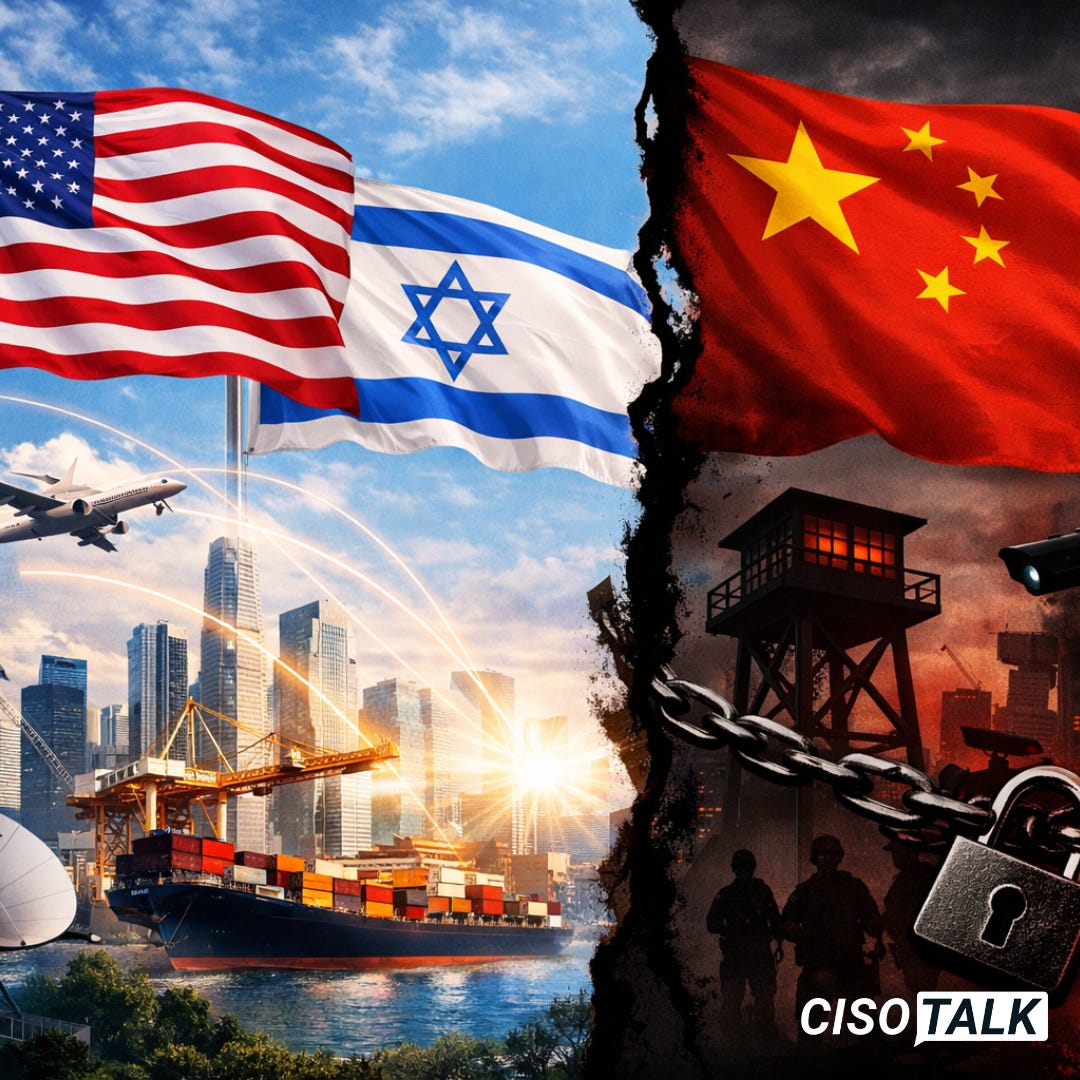
This decision marks the end of a long-running illusion: that China and the United States were converging toward partnership. They were not. They were diverging slowly, deliberately, and now openly.
Cybersecurity Was Never Neutral
Cybersecurity platforms define how environments are observed, how incidents are contained, and how systems recover under stress. For a state pursuing long-term strategic dominance, outsourcing that layer to foreign firms operating under rival legal and intelligence frameworks is untenable.
From Beijing’s perspective, Western cybersecurity vendors represent embedded leverage. Capability plus foreign jurisdiction equals risk. Once China assessed it had reached sufficient internal maturity, and sufficient AI-enabled compensation continued reliance on those tools stopped making sense.
The ban is not escalation. It is consolidation.
One Bucket: Why U.S. and Israeli Firms Are Treated the Same
China does not categorize vendors by branding or nationality alone; it categorizes them by alignment.
The United States is viewed as China’s primary strategic adversary. Israeli cybersecurity firms, while operating under a different passport, are tightly coupled to Western defense norms, export controls, and intelligence-aligned ecosystems. Many were founded by veterans of elite military and intelligence units and operate inside U.S. aligned legal and strategic frameworks.
From Beijing’s risk calculus, Israeli cyber companies are allied capability, not neutral innovation.
Same risk profile. Same outcome.
The 100-Year Strategy: Replacement, Not Partnership
Western policymakers spent decades operating under the assumption that economic integration would soften strategic intent. China never shared that assumption.
Its long-term strategy often described as national rejuvenation has always aimed at replacement, not coexistence. The objective is not to compete indefinitely under U.S. leadership, but to surpass it.
Cyber operations fit perfectly into that doctrine. They are persistent, asymmetric, deniable, and strategically corrosive. Cyber espionage was not a deviation from policy; it was a mechanism of acceleration.
The West treated cyber intrusions as violations. China treated them as investment.
A Record of Cyber Activity, Not a Theory
Over two decades, Chinese state-linked actors have conducted sustained cyber campaigns against U.S. government agencies, defense contractors, critical infrastructure, and close allies, including Israel.
These operations included:
Theft of defense, aerospace, and advanced manufacturing intellectual property
Breaches exposing sensitive data on millions of U.S. federal employees
Long-term reconnaissance and pre-positioning within energy, water, transportation, and communications systems
Espionage against Israeli defense, water, energy, and dual-use technology sectors
These were not isolated incidents or criminal outliers. They were state-aligned intelligence operations executed over time to accelerate domestic capability and map adversarial systems.
Cyber espionage was a feature of the strategy, not a bug in the relationship.
Post–October 7: Alignment Without Illusion
China’s posture following the October 7 Hamas attack on Israel removed any remaining ambiguity.
Beijing avoided condemning Hamas, shifted blame toward Israel, and aligned diplomatically with blocs openly hostile to U.S. and Israeli interests. This was not neutrality. It was positioning.
For Western security leaders, this confirmed what had long been evident: China does not see democratic allies as partners in global stability, but as systems to be outpaced, pressured, and eventually replaced.
A Telling Detail: Who Was Actually Banned
One detail in this decision deserves far more attention than it has received.
When reviewing the list of banned companies, a clear pattern emerges: the overwhelming majority are publicly traded firms. There are very few private companies and almost no early-stage startups.
That distinction matters.
Public companies are:
Highly sensitive to market reaction
Constrained by disclosure obligations
Exposed to shareholder pressure
Ideal targets for visible economic signaling
This begins to look less like pure security hygiene and more like strategic leverage ahead of diplomacy, particularly as tensions rise before a potential meeting between Donald Trump and Xi Jinping.
The message is precise: China understands exactly where pressure points live and how to pull them.
The Gloves Are Off: What Changes Now
There is a second-order effect that may prove even more consequential.
For years, many Western cybersecurity companies operated under an unspoken constraint defending against Chinese activity while maintaining exposure to the Chinese market. That tension inevitably shaped disclosure, attribution, and tone.
With that market now effectively closed, the constraint disappears.
The question becomes unavoidable: will companies that once muted research, delayed attribution, or softened language now change their posture?
There is no longer a commercial penalty for candor.
We should expect:
More detailed reporting on Chinese cyber operations
More explicit attribution
Deeper technical research released publicly
Less hedging language and fewer diplomatic euphemisms
When access disappears, honesty tends to follow.
The TikTok Parallel: Strategic Separation Becomes Visible
This breakdown is occurring alongside another highly visible confrontation: the U.S. government’s effort to force the sale or separation of TikTok from Chinese control.
This is not a separate issue. It is the same argument, expressed in consumer terms.
TikTok was long defended as a harmless entertainment platform. What was consistently minimized was jurisdictional control over data, algorithms, behavioral influence, and narrative amplification. In an era where perception can be shaped at scale, platforms that decide what hundreds of millions of people see are not neutral infrastructure. They are strategic assets.
The TikTok debate brought into public view what cybersecurity professionals have known for years: foreign-controlled technology embedded in critical systems whether digital, informational, or cognitive creates leverage.
Why This Clarity Is Healthy for the American Public
The forced reckoning around TikTok, cybersecurity, and AI may ultimately benefit the American public.
For too long, Chinese strategic intent was discussed in classified settings or academic papers. Now it is visible through behavior, policy alignment, and reciprocal actions.
When the same government that:
Conducts sustained cyber espionage
Aligns with U.S. adversaries
Avoids condemning terrorist organizations
Explicitly bans Western cybersecurity firms
also controls platforms shaping American discourse, the conversation moves from paranoia to prudence.
Clarity replaces comfort. And clarity is healthier.
The AI Equation: Why This Happened Now
The timing of the ban is not incidental.
Artificial intelligence has crossed from experimentation into power projection, and its dependencies energy, compute, and scale are now geopolitical choke points.
As U.S. policy tightened pressure across advanced computing, AI-enabling technologies, and energy dynamics, Beijing faced a narrowing window of dependency. AI does not function without electricity, silicon, and infrastructure.
No energy, no training.
No training, no advantage.
When access to those inputs becomes uncertain, reliance on foreign cybersecurity platforms becomes an unacceptable liability.
AI Changed the Risk Calculation
Five years ago, removing Western cybersecurity platforms would have carried unacceptable operational risk. Today, China believes centralized control, AI-driven automation, and state-backed domestic platforms can compensate.
AI shifts value from craftsmanship to compute. From interoperability to sovereignty. From elegance to scale.
China is betting that:
Model scale can offset vendor sophistication
Centralized AI can replace decentralized excellence
Control matters more than feature depth
Once that confidence was reached, earned, assumed, or overstated—the ban moved from “eventually” to “now.”
Final Thought
This decision is not about firewalls, endpoint tools, or vendor politics.
It is about leverage, timing, and confidence — confidence that China can operate, defend, and project power in an AI-driven world without Western code in the loop.
The split between China and the United States was not caused by this ban.
This ban merely made the split impossible to ignore.
And now that the gloves are off, the next phase will not be defined by access or diplomacy — but by clarity, alignment, and honesty about intentions that were never truly hidden.


