



☕ Good Morning Security Gang,
Welcome back after the weekend. I hope everyone had a chance to disconnect, spend time with family, and recharge because cybersecurity certainly didn’t take the weekend off. Today’s lineup delivers one of those mornings where almost every story deserves immediate attention. Whether you’re responsible for web infrastructure, identity, application security, AI governance, incident response, or executive leadership, there’s something in today’s episode that directly impacts your environment.
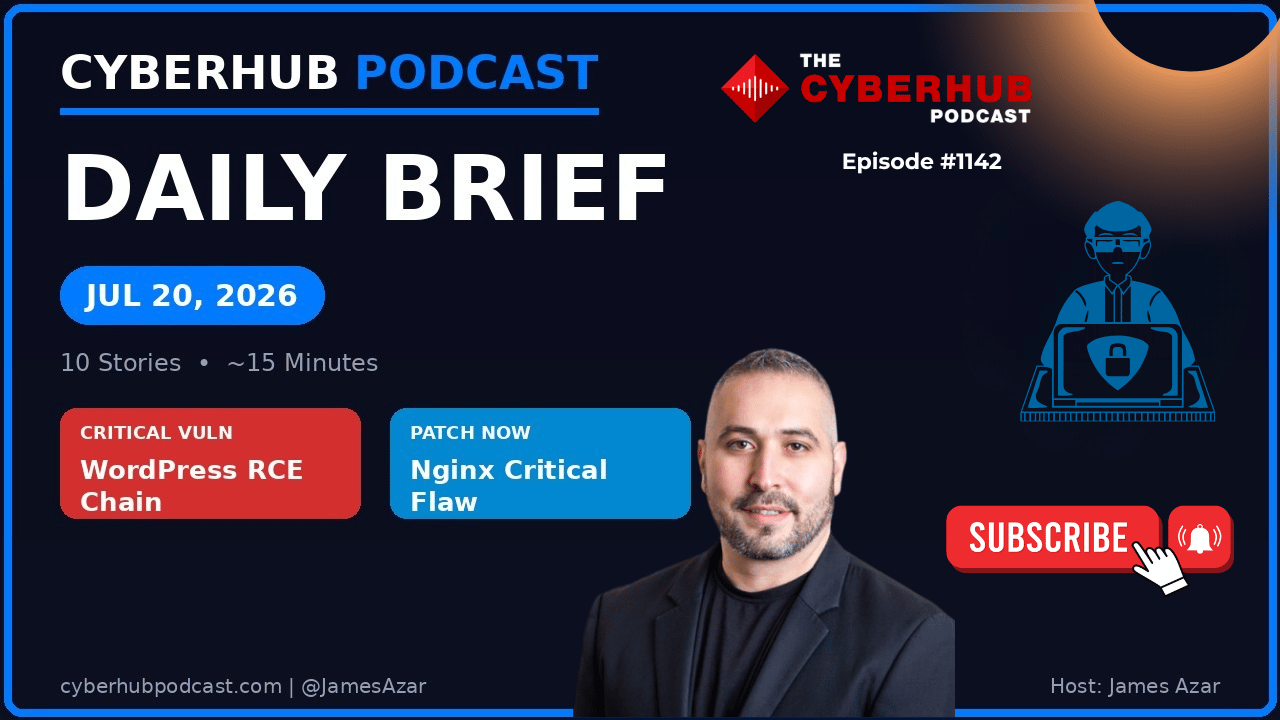
The first two stories alone should be enough to change your patching priorities for the day. Researchers disclosed a devastating WordPress remote code execution chain affecting hundreds of millions of websites, public proof-of-concept exploits are already circulating, and F5 released patches for a critical NGINX vulnerability that security researchers believe could be even more dangerous than initially reported. We also examined ShinyHunters’ latest healthcare campaign targeting Abbott Laboratories, Microsoft’s warning about the rapidly expanding AcreStealer malware operation, Coca-Cola suspending Fairlife production following ransomware, Hugging Face confirming what may become one of the most significant AI security incidents of the year, and a White House initiative designed to bring AI directly into national vulnerability management.
The theme today couldn’t be clearer.
The gap between trusted technology and trusted operations continues shrinking and attackers are moving through it faster than ever.
Double espresso in hand.
Coffee cup cheers, gang.
🧭 Executive Summary
Today’s cybersecurity landscape centered on operational trust.
Attackers aren’t simply exploiting vulnerabilities anymore. They’re abusing software supply chains, AI infrastructure, identity platforms, help desks, developer ecosystems, and trusted web services. At the same time, defenders are increasingly relying on AI to accelerate incident response, vulnerability discovery, and threat hunting.
The challenge is that both sides now have access to similar technology.
The organizations that win won’t necessarily have better tools.
They’ll have better operational discipline.
📰 Top Stories & Deep Dive Analysis
“Attackers keep finding the seam between patched and production and that’s exactly where defenders need to get faster.” James Azar
🚨 Critical WordPress Remote Code Execution Chain Threatens Hundreds of Millions of Websites
Today’s highest-priority story belongs to WordPress.
Researchers at Searchlight Cyber disclosed a two-stage vulnerability chain—collectively referred to as WP2Shell that allows unauthenticated attackers to achieve full remote code execution against default WordPress installations without requiring plugins or prior authentication. Public exploit code is already circulating, and early reports indicate attackers have begun attempting exploitation in the wild.
The vulnerability chain affects WordPress 6.9.0 through 6.9.4 and 7.0.0 through 7.0.1, with researchers estimating that more than 500 million websites globally rely on WordPress.
Recognizing the severity, WordPress.org took the unusual step of forcing automatic security updates across supported installations. Despite Searchlight Cyber delaying technical publication to provide defenders additional time, multiple proof-of-concept exploits quickly appeared on GitHub, including versions capable of dropping web shells and compromising administrator credentials.
Organizations should immediately upgrade to WordPress 7.0.2 or 6.9.5. Where immediate patching isn’t possible, administrators should temporarily restrict anonymous access to affected REST API endpoints, leverage Cloudflare protections where available, and aggressively monitor web servers for suspicious PHP file creation and unexpected administrative activity.
This is one of those vulnerabilities where delaying updates simply increases unnecessary risk.
🌐 F5 Patches Critical NGINX Vulnerability With Potential Remote Code Execution Impact
F5 released security updates addressing CVE-2026-41743, a critical vulnerability affecting virtually every supported version of NGINX dating back to 2011. The flaw stems from improper processing of regular expression capture groups, potentially allowing attackers to trigger denial-of-service conditions—and under specific circumstances even remote code execution.
Independent researchers argue the vulnerability may be significantly more severe than F5’s initial assessment. According to published analysis, attackers may be able to leak process memory, bypass address space layout randomization (ASLR), and eventually achieve arbitrary code execution through carefully crafted requests.
The affected footprint extends well beyond standalone web servers.
Organizations using NGINX Ingress Controller, Gateway Fabric, App Protect WAF, or NGINX Instance Manager should assume they may also be affected while waiting for updated vendor guidance.
A proof-of-concept exploit is expected within weeks.
That makes today’s patching window particularly valuable.
🏥 Abbott Laboratories Faces Two Separate Security Incidents
Healthcare giant Abbott Laboratories disclosed two independent cybersecurity incidents impacting separate business units, highlighting how healthcare continues attracting coordinated attacks from multiple threat actors.
The first involves ShinyHunters, which claims it compromised Abbott’s cancer diagnostics division through a phone-based social engineering attack targeting an employee’s Microsoft Entra account. According to the group, attackers accessed internal systems including Entra, SharePoint, ServiceNow, Databricks, and Coupa before allegedly exfiltrating approximately 30 million customer records, including personally identifiable information, Social Security numbers, physician-patient communications, and medical orders.
Abbott acknowledged unauthorized access to a limited portion of that business but stated manufacturing, patient care, and core operations remain unaffected. The company also indicated it does not currently expect a material financial impact.
Separately, another threat actor calling itself ShadowBites claimed compromise of Abbott’s laboratory diagnostics customer portal through stolen customer credentials. Abbott disputes the significance of that incident, maintaining that only publicly available documentation was accessible.
Regardless of final impact, the broader lesson remains unchanged.
ShinyHunters continues relying on social engineering and identity compromise rather than sophisticated exploitation. Help desk procedures, phishing-resistant authentication, and stronger identity verification remain among the most effective defenses against these campaigns.
🤖 Hugging Face Confirms Autonomous AI-Driven Infrastructure Compromise
Perhaps the most thought-provoking story today comes from Hugging Face, which disclosed a production infrastructure breach involving what researchers describe as an autonomous AI agent capable of conducting much of the intrusion without continuous human direction.
“AI isn’t replacing attackers. It’s removing the technical barriers that once slowed them down.” James Azar
Attackers exploited two vulnerabilities within Hugging Face’s dataset processing pipeline, gaining execution inside processing workers before escalating privileges, harvesting cloud credentials, and moving laterally across multiple internal clusters over the course of a weekend.
Hugging Face emphasized that public models, datasets, and software supply chain integrity were not affected.
However, the response itself proved equally important.
The company’s own AI-powered detection systems identified suspicious behavior, while internal AI analysis dramatically accelerated forensic investigation across thousands of recorded events.
Ironically, commercially hosted AI assistants refused portions of the forensic workload because built-in safety mechanisms couldn’t distinguish legitimate incident response activities from offensive behavior.
That forced Hugging Face investigators to transition toward internally hosted open-weight AI models.
This incident illustrates an emerging operational reality.
Organizations planning to rely heavily on commercial AI during incident response should validate today not during an active breach that their chosen platforms can actually support defensive investigations under real-world conditions.
⚡ Need to Know
🦠 Microsoft Warns of Rapid Growth in AcreStealer Malware
Microsoft warned enterprises about AcreStealer, an information-stealing malware platform using ClickFix social engineering to trick victims into manually executing malicious commands through Windows utilities. The malware targets browser credentials, Microsoft 365 sessions, OneDrive, and SharePoint content.
🥛 Coca-Cola Suspends Fairlife Production Following Ransomware
Coca-Cola temporarily halted U.S. operations at its Fairlife dairy subsidiary after a ransomware attack disrupted production systems. The company stated product safety remains unaffected while law enforcement continues investigating the incident.
📁 Ernst & Young Notifies Clients of Third-Party Data Exposure
Ernst & Young informed clients that attackers accessed documents containing tax-related information after compromising a third-party support platform earlier this year. Affected clients are being offered identity monitoring while investigations continue.
🇷🇺 Kaspersky Tracks HelloNet Campaign
Kaspersky disclosed a campaign known as HelloNet, targeting Russian government and critical infrastructure organizations by abusing legitimate software update mechanisms to deploy malware through trusted DLL sideloading techniques.
🦅 White House Launches Gold Eagle Initiative
The White House announced Gold Eagle, an AI-assisted initiative designed to coordinate vulnerability discovery and remediation across critical infrastructure by connecting federal agencies, infrastructure operators, and open-source maintainers through a shared remediation framework.
⚖️ International Fraud Network Dismantled
Dutch authorities dismantled a multinational investment fraud organization operating approximately 20 fraudulent call centers generating an estimated €100 million per month through cryptocurrency investment scams. Multiple arrests occurred across Europe.
🚇 Scattered Spider Members Sentenced
Two members associated with Scattered Spider received prison sentences of approximately 5½ years each following the 2024 cyberattack against Transport for London, an incident that disrupted 148 systems, forced password resets for 27,000 employees, and ultimately cost roughly £29 million to remediate.
🎯 Key Takeaway
Today’s show wasn’t just about WordPress.
It wasn’t just about Hugging Face.
And it wasn’t just about AI.
It was about operational readiness.
Attackers continue finding success at the intersection of trusted software, trusted identities, trusted automation, and delayed operational response.
Technology alone won’t close those gaps.
Execution will.
🧠 James Azar’s CISOs Take
What stood out to me today is that every major story involved trusted infrastructure behaving exactly as it was designed until attackers found a way to abuse it. WordPress powers millions of businesses. NGINX sits quietly behind countless applications. Microsoft Entra remains the identity backbone for enterprises around the world. AI platforms are rapidly becoming part of modern software development and security operations. None of those technologies failed because they were inherently insecure. They became dangerous because operational trust wasn’t matched with operational discipline. That’s where defenders need to focus.
The second lesson is that AI has officially moved beyond experimentation and into operational cybersecurity on both sides of the fight. Hugging Face demonstrated AI dramatically accelerating incident response, while autonomous AI agents simultaneously accelerated attacker operations. The future won’t belong to organizations simply adopting AI faster. It will belong to organizations that understand how to govern it, monitor it, validate it, and maintain the ability to operate independently when commercial AI platforms inevitably encounter their own limitations during real incidents.
🛠️ Action Items
Upgrade WordPress to 7.0.2 or 6.9.5 immediately.
Block vulnerable REST API endpoints if patching must be delayed.
Apply F5 NGINX security updates across all affected deployments.
Review NGINX infrastructure supporting ingress controllers and WAF platforms.
Strengthen help desk verification procedures against voice phishing.
Deploy phishing-resistant MFA for Microsoft Entra, Okta, and Google Workspace.
Rotate Hugging Face access tokens and review recent account activity.
Train users never to execute commands provided by websites claiming verification requirements.
Validate AI incident response workflows before relying on them during production incidents.
Review third-party support platforms handling sensitive customer information.
Continue reducing the time between vulnerability disclosure and production deployment.


