



☕ Good Morning Security Gang,
We’re approaching the halfway point of the year, and honestly, from a cybersecurity perspective, the outlook isn’t getting any prettier.
Today’s episode had one major theme running through nearly every story we covered:
👉 The attack surface has officially gone fully multi-domain.
We’re no longer talking about isolated phishing emails or standalone ransomware attacks. We’re talking about Iranian state actors inside transit systems, criminals physically showing up at law firms with USB drives, Chinese phishing platforms intercepting MFA in real time, AI chatbots unknowingly recommending malware, and supply chain compromises specifically targeting AI development environments.
Meanwhile, governments are responding with increasingly aggressive policies from India mandating twelve-hour patching timelines to U.S. Cyber Command reviewing its operational structure as the gap between vulnerability disclosure and exploitation continues collapsing.
Double espresso in hand this morning, using Café Elite capsules straight from Israel, by the way, and coffee cup cheers, gang. Let’s get into it.
🧭 Executive Summary
Today’s threat landscape demonstrates that cybersecurity is no longer confined to digital-only operations. Threat actors are blending cyber intrusion, physical access operations, AI-assisted exploitation, real-time MFA interception, and infrastructure targeting into coordinated attack campaigns that move far faster than traditional enterprise defense cycles were designed to handle.
At the same time, AI is becoming both an offensive and defensive force multiplier. Attackers are leveraging AI for phishing localization, malware generation, and social engineering enhancement, while defenders are struggling to operationalize security fast enough to keep pace. The organizations that survive the next phase of cyber conflict will be the ones capable of compressing detection, patching, and response timelines dramatically.
📰 Top Stories & Deep Dive Analysis
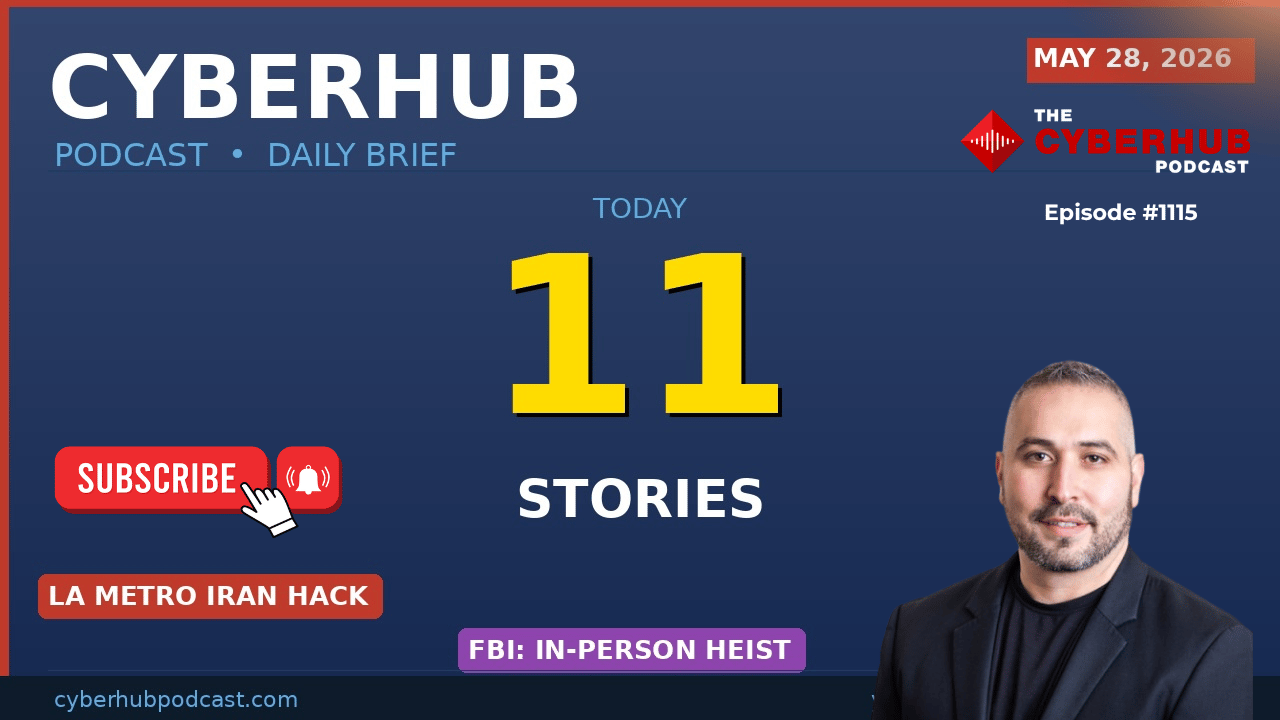
🚇 Iranian State-Linked Hackers Connected to LA Metro Cyberattack
One of the biggest stories today involved the cyberattack against Los Angeles Metro back in March, which has now been attributed by Israeli cyber resilience firm Gambit to the Iranian-linked threat group Black Shadow. Israeli intelligence and the National Cyber Directorate have tied the group directly to Iran’s Ministry of Intelligence and Security, the same ecosystem associated with MuddyWater operations.
The attackers reportedly exfiltrated more than 700 gigabytes of data and reached rail yard control display systems, meaning this was not simply an IT compromise, it crossed directly into operational technology territory.
That distinction matters because once attackers touch transit control environments, operational disruption becomes the likely next escalation point. Transit systems, utilities, and public infrastructure are increasingly becoming strategic targets because disruption there creates both economic and psychological impact simultaneously.
The lesson here for critical infrastructure operators is painfully clear:
Segment OT and IT aggressively
Remove operational systems from direct internet exposure
Use data diodes or unidirectional gateways where possible
Treat OT visibility as a crown jewel priority
If attackers can reach control systems, the conversation is no longer about data theft, it becomes about operational disruption and public safety.
🚪 FBI Warns of Criminals Physically Entering Offices to Steal Data
The FBI issued a warning that the Silent Ransom Group—also known as Luna Moth or UNC3753—is escalating beyond traditional phone-based phishing attacks and now physically dispatching actors to victim organizations.
The attack flow begins with someone posing as internal IT support requesting remote access. If the target refuses, attackers may then send a person physically to the office carrying a USB drive to plug directly into workstations and steal data onsite.
No ransomware. No encryption.
Just direct theft followed by extortion.
This completely breaks the assumption that cyber threats are purely remote. Organizations invest heavily in:
Firewalls
EDR
MFA
Email filtering
But none of those controls stop someone walking through the front door with a believable story and a malicious USB device.
"This breaks the assumption that cyber threats are remote only. When the digital door is closed, these actors will walk through the physical one knowing a physical confrontation is unlikely. Your traditional security controls like firewalls, EDR, and MFA provide zero protection against someone walking through your front door with a convincing story and a USB drive." James Azar
This is where physical security and cybersecurity finally converge operationally. Front desk procedures, visitor management, badge systems, camera coverage, and employee verification training become cybersecurity controls now, not just facilities functions.
Security teams should strongly consider running physical social engineering exercises as part of tabletop scenarios moving forward.
💳 Chinese Phishing-as-a-Service Platforms Bypassing MFA in Real Time
Google’s Threat Intelligence Group published research showing Chinese-language phishing-as-a-service platforms have evolved into fully operational real-time MFA interception systems targeting digital wallet fraud. The way these attacks work is operationally sophisticated:
Victims enter credentials into phishing portals
Attackers instantly receive them through live admin dashboards
MFA requests are triggered in real time
OTP codes are intercepted before expiration
Payment cards are immediately provisioned into attacker-controlled digital wallets
The result is instant fraud capability through:
Contactless payments
ATM withdrawals
High-value transactions
What’s accelerating these campaigns further is AI-driven localization. AI now removes the awkward phrasing, cultural inconsistencies, and translation artifacts that historically exposed many phishing attempts. Attackers can now generate:
Region-specific language
Local slang
Native writing styles
Context-aware social engineering messages
This is why time-based OTP MFA is rapidly losing effectiveness against sophisticated phishing operations. Organizations should aggressively move toward:
FIDO2 authentication
Passkeys
Hardware-backed authentication models
because traditional OTP workflows are increasingly being defeated at scale.
⚽ FIFA World Cup Fraud Campaign Expands Across 3,500 Domains
With the FIFA World Cup only weeks away, researchers uncovered a massive fraud ecosystem called “Ghost Stadium” involving over 3,500 malicious domains targeting fans worldwide. The operation includes:
Fake FIFA login portals
Fraudulent ticket sales
Counterfeit merchandise stores
Fake streaming sites
Betting scams
Credential harvesting campaigns
Researchers identified more than:
2,500 FIFA account credentials already circulating
170,000 InfoStealer logs referencing FIFA-related accounts
The sophistication of the phishing kits is significant. They are pixel-perfect clones supporting eleven languages and multiple Chinese dialect variants while leveraging Meta advertising infrastructure to drive traffic.
This matters operationally because global events like the World Cup create emotional urgency and excitement that attackers weaponize extremely effectively.
Security teams should proactively educate employees and customers about:
Official ticketing channels
Fake streaming scams
Credential reuse risks
Financial fraud patterns
This is a major opportunity for security teams to build trust with users through practical education instead of fear-based awareness alone.
🤖 AI Chatbots Recommending Malware-Infected Software
Microsoft researchers documented an active cryptojacking campaign where attackers poison AI chatbot recommendations to steer users toward malware-laced software downloads. Victims asking AI tools for download recommendations are redirected toward malicious versions of:
CrystalDiskInfo
HWMonitor
FurMark
Display Driver Uninstaller
K-Lite Codec Pack
The targeting is deliberate because these utilities are popular among users with high-performance GPUs, ideal systems for cryptocurrency mining malware. The payloads establish persistence using ScreenConnect and provide remote access capabilities that can later escalate into:
Data theft
Ransomware deployment
Additional malware staging
This is a major shift:
👉 AI chatbots themselves are becoming attack surface infrastructure.
Users increasingly trust AI-generated recommendations as authoritative, which gives attackers a new high-trust distribution channel.
Organizations should reinforce policies requiring software downloads only from official vendor domains and aggressively monitor for unauthorized remote management tools like ScreenConnect.
📦 Malicious npm Package Stealing Anthropic Cloud AI Session Files
Researchers at Aikido Security discovered a malicious npm package called mouse5212-superformatter specifically engineered to steal Anthropic Cloud AI session files from developer environments. Once installed, the malware:
Authenticates into GitHub repositories
Recursively uploads AI session data
Steals cloud code session information
Harvests outputs and uploads directories
The package was downloaded hundreds of times before detection. What’s especially interesting is that the attacker accidentally embedded their own GitHub token into the malware, leading researchers to speculate the package itself may have been AI-assisted malware generated without proper operational security review.
This highlights a rapidly emerging risk:
👉 AI development environments now sit in deeply trusted positions with broad filesystem and credential access.
Compromising one malicious dependency can expose everything the AI tooling has ever touched.
Organizations building AI workflows should aggressively audit:
npm dependencies
AI development environments
File access patterns within
/mnt/userdatadirectories
🛡️ CrowdStrike and Google Disrupt GlassWorm Botnet
In one of the few positive stories today, CrowdStrike, Google, and the ShadowServer Foundation successfully disrupted all four command-and-control channels tied to the GlassWorm botnet.
GlassWorm originally spread through trojanized VS Code extensions and used Unicode variation selectors to invisibly hide malicious code inside seemingly legitimate source files. The infrastructure was remarkably resilient, leveraging:
VPS infrastructure
Google Calendar covert channels
BitTorrent peer-to-peer communication
Solana blockchain backup channels
Attribution evidence strongly suggests Russian operational origins. The story is important because it demonstrates how modern malware is increasingly:
Multi-channel
Decentralized
Blockchain-aware
Supply-chain-focused
Botnets are evolving operational resilience faster than many traditional detection models are adapting.
🇮🇳 India Mandates 12-Hour Critical Vulnerability Patching
India’s CERT issued a new cybersecurity framework mandating twelve-hour patching timelines for critical internet-facing vulnerabilities. The guidance specifically cites:
AI-assisted exploit generation
Automated attack surface mapping
AI-enhanced phishing
Rapid exploit weaponization
as justification for dramatically compressed remediation timelines. The framework now requires:
Critical internet-facing vulnerabilities patched within one day
High-value internal systems within three days
High-severity vulnerabilities within five days
This directly aligns with what many practitioners are already experiencing operationally:
👉 The old thirty-day patching model is becoming operationally obsolete.
Attackers are exploiting vulnerabilities far too quickly for traditional remediation cadences to remain effective.
🎯 Key Takeaway
👉 The attack surface has evolved into a fully blended cyber, physical, AI-assisted, and operational battlefield—and traditional defensive timelines are collapsing under the pressure.
"Today's show has a clear monolithic through line: the attack surface has gone fully multi-domain. Iran's inside LA's transit control displays. Cybercriminals are walking through your front door. Chinese phishing-as-a-service operators are defeating MFA in real time. AI chatbots are recommending malware. Developer tooling is a deliberate supply chain target. India's twelve-hour patching mandate and US Cyber Command's MITRE review are two governments acknowledging the same reality, we are operating in an environment where the time between vulnerability and exploitation is collapsing fast. The old defensive cadences were built for a world that no longer exists."
🛠️ Action Items for Security Leaders
🚇 Segment OT and IT environments aggressively in critical infrastructure
🚪 Implement stronger visitor verification and USB device restrictions
💳 Move financial workflows toward FIDO2 and passkey authentication
⚽ Educate employees and customers about FIFA-related fraud campaigns
🤖 Restrict software downloads to official vendor domains only
📦 Audit npm dependencies across AI development environments
🛡️ Monitor developer tooling for unauthorized VS Code extensions
🇮🇳 Compress vulnerability remediation timelines for internet-facing systems
🔍 Conduct physical social engineering tabletop exercises
⚡ Treat AI chatbot recommendations as untrusted input unless validated
🧠 James Azar’s CISOs Take
What stood out to me today is how quickly the definition of cybersecurity is changing operationally. We’re no longer dealing with isolated technical attacks. We’re seeing blended operations involving AI-assisted phishing, physical intrusion attempts, operational technology targeting, and supply chain compromise all happening simultaneously. Attackers are adapting faster than many enterprise security programs are structurally capable of responding.
The second major takeaway is around speed. India’s twelve-hour patching mandate reflects what many security practitioners already know internally but haven’t fully operationalized yet: the time between vulnerability disclosure and active exploitation is collapsing. Organizations still operating on thirty-day remediation cycles for critical systems are increasingly taking on unacceptable operational risk. Security programs need to evolve toward rapid-response operational models because attackers already have.
🔥 Stay Cyber Safe.


