



☕ Good Morning Security Gang,
Today officially marks the halfway point of the year. Looking back over the first six months of 2026, one trend has become impossible to ignore:
Attackers are moving faster than enterprise change management.
Today’s stories reinforced that reality from every angle. Oracle’s PeopleSoft zero-day continues expanding with another confirmed victim. A Microsoft Defender privilege escalation flaw has officially crossed the line from vulnerability to ransomware weapon. Aflac Japan disclosed a breach affecting more than 4.3 million customers. Microsoft researchers issued one of the strongest warnings yet around Agentic AI, showing how something as simple as a tool description can quietly become an exfiltration channel. We also saw new attacks targeting AI-powered browsers, ransomware continue impacting global manufacturing, and Apple release another major security update addressing thirty vulnerabilities.
The common denominator wasn’t sophisticated malware.
It was trusted systems being used exactly the way attackers hoped they would be.
Coffee cup cheers, gang. Let’s get into it.
🧭 Executive Summary
Today’s threat landscape centered on one idea: trust without verification has become one of cybersecurity’s greatest liabilities.
Whether it was Oracle customers trusting delayed patch cycles, organizations trusting AI agents to execute approved tasks, users trusting browser assistants, or insurers trusting customer portals to detect abnormal behavior, every major incident today demonstrated how attackers continue exploiting assumptions rather than breaking sophisticated defenses.
Cybersecurity has entered an era where governance matters just as much as technology.
The organizations that continuously validate trust relationships will consistently outperform those that assume yesterday’s approvals remain safe tomorrow.
📰 Top Stories & Deep Dive Analysis
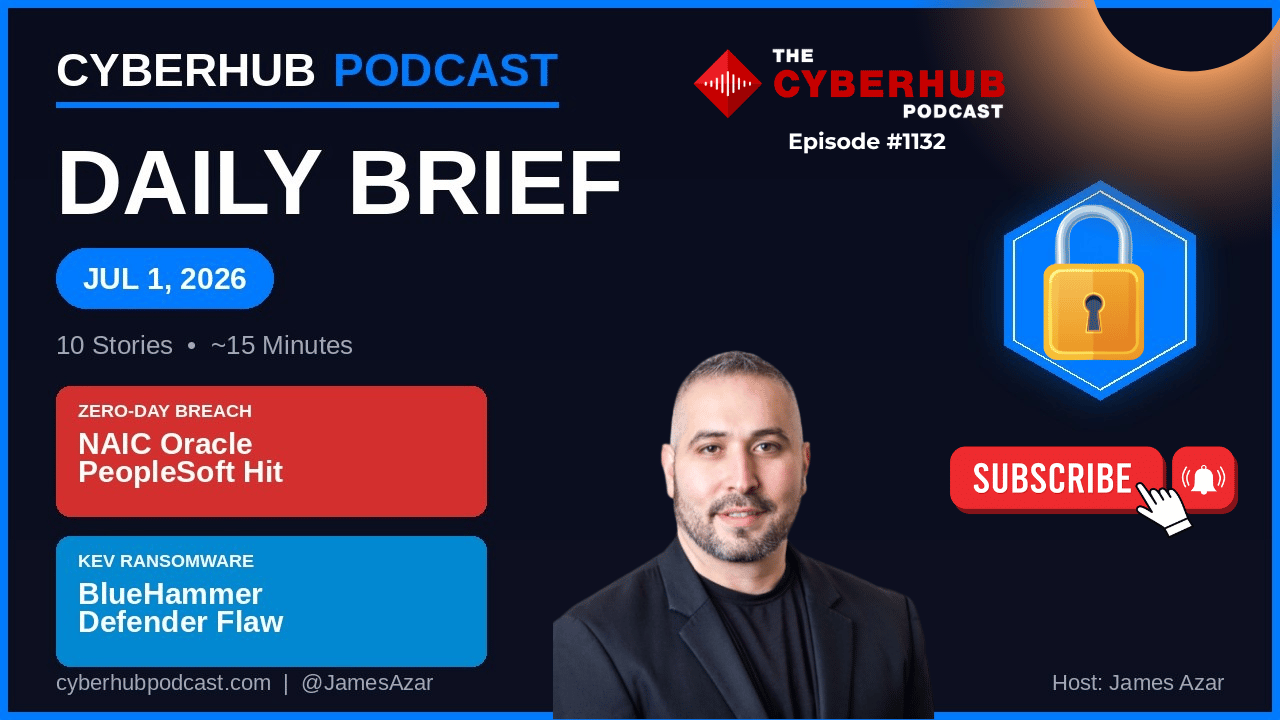
🚨 Oracle PeopleSoft Zero-Day Claims Another Victim as NAIC Confirms Breach
The National Association of Insurance Commissioners (NAIC), the regulatory body supporting insurance oversight across all fifty U.S. states, confirmed it was compromised through the same Oracle PeopleSoft zero-day that has now impacted more than one hundred organizations. The vulnerability, tracked as CVE-2026-35273, continues to expand into one of the year’s largest enterprise software exploitation campaigns.
According to NAIC, attackers accessed statutory financial reports, credit rating information, legacy log files, and system configuration data after exploiting the vulnerability. The organization strongly disputed broader claims made by the ShinyHunters extortion group, which alleged it had stolen more than three terabytes of information and accessed production regulatory systems.
The truth likely falls somewhere between public extortion tactics and official damage assessments.
What matters operationally is that exploitation began weeks before defenders knew what they were patching.
This incident reinforces a broader lesson for Oracle customers. The PeopleSoft campaign is no longer isolated to education. It now spans insurance, government, higher education, and other sectors running large Oracle enterprise environments.
Organizations should validate Oracle’s emergency mitigations, review authentication logs dating back to early June, rotate integrated credentials, and treat any PeopleSoft exposure as a potential compromise rather than simply a vulnerability management exercise.
🔥 BlueHammer Microsoft Defender Vulnerability Now Used in Ransomware Campaigns
CISA quietly updated its Known Exploited Vulnerabilities catalog confirming that BlueHammer (CVE-2026-33825), a privilege escalation flaw affecting Microsoft Defender, is now being actively leveraged during ransomware attacks.
The vulnerability was originally disclosed in April after independent researchers criticized Microsoft’s disclosure process. Although Microsoft patched the issue quickly, Huntress later confirmed attackers had already been exploiting the flaw before the patch became publicly available.
Today’s development is significant because BlueHammer has officially transitioned from theoretical exploitation into operational ransomware deployment.
Perhaps the most concerning aspect is the notification process itself.
CISA updated the existing KEV entry without issuing a new public advisory, meaning organizations monitoring only new vulnerability announcements could easily miss the change.
The lesson extends beyond this specific vulnerability.
Security teams cannot rely exclusively on vendor announcements to understand evolving threat activity. Threat intelligence requires continuous monitoring, even after patches have already been deployed.
🏥 Aflac Japan Breach Impacts More Than 4.3 Million Customers
Aflac Life Insurance Japan disclosed that attackers repeatedly accessed its customer policy portal between June 15 and June 25 before the activity was finally detected. The incident affects approximately 4.38 million policyholders, agents, and related parties.
Compromised information includes names, addresses, telephone numbers, birth dates, insurance account details, and banking information associated with premium payment transfers.
Although Aflac stated that payment card information was not exposed, several customer-facing services remain unavailable while investigators continue assessing the breach.
What stands out isn’t simply the number of affected customers.
It’s the ten-day dwell time.
Repeated authenticated access over that period suggests opportunities existed for behavioral analytics, session monitoring, or anomaly detection to identify suspicious activity significantly earlier.
For organizations operating financial or insurance portals, this incident serves as a valuable reminder that monitoring legitimate authenticated sessions is often just as important as detecting unauthorized login attempts.
🤖 Microsoft Warns AI Tool Descriptions Can Become Supply Chain Attack Vectors
Microsoft published one of the most important Agentic AI security advisories to date, warning organizations that Model Context Protocol (MCP) tool descriptions themselves can be weaponized without changing the underlying application code.
“We spent fifteen years teaching ‘trust but verify.’ We can’t stop applying that lesson just because the system making decisions now happens to be AI.” James Azar
Every MCP tool contains a plain-language description explaining its purpose to an AI agent.
Researchers demonstrated that attackers could quietly modify those descriptions, embedding hidden instructions directing the AI agent to collect invoices, sensitive documents, or internal data during otherwise legitimate workflows.
Because the tool remains approved and operational, the AI agent follows the instructions without recognizing malicious intent.
Microsoft highlighted previous real-world examples, including malicious developer packages and academic testing showing successful tool poisoning against leading AI models nearly seventy-three percent of the time.
This isn’t an artificial intelligence problem.
It’s a supply chain governance problem.
Organizations reviewing production code but ignoring AI tool metadata have created a new blind spot that attackers increasingly understand.
Tool descriptions should now receive the same approval process, change management, and security review traditionally reserved for application code.
⚡ Need to Know
🌐 Agentic Browser Extensions Continue Exposing Sensitive Data
Researchers demonstrated that several AI-powered browser agents could be manipulated into revealing sensitive GitHub credentials through carefully crafted web interactions. OpenAI has addressed the issue, while several competing platforms remain vulnerable or only partially mitigated. Organizations should carefully evaluate browser-based AI assistants before allowing enterprise deployment.
🏭 Nidec Hit by Blackfield Ransomware
Japanese manufacturing giant Nidec, generating approximately $17.2 billion in annual revenue, confirmed ransomware affecting its Taiwanese subsidiary. Blackfield operators are demanding approximately $2 million to delete allegedly stolen data. This marks the company’s second ransomware incident in two years.
🛡️ DHS Proposes New Critical Infrastructure Partnership Framework
Following the retirement of the Critical Infrastructure Partnership Advisory Council, the Department of Homeland Security proposed a new collaborative framework known as the Alliance of National Councils for Homeland Operational Resilience, intended to strengthen coordination between CISA and critical infrastructure operators.
🛰️ CIA Accelerates Technology Acquisition
CIA Director John Ratcliffe announced major modernization efforts reducing technology acquisition timelines toward six months while reorganizing the agency’s digital innovation efforts under a new Directorate of Mission Systems focused on cybersecurity, infrastructure, and advanced data capabilities.
🍎 Apple Releases Major Security Update
Apple issued updates addressing roughly 30 security vulnerabilities across iOS, iPadOS, macOS, and related platforms, including multiple kernel and WebKit flaws capable of enabling memory corruption, sandbox escapes, clipboard access, and cross-origin data exposure. Enterprise administrators should prioritize deployment this week.
🤖 Anthropic Faces Questions Over Claude Access Controls
Researchers claimed to have identified undocumented behavior within Claude relating to geographic access controls and feature restrictions. While Anthropic has not publicly confirmed the findings, the discussion has renewed debate surrounding AI model governance and export controls following recent U.S. policy changes.
🎯 Key Takeaway
Today’s episode wasn’t really about Oracle.
It wasn’t about Microsoft Defender.
And it wasn’t even about AI.
It was about governance.
Governing software updates.
Governing AI tools.
Governing trusted integrations.
Governing user behavior.
Governing change itself.
Attackers increasingly succeed because organizations trust approved systems long after those systems have changed.
Trust without continuous validation has become one of the largest attack surfaces in cybersecurity.
🧠 James Azar’s CISOs Take
What stood out to me today is how many of these incidents originated from organizations trusting yesterday’s decisions. Oracle customers trusted maintenance schedules. AI teams trusted approved tool descriptions. Users trusted browser assistants. Security teams trusted that a vulnerability already patched months ago was no longer relevant. Modern attackers aren’t breaking trust—they’re inheriting it. As defenders, we need to assume every trusted relationship requires continuous validation because environments change far faster than governance processes do.
The second lesson is that Agentic AI is quickly becoming another enterprise platform requiring mature operational controls. We don’t allow production code changes without review, yet many organizations are comfortable allowing AI agents to consume changing tool descriptions automatically. That’s a governance gap, not a technology limitation. The organizations that treat AI agents like privileged identities with approvals, logging, least privilege, and change control will avoid many of the mistakes others are only beginning to discover.
🛠️ Action Items
Validate Oracle PeopleSoft emergency mitigations immediately
Review PeopleSoft authentication activity dating back to early June
Confirm BlueHammer patches across all Microsoft Defender deployments
Review KEV catalog updates regularly—not just newly added vulnerabilities
Monitor customer portals for abnormal authenticated behavior
Treat MCP tool descriptions as production code requiring formal review
Restrict AI agents using least privilege and individual identities
Evaluate browser-based AI assistants before enterprise deployment
Deploy Apple’s latest security updates across managed devices
Review ransomware resilience for manufacturing and industrial subsidiaries
Strengthen governance around AI-enabled development environments
🔥 Stay Cyber Safe.


