



☕ Good Morning Security Gang,
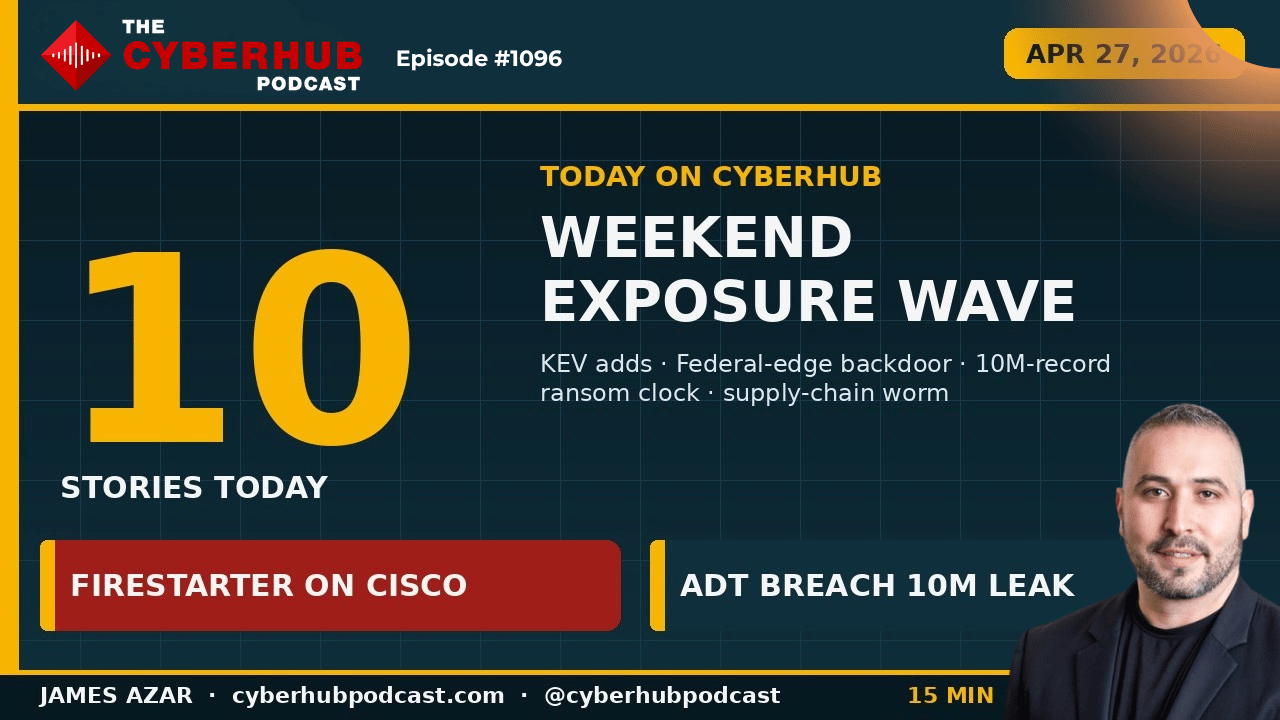
We’re kicking off the week with a packed 10-story rundown that hits everything from federal edge compromises to SaaS breach chains, supply chain worms, and even a 12-year-old Linux root flaw still alive and well.
If last week was about trust breaking, this week is about exposure at speed. Attackers are moving faster, pivoting across ecosystems, and exploiting anything left unpatched, unsegmented, or simply forgotten.
Double espresso ready; let’s get into it.
🧭 Executive Summary
Today’s stories highlight two critical realities:
Exposure is everywhere—from SaaS identity chains to federal firewalls to developer ecosystems
Tempo is accelerating—attackers are chaining exploits, pivoting faster, and monetizing access almost immediately
We’re seeing convergence across edge infrastructure compromise, SaaS phishing chains, supply chain propagation, and legacy system exploitation, all amplified by a pace that most organizations struggle to match operationally.
🛡️ CISA KEV Additions – Remote Access Tools Become Enterprise Gateways
CISA added multiple actively exploited vulnerabilities to the KEV catalog, including flaws in SimpleHelp, Samsung MagicINFO, and D-Link routers.
What makes this particularly dangerous is the role these systems play. SimpleHelp, for example, is widely used as a remote support tool. A compromised technician account doesn’t just impact one system—it can cascade across every client environment that tool touches.
This is a recurring pattern: attackers aren’t targeting endpoints—they’re targeting tools that manage endpoints, turning a single foothold into multi-tenant compromise.
🔥 Firestarter Backdoor – Federal Cisco ASA Compromise Persists
A Linux-based backdoor dubbed Firestarter was discovered on a federal Cisco ASA firewall, persisting even after firmware updates.
The malware survives by intercepting termination signals and relaunching itself, meaning standard patching or rebooting does nothing to remove it.
This changes the playbook. Instead of patching, organizations must fully power down, reimage, and rotate all credentials tied to the device.
The broader implication is serious: edge infrastructure is now a long-term persistence layer for attackers, not just an entry point.
🏠 ADT Breach – Phishing to SaaS Chain Hits Again
ADT disclosed a breach involving unauthorized access to cloud environments, with attackers leveraging phishing against Okta to gain entry and pivot into Salesforce.
This is now a well-established attack chain:
Phishing → Identity provider compromise
Pivot → SaaS platform access
Extract → Customer data at scale
With a 10 million record leak potentially imminent, this case reinforces that SaaS ecosystems are only as secure as the identity layer protecting them.
And attackers know it.
🧩 Checkmarx Supply Chain Attack – CI/CD Integrity at Risk
Checkmarx was hit again, with attackers compromising Docker images and VS Code extensions tied to its KICS analysis tool.
Although exposure lasted less than 90 minutes, that’s more than enough time in modern pipelines. Any system pulling updates during that window could now be compromised.
This highlights a key issue: CI/CD pipelines operate at machine speed, but security validation often lags behind, creating a window attackers can exploit repeatedly.
🐧 Pack2TheRoot – 12-Year Linux Privilege Escalation Flaw
A privilege escalation flaw present since 2014 has been confirmed exploitable across major Linux distributions.
This vulnerability allows a low-privileged user to escalate to root through PackageKit, meaning any malware landing on a Linux endpoint can immediately gain full control.
This is not a zero-day, it’s worse. It’s a decade-old design flaw that went largely unnoticed, proving that legacy components remain one of the biggest risks in modern environments.
⚡ Itron Breach – Utility Supply Chain Risk Expands
Itron disclosed unauthorized access to corporate IT systems, though no customer environments were impacted.
Even so, the implications are significant. Itron operates in the utility and grid-edge ecosystem, meaning any compromise raises concerns about downstream risk to critical infrastructure.
This reinforces a key shift: attackers are increasingly targeting vendors and suppliers as indirect entry points into high-value environments.
🧬 NPM → PyPI Worm – Cross-Ecosystem Supply Chain Attack
The supply chain worm we’ve been tracking continues to evolve, now spreading across both npm and PyPI ecosystems.
This worm:
Harvests credentials from developer environments
Uses stolen tokens to publish malicious packages
Propagates automatically across repositories
This is supply chain compromise at industrial scale. One compromised developer machine can now infect multiple ecosystems within hours, making containment extremely difficult.
💾 Vercel Data Leak – Breach Data Hits Underground Markets
Data from the earlier Vercel breach has now surfaced for sale, including access keys, source code, and internal databases.
Although the listing was removed, the assumption must be that the data is already circulating.
The attack chain starting with infostealer malware and OAuth token theft—shows how endpoint compromise can quickly escalate into cloud environment exposure.
📱 Apple App Store – 26 Fake Crypto Wallet Apps Discovered
Kaspersky identified 26 malicious crypto wallet apps on Apple’s App Store, impersonating major platforms like Coinbase and MetaMask.
These apps harvested recovery phrases and even used OCR to extract sensitive data from screenshots.
This challenges a long-held assumption: app stores are no longer a reliable trust boundary, especially for financial applications.
🌍 Iran Threat Model – From Destruction to Influence
Industry leaders are reframing Iran’s cyber posture, suggesting a shift from large-scale infrastructure attacks to targeted opportunistic breaches amplified through information operations.
Instead of shutting down power grids, the focus is now:
Breach a target
Publicize it
Amplify impact through media
This aligns with broader geopolitical trends where perception and narrative are as valuable as technical impact.
🎯 Key Takeaway
👉 Exposure + Speed = Modern Cyber Risk
Attackers are no longer waiting. They’re exploiting, pivoting, and monetizing in real time.
🛠️ Action Items for Security Leaders
🔐 Patch all KEV-listed vulnerabilities immediately
🔥 Reimage and hard reset compromised edge devices (do not rely on patching alone)
🧩 Enforce phishing-resistant MFA across identity providers
🔍 Audit SaaS integrations, especially Okta and Salesforce chains
🚀 Validate CI/CD pipelines and restrict external dependency pulls
🐧 Patch Linux systems and monitor for privilege escalation activity
🧬 Rotate all npm and PyPI tokens and enforce strict credential hygiene
⚡ Conduct vendor risk assessments for critical infrastructure suppliers
📱 Restrict unverified mobile app installations through MDM policies
🌍 Prepare incident response playbooks for reputational and information warfare scenarios
🧠 James Azar’s CISOs Take
What stood out to me today is how much of our risk is tied to systems we assume are already secure. Whether it’s a firewall that survives patching, a SaaS chain built on identity trust, or a Linux component that’s been around for over a decade, attackers are finding value in what we’ve stopped questioning. That’s the real challenge, we’re defending what we see, while attackers exploit what we’ve forgotten.
The second takeaway is tempo. Every story today reflects a faster cycle from compromise to propagation to monetization. Supply chain worms spread in hours. SaaS breaches turn into data leaks within days. If our detection and response don’t match that speed, we’re always going to be behind. The future of security isn’t just about control it’s about keeping up.
🔥 Stay Cyber Safe.


