



☕ Good Morning Security Gang,
Today’s episode is one of those that forces you to zoom out and realize, this is no longer just cybersecurity, this is national security, operational resilience, and business survival all wrapped into one.
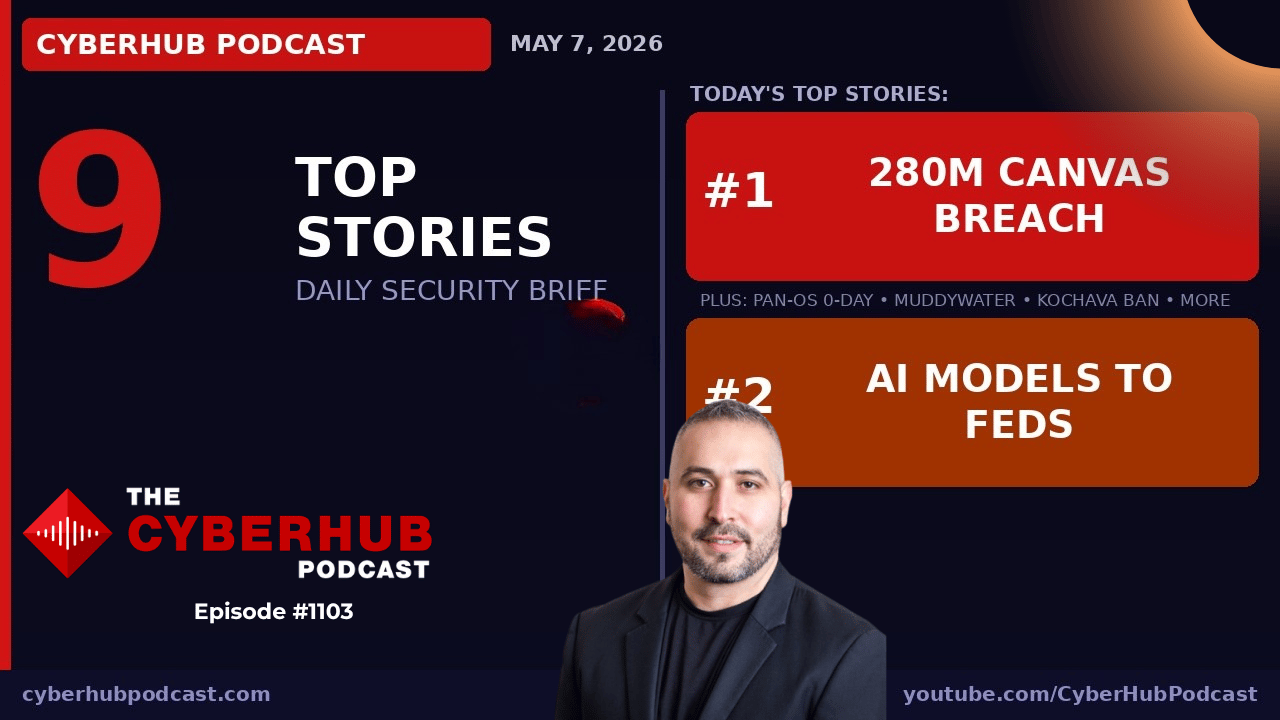
We’ve got a firewall zero-day with no patch, a massive education sector breach impacting hundreds of millions, a nation-state false flag operation, and even AI now being evaluated for offensive cyber capabilities before release.
👉 The theme today: Everything we depend on vendors, infrastructure, APIs, even trust itself is being challenged.
Double espresso ready, let’s go.
🧭 Executive Summary
Today’s threat landscape highlights a convergence of unpatched critical vulnerabilities, API-driven data exfiltration, supply chain compromise, and nation-state deception tactics. Attackers are no longer just exploiting software flaws—they’re leveraging legitimate system capabilities, abusing trust relationships, and introducing misdirection into incident response.
At the same time, regulators and governments are stepping in, from data privacy enforcement to AI governance, while the cyber insurance market evolves to reflect real-time risk. The environment is shifting from reactive defense to strategic resilience, where organizations must assume disruption and design for continuity.
📰 Top Stories & Deep Dive Analysis
🔥 Palo Alto PAN-OS Zero-Day – Root Access Without a Patch
A critical zero-day vulnerability in Palo Alto’s PAN-OS allows unauthenticated remote attackers to execute arbitrary code with root privileges via the authentication portal. With over 5,800 exposed devices and active exploitation confirmed, this is a high-severity issue with no immediate patch available.
Firewalls are the crown jewel of network defense. Compromise here means visibility and control over everything behind it—traffic flows, credentials, and segmentation policies. The fact that attackers are actively targeting perimeter devices reinforces a long-standing truth: if you own the edge, you own the network.
Mitigation now requires immediate action, restricting access, disabling unnecessary services, and monitoring for anomalous behavior because waiting for a patch is not an option.
🏭 CISA CI Fortify – Prepare to Operate Without Vendors
CISA launched the CI Fortify initiative, urging critical infrastructure operators to prepare for scenarios where they must operate completely isolated from vendors, cloud providers, and external networks for extended periods.
This is a major shift in thinking. Most disaster recovery plans assume vendor availability, but CISA is explicitly warning that in a geopolitical conflict, those assumptions may fail.
The implication is profound: organizations must validate manual operations, air-gapped capabilities, and independent recovery processes. This is not theoretical, it’s a direct response to observed adversary positioning within OT environments.
🔄 Oracle Moves to Monthly Patching – The End of Quarterly Cycles
Oracle announced a shift from quarterly patch cycles to monthly updates for critical vulnerabilities, driven by the shrinking window between disclosure and exploitation.
With exploit timelines now measured in minutes rather than days, traditional patching models are no longer sufficient. Organizations must adapt their processes to handle more frequent updates without disrupting operations.
This is part of a broader industry trend toward continuous vulnerability management, where patching becomes an ongoing process rather than a scheduled event.
🧬 Daemon Tools Supply Chain Attack – Signed Software, Malicious Payload
The makers of Daemon Tools confirmed a supply chain attack where their official installer was trojanized and distributed with valid code-signing certificates. The malicious version deployed an information stealer and backdoor across multiple sectors globally.
This attack underscores the danger of trusted software distribution channels being compromised. Even signed binaries cannot be assumed safe if the vendor itself is breached.
Organizations must treat any affected installations as compromised and conduct thorough investigations, even if endpoint protection tools show no alerts.
🎓 Canvas Breach – 280 Million Records via Legitimate APIs
ShinyHunters claimed to have exfiltrated 280 million records from Instructure’s Canvas platform, impacting over 40% of North American universities. The attackers did not exploit a vulnerability, instead, they abused legitimate API features to extract data.
This is a critical shift. The breach was executed using authorized functionality, making it harder to detect and prevent.
The exposed data includes student records, communications, and institutional details, creating immediate risk for phishing campaigns and regulatory fallout. This highlights the need for API monitoring and anomaly detection, not just vulnerability management.
⚖️ FTC Bans Data Broker – Privacy Enforcement Accelerates
The FTC permanently banned data broker Kochava from selling precise location data without explicit consent, marking a significant step in privacy enforcement.
This decision reflects growing concern over how sensitive data is collected, shared, and monetized. It also signals increased regulatory scrutiny across industries, particularly those handling consumer data.
Organizations must now consider privacy compliance as a core component of cybersecurity, not just a legal requirement.
🎭 MuddyWater False Flag Campaign – Ransomware as a Distraction
Iran-linked MuddyWater conducted a sophisticated false flag operation, using ransomware as a decoy to mask credential theft and data exfiltration activities.
The attackers initiated contact through Microsoft Teams, posing as IT support, and used screen sharing to capture credentials and manipulate MFA approvals in real time. The ransomware component was never intended to encrypt data, it was used to mislead responders.
This represents a new level of sophistication where attackers manipulate both systems and defenders, delaying response and increasing impact.
🛡️ Cyber Insurance Shift – Coalition Becomes Market Leader
Allianz transferred its cyber insurance portfolio to Coalition, making it the largest commercial cyber insurer globally. Coalition’s model integrates real-time threat monitoring with insurance coverage, enabling dynamic risk pricing.
This reflects a broader shift toward technology-driven underwriting, where insurers actively monitor risk rather than relying solely on historical data.
For organizations, this means cybersecurity posture will increasingly influence insurance costs and coverage availability.
🤖 AI Governance – Government Testing Before Release
Google, Microsoft, and XAI agreed to provide pre-release access to advanced AI models for government testing, allowing evaluation of potential risks before public deployment.
This includes assessing capabilities related to offensive cyber operations, disinformation, and even CBRN threats.
This marks a turning point where AI is being treated as a strategic technology with national security implications, requiring oversight and governance at the highest levels.
🎯 Key Takeaway
👉 Cybersecurity is no longer just about defense, it’s about resilience in a world where trust, infrastructure, and even assumptions are under attack.
🛠️ Action Items for Security Leaders
🔥 Restrict access to PAN-OS authentication portals and monitor for exploitation attempts
🏭 Conduct OT segmentation audits and validate air-gap capabilities
🔄 Update patch management processes for monthly and continuous cycles
🧬 Audit all installations of Daemon Tools and hunt for indicators of compromise
🎓 Monitor API usage for abnormal data access patterns in SaaS platforms
⚖️ Align data handling practices with evolving privacy regulations
🎭 Update incident response playbooks to account for deception tactics
🛡️ Review cyber insurance policies and align them with current risk posture
🤖 Prepare for AI governance requirements and risk assessments
🔍 Continuously validate trust across all systems and integrations
🧠 James Azar’s CISOs Take
What stood out to me today is how attackers are no longer limited by technical barriers. The Canvas breach shows they can use legitimate APIs, the MuddyWater campaign shows they can manipulate defenders, and the PAN-OS zero-day shows they can go straight for the heart of our defenses. This is a shift from exploitation to orchestration—attackers are orchestrating outcomes rather than just executing attacks.
The second takeaway is that resilience is becoming the defining factor in cybersecurity. With CISA pushing for isolated operations and Oracle accelerating patch cycles, it’s clear that the environment is changing faster than ever. Organizations that can adapt—operationally, technically, and strategically—will be the ones that survive. Those that can’t will struggle to keep up.
🔥 Stay Cyber Safe.


