



Daily cybersecurity news for security practitioners — no FUD, just risk, impact, and mitigation.
☕ Good Morning Security Gang,
Today’s episode is one of those that hits every layer of the stack from SaaS breaches to AI exploitation, from ransomware evolution to geopolitical cyber pressure.
And if there’s one theme that ties everything together today, it’s this:
👉 Attackers are targeting both the systems that run your environment and the people who have access to them.
Double espresso in hand, let’s dive in.
🧭 Executive Summary
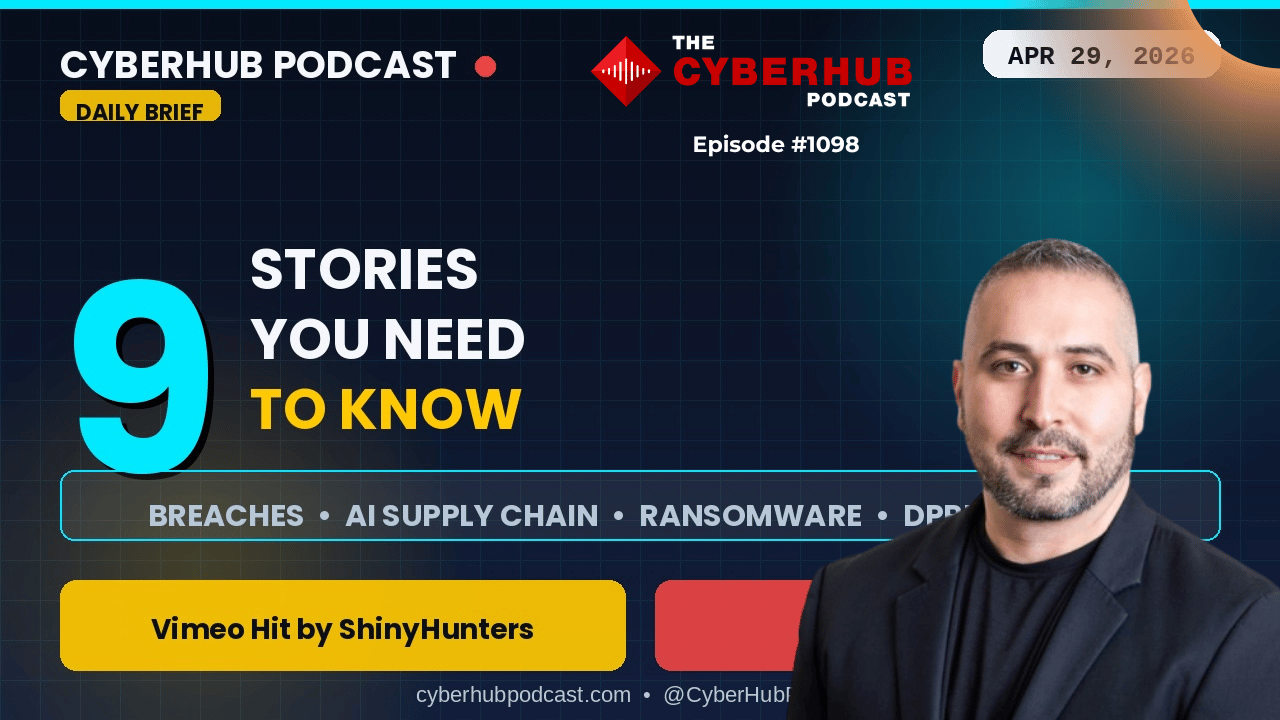
Today’s episode highlights a convergence of SaaS supply chain breaches, CI/CD vulnerabilities, AI gateway exploitation, and evolving ransomware tactics. At the same time, nation-state actors are doubling down on long-term social engineering campaigns, while governments begin aligning policy and regulation around AI security.
The risk environment is no longer siloed identity, automation, AI, and human behavior are now interconnected attack surfaces, and attackers are exploiting them simultaneously.
📰 Top Stories & Deep Dive Analysis
🎥 Vimeo Breach – Third-Party Risk Continues to Expand
Vimeo confirmed a breach stemming from a compromise of its third-party analytics vendor, Anodot, exposing customer data including emails, video metadata, and technical information. ShinyHunters has set a public deadline for ransom payment, threatening to release the data if demands are not met.
This is part of a broader campaign we’ve been tracking across multiple organizations, where attackers compromise SaaS ecosystems through third-party integrations rather than direct attacks. The real risk here isn’t just the exposed data, it’s the follow-on attacks. Metadata and email exposure enable highly targeted phishing campaigns, especially against content creators and enterprise users relying on Vimeo workflows.
💻 GitHub RCE – One Push to Compromise the System
A critical command injection vulnerability in GitHub’s git push pipeline allows authenticated users with push access to execute remote code on the instance with a single command. While GitHub.com deployed a rapid fix, self-hosted and enterprise environments remain at risk until patched.
This vulnerability represents a direct threat to the software development lifecycle. CI/CD pipelines are designed for automation and speed, but this same efficiency becomes a liability when exploited. Attackers gaining control of these pipelines can inject malicious code, access secrets, and compromise production environments without needing traditional lateral movement.
🤖 LiteLLM Exploit – AI Gateway Becomes Data Exfiltration Tool
Attackers began exploiting a pre-authentication SQL injection vulnerability in LiteLLM just 36 hours after disclosure. As a gateway platform connecting multiple AI providers, LiteLLM stores API keys and credentials, making it a high-value target.
The vulnerability allows attackers to extract sensitive data directly from backend databases, including cloud credentials and API keys. This highlights a growing issue AI orchestration layers are being deployed without the same security rigor as traditional infrastructure, creating new high-risk entry points into enterprise environments.
💣 VECT Ransomware – When Encryption Becomes Destruction
Checkpoint Research analyzed VECT ransomware, revealing that its encryption process is fundamentally flawed. Instead of enabling decryption after payment, the malware discards critical data during encryption, effectively making recovery impossible.
This transforms ransomware into a wiper event disguised as extortion. Organizations impacted by VECT cannot recover data even if they pay, shifting the focus entirely to prevention and resilience. This represents a dangerous evolution where attackers either don’t care about recovery—or are unable to provide it.
🧠 North Korea Campaign – Six Months of Social Engineering
A North Korea-linked group conducted a six-month campaign targeting Web3 executives, using sophisticated social engineering techniques to gain access to wallets, admin panels, and private keys.
The campaign culminated in a major crypto theft, demonstrating the effectiveness of long-term, relationship-based attacks. Unlike traditional phishing, these operations build trust over time, making them far more difficult to detect and prevent. This reinforces that humans remain one of the most critical and vulnerable attack surfaces.
🚇 Singapore Infrastructure Incident – Supply Chain in Critical Systems
A cybersecurity incident affecting a contractor involved in Singapore’s MRT rail and water infrastructure highlights the risk of third-party access to critical systems.
Even though public-facing data may be available elsewhere, the contractor’s access to internal systems introduces a potential pathway for attackers into sensitive infrastructure environments. This underscores the importance of tight access control and monitoring for vendors operating within critical sectors.
🏛️ White House AI Cyber Huddle – Policy Meets Technology
Senior U.S. officials convened a cybersecurity summit with leading AI and tech executives to address risks associated with advanced AI systems ahead of upcoming releases like Anthropic’s Mythos.
"JD Vance, whether you like him or not as vice president, is Ivy League educated, a very smart individual, a younger VP with time in Silicon Valley working with some of the big players in the venture capital space. The West Wing is leading the charge here they're not waiting for the cyber czar or CISA or DHS or even the Pentagon. The White House itself is operating at this level on AI security. We ought to prepare ourselves for board-level questions of what may happen here." James Azar
This signals a shift where AI security is no longer just a technical issue—it’s a national priority. Organizations should expect increased scrutiny, regulatory requirements, and board-level discussions around AI risk management in the near future.
📜 AI Regulation Advances – Bipartisan Momentum Builds
New bipartisan legislation aims to regulate AI chatbot usage, focusing on fraud prevention, parental controls, and transparency.
This aligns with broader federal efforts to establish guardrails around AI deployment. For organizations, this means preparing for compliance requirements, data transparency expectations, and enhanced fraud detection responsibilities tied to AI systems.
📊 Cyber Insurance Data – MFA Misconfiguration Leads Losses
Cyber insurance data reveals that misconfigured MFA accounts for nearly 26% of total losses, making it the single largest contributor to financial impact. Meanwhile, ransomware represents a smaller portion of incidents but drives the majority of financial damage.
“Cyber risk isn’t just technical anymore, it’s financial, human, and regulatory all at once.”
This provides a clear, data-driven insight: basic security controls, when misconfigured, can have outsized financial consequences. It also highlights how boards respond more effectively to financial metrics than technical risk descriptions.
🛠️ Action Items for Security Leaders
🔐 Rotate credentials and tokens tied to SaaS and AI integrations
💻 Patch GitHub Enterprise and audit push access permissions immediately
🤖 Upgrade and secure LiteLLM deployments; rotate exposed API keys
💾 Treat ransomware scenarios as potential wiper events; validate backups
🧠 Implement phishing-resistant MFA, especially for executive accounts
🚇 Audit third-party access to critical infrastructure systems
🏛️ Prepare board-level briefings on AI security and regulatory risk
📜 Begin mapping AI data flows and compliance requirements
📊 Use cyber insurance data to justify budget and control investments
🔍 Monitor for abnormal activity in CI/CD and AI pipeline environments
🧠 James Azar’s CISOs Take
What stood out to me today is how attackers are blending technical exploitation with human manipulation. The GitHub RCE and LiteLLM vulnerabilities show how easily automation layers can be compromised, while the North Korea campaign highlights how effective patient social engineering can be. When these two come together—technical access and human trust—the impact becomes exponential.
The second takeaway is that cybersecurity is no longer just about defense—it’s about alignment. Alignment between security and business, between technology and policy, and between risk and financial impact. The cyber insurance data makes it clear: when we frame risk in dollars, it resonates. And that’s how we drive real change at the executive level.
🔥 Stay Cyber Safe.


